
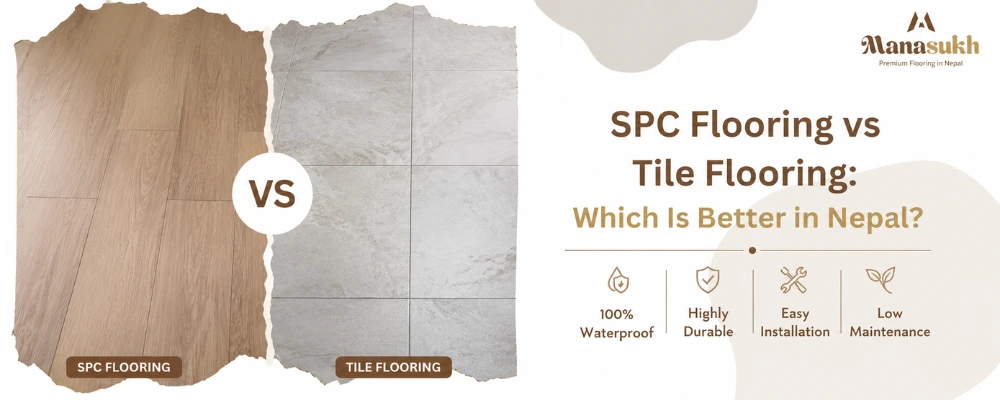
For most Kathmandu Valley homes, SPC flooring is the more practical choice; it costs roughly 20-35% less installed (about NPR 230-550/sq ft versus NPR 160-500+/sq ft for tile), tolerates monsoon humidity and minor structural movement well, and doesn’t require a mason. Tile still wins where a 30-50 year lifespan, resale value, or a fully wet commercial floor matters more than upfront cost.
That single paragraph won’t cover your situation completely, though a rental apartment in Kathmandu, a new RCC house in Chitwan, and a hotel lobby in Pokhara each call for a different answer. Below is the full comparison, built around how these two materials actually behave in Nepal’s climate, building stock, and supply chain, not just generic manufacturer claims.
At a Glance: SPC vs Tile Flooring in Nepal
| Factor | SPC Flooring | Tile Flooring (Ceramic/Vitrified/Porcelain) |
|---|---|---|
| Installed cost (Kathmandu, 2026) | NPR 230 – 550/sq ft | NPR 160 – 500+/sq ft (ceramic low end, porcelain/vitrified high end) |
| Installation time (average room) | 1-2 days, no curing time | 3-6 days, plus curing/setting time |
| Skilled labor required | Basic carpentry-level skill | Trained tile mason (mistri) |
| Waterproofing | 100% waterproof core | Waterproof tile body, but grout lines are the weak point |
| Feel underfoot | Warmer, slightly cushioned | Cold, hard, especially in winter mornings |
| Typical lifespan | 15-25 years | 25-50+ years if installed well |
| Behaviour with building settling/movement | Flexes; floating installation absorbs minor shifts | Rigid; grout and tiles can hairline-crack if the slab moves |
| Repair | Replace individual planks | Usually requires re-tiling the whole affected area |
| Resale perception in Nepal | Modern, but still seen as a “renovation” material by some buyers | Seen as a permanent, higher-value finish |
| Best suited for | Bedrooms, living rooms, rental units, offices, quick renovations | Bathrooms, kitchens, ground floors, high-end permanent builds, commercial wet areas |
What Is SPC Flooring, Exactly?
SPC stands for Stone Plastic Composite (also called Stone Polymer Composite). <cite index=”18-1″>The core is made primarily of limestone (calcium carbonate), which gives the flooring its stability, combined with a smaller amount of PVC resin that acts as a binder and makes the flooring waterproof.</cite> On top of that rigid core sits a printed decorative layer, a wear layer, and usually a UV coating, with a foam or IXPE underlayment beneath for sound absorption and a bit of cushioning.
In practice, it looks and installs like modern laminate or luxury vinyl plank, but the stone-composite core makes it noticeably more rigid and dimensionally stable than ordinary vinyl. Planks click together into a floating floor — no glue, no grout, no waiting for anything to cure.
In Nepal, SPC is sold under brands like Gerflor, Inovar, Mannington, and various budget “Dura”-type local imports, alongside a large volume of unbranded Chinese-manufactured stock, since China remains the dominant global exporter of SPC/PVC flooring material.
What Is Tile Flooring, Exactly?
Tile is a fired clay or clay-mineral product, and the category actually covers three distinct products that Nepali suppliers often lump together:
- Ceramic tile – clay fired at lower temperatures, more porous, the most affordable option, typically used in bathrooms, kitchens, and budget bedrooms.
- Vitrified tile – clay fused with silica at very high temperatures, nearly zero water absorption, the standard choice for Kathmandu Valley living rooms and apartments today.
- Porcelain tile – the densest, least porous variant, fired at the highest temperatures, used where durability and low water absorption matter most (bathrooms, balconies, high-traffic commercial floors).
Tile is set into cement mortar or tile adhesive, then grouted between joints — a labor-intensive, skill-dependent process compared to SPC’s click-lock installation.
Cost Comparison: What You’ll Actually Pay in Nepal (2026)
This is where a lot of generic “SPC vs tile” articles go vague. Nepal has its own supply chain and pricing, so here’s what current local sourcing looks like.
SPC flooring in Nepal:
- Material only: roughly NPR 180-450 per sq ft
- Installation: roughly NPR 30-80 per sq ft
- Total installed: roughly NPR 230-550 per sq ft
- Branded importsrun toward the top of that range; budget unbranded stock sits near NPR 150-300
Tile flooring in Nepal:
- Ceramic tile: roughly NPR 100-210 per sq ft (material)
- Vitrified tile: roughly NPR 160-260 per sq ft (material)
- Porcelain tile: roughly NPR 120-700 per sq ft depending on grade and origin
- Add labor, tile adhesive/mortar, grout, and floor-levelling (subfloors in older Nepali buildings are rarely perfectly flat), which typically adds NPR 60-150 per sq ft or more
- Total installed: roughly NPR 160-500+ per sq ft, and considerably higher for imported porcelain or large-format 800x800mm slabs
The headline gap narrows once you add tile’s hidden costs: floor levelling, mortar, grout, and a trained mason’s time. On paper SPC and mid-range tile can land in a similar band; SPC pulls ahead mainly on labor and prep cost, and pulls further ahead if your existing subfloor is uneven, since tile installation demands a flatter base than most competitor articles admit.
Durability and Climate Performance: The Part Competitors Skip
Most SPC-vs-tile comparisons are written for a generic Western or Chinese climate. Nepal’s conditions change the calculus in three specific ways.
1. Monsoon humidity and moisture
Kathmandu isn’t a dry climate.On average, humidity in Kathmandu sits around 75% annually, with rainfall concentrated heavily between June and September. Humidity peaks around 85% in November and drops to its lowest, around 53%, in April. That’s a wide seasonal swing, and it matters for flooring that isn’t fully sealed.
Both SPC and well-installed vitrified/porcelain tile handle this fine on the surface. The real risk sits at the joints: tile grout is porous and can absorb moisture over a monsoon season unless it’s sealed and re-sealed periodically, while SPC’s click-lock seams stay sealed by design as long as the floor isn’t submerged for long periods. If you’re flooring a ground-floor room in an older building without a proper damp-proof course common in parts of the Kathmandu Valley SPC’s tolerance for rising or seasonal dampness is a genuine practical advantage, not just a sales pitch.
2. Cold-morning comfort in winter
Kathmandu’s winter mornings routinely sit near or below freezing, with average January lows around 2-5°C. Tile is thermally conductive and stays cold to the touch through the morning; SPC’s composite core and foam underlayment retain a bit of warmth and feel noticeably less harsh underfoot on a Poush or Magh morning. This is a minor factor for a bathroom, but it’s a real, lived-experience difference in a bedroom or a living room where people sit on the floor.
3. Building movement and hairline settling: a Nepal-specific consideration most articles don’t mention
This is the genuine content gap. Nepal sits in an active seismic zone, and a large share of the country’s building stock was built or repaired around the 2015 earthquake era, with ongoing minor ground movement, foundation settling, and hairline structural shifts that are normal in RCC construction over time separate from the risk of a major quake itself.
Rigid, mortar-bonded flooring systems generally have less tolerance for the small movements a slab makes as a building settles: grout lines are a known weak point, since conventional cement-sand mortar doesn’t flex the way the slab beneath it can shift. Floating floor systems like SPC, by contrast, are engineered with expansion gaps specifically to absorb minor movement without transmitting stress into the surface layer. Some seismic-engineering commentary on flexible versus rigid flooring makes the same general point outside Nepal’s context: rigid tile is more prone to cracking under structural movement, while a floating floor moves with the structure. This isn’t a claim that either flooring type meaningfully protects a building during a major earthquake that comes down to the structure itself, not the floor finish but it is a legitimate, underexplored reason some Nepali contractors now favor SPC for upper floors of buildings that have already been through settling or minor retrofit work, where fresh hairline cracks in tile grout are a recurring, low-grade maintenance headache.
If your engineer has flagged your building as post-earthquake retrofitted or if you’ve noticed existing hairline cracks in walls or old tile joints, this is worth discussing directly with your contractor before you commit to a full re-tiling job.
Installation: What Actually Happens on Site
SPC flooring installation:
- The existing floor is cleaned, and any major unevenness is corrected (SPC still needs a reasonably flat surface — the “install over anything” claim in some marketing material is misleading).
- An underlayment is rolled out.
- Planks click together edge to edge, floating over the subfloor with a small expansion gap left at the walls.
- Skirting is fitted to hide the expansion gap.
A typical room can be finished in a day, and there’s no curing time — furniture goes back the same day.
Tile installation:
- The subfloor must be levelled, often with a screed layer, since Nepali RCC slabs are rarely poured perfectly flat.
- Tile adhesive or cement mortar is mixed and applied.
- Tiles are laid, spaced, and checked for level with a spirit level or laser line.
- Grout is applied after the adhesive cures (usually 24-48 hours), and the floor needs further curing before heavy use.
Total time for an average room, including drying and curing, commonly runs 3-6 days — longer for larger format tiles that require more precise handling.
Maintenance: Day-to-Day Reality
SPC flooring is low-maintenance by design: sweep or vacuum regularly, damp-mop occasionally, and avoid leaving standing water for extended periods (it’s waterproof, but pooled water sitting for days can still affect the seams over time). Scratches from dragged furniture are the main risk, since the surface is still a plastic wear layer regardless of how “scratch-resistant” the marketing claims it to be.
Tile is also easy to keep clean on the surface, but grout is the maintenance burden competitors underplay. Unsealed or poorly sealed grout stains, especially in a kitchen, and needs periodic scrubbing or resealing to keep its color. Porcelain and vitrified tiles resist this better than basic ceramic because of their lower porosity, but grout lines exist regardless of tile quality.
One real advantage tile does have: if a single tile cracks, in principle you replace that tile — in practice, matching an old tile’s exact shade after a few years is difficult, and the repair job usually disturbs neighboring tiles. SPC’s individual plank replacement tends to be genuinely simpler because there’s no adhesive bond to break.
Design and Aesthetics
Both materials now cover a similar visual range wood-look, stone-look, marble-look, and abstract patterns are available in both SPC and tile, and digital printing technology has closed most of the visual gap between them. The differences that remain are practical rather than aesthetic:
- Tile can be laid in genuinely large, seamless-looking formats (up to 800x800mm and larger), which some buyers still associate with a premium, “built to last” look.
- SPC plank formats tend to mimic wood or narrow stone strip patterns more convincingly than tile does, since the material itself has a slight give and texture closer to timber.
- Tile supports more elaborate inlay, mosaic, and border work for feature areas; SPC is limited to what comes pre-printed on the plank.
Neither material is objectively better-looking it comes down to the specific design language of the room.
Health and Environmental Considerations
This is another angle most competitor content skips entirely. Tile is a fired mineral product with no ongoing off-gassing once installed; its embodied footprint comes mainly from the high firing temperatures and, in Nepal’s case, the fact that most premium tile is imported from India, the UAE, Italy, or Spain, adding transport emissions and cost.
SPC is a PVC-based composite. Reputable brands use low-VOC formulations and the material is considered safe for residential use once cured, but as with any PVC-containing product, it’s worth asking suppliers for compliance documentation (low-formaldehyde/low-VOC certification) rather than assuming every unbranded import meets the same standard — Nepal’s market currently has a wide quality spread between branded and unbranded SPC stock.
Which One Fits Your Property? A Room-by-Room and Property-Type Breakdown
| Space / Property Type | Better Fit | Why |
|---|---|---|
| Bedrooms, living rooms | SPC | Warmer underfoot, quieter, faster and cheaper installation |
| Kitchens | Either, tile if heavy cooking/oil exposure is expected | Tile’s rigid surface resists localized heat and grease better; SPC is fine for light kitchen use |
| Bathrooms | Tile (porcelain/vitrified), SPC as a budget alternative | Full water exposure and slope-to-drain detailing still favor tile’s proven wet-area track record |
| Rental apartments / quick renovations | SPC | Lower cost, faster turnaround, easy to replace between tenants |
| New RCC house, ground floor | Tile | Higher moisture exposure at ground level and long-term investment horizon favor tile |
| Buildings with known settling/retrofit history | SPC | Floating installation tolerates minor movement without visible grout cracking |
| Hotels, restaurants, retail (high foot traffic, wet cleaning) | Tile (vitrified/porcelain) | Commercial wear ratings and cleaning chemical resistance are better documented for tile |
| Offices, co-working spaces | SPC | Lower cost per sq ft across large floor areas, easier and faster fit-out |
| Luxury permanent residences meant for eventual resale | Tile | Buyers in Nepal’s resale market still tend to associate tile/marble with a “finished, permanent” home |
Resale Value: A Nepal-Specific Reality Check
Property buyers and appraisers in Nepal’s residential resale and rental market still commonly treat tile especially vitrified and porcelain tile — as a marker of a “complete,” non-renovation-needed home, similar to how granite and marble are perceived. SPC flooring, despite performing well functionally, is a newer material in the local market and is sometimes still read by conservative buyers as a rental-grade or budget-renovation finish, fairly or not. This perception gap is narrowing as SPC use grows in mid-to-upper apartments, but if your main goal is maximizing resale value on a property you plan to sell within the next few years, factor in buyer perception, not just performance data.
Common Mistakes to Avoid (Regardless of Which You Choose)
- Assuming SPC needs no subfloor prep. It still needs a reasonably flat, clean surface laying it over a badly uneven old floor will telegraph every dip and bump.
- Skipping grout sealing on tile. Especially in kitchens and bathrooms, unsealed grout in Nepal’s humid months stains and discolors far faster than showroom samples suggest.
- Buying SPC purely on price without checking wear-layer thickness. A 0.3mm wear layer and a 0.5mm wear layer are priced similarly by some unbranded sellers but perform very differently under heavy foot traffic.
- Assuming tile is immune to cracking. In buildings with any settling history, hairline grout and tile cracks are common even with good installation — it’s a mortar-and-movement issue, not a workmanship failure.
- Ignoring installation cost when comparing material price alone. Tile’s total installed cost, once mortar, levelling, grout, and skilled labor are included, is frequently underestimated by 30-40% in quick online comparisons.
The Bottom Line
There’s no universally “better” flooring between SPC and tile in Nepal there’s a better flooring for your specific building, budget, and timeline. If you’re renovating a rented apartment, fitting out an office, or working with a building that’s already shown signs of structural settling, SPC flooring’s cost, speed, and flexibility make it the more sensible choice. If you’re building a permanent home from scratch, finishing a ground-floor wet area, or prioritizing long-term resale perception over upfront cost, tile — specifically vitrified or porcelain — remains the safer long-term investment. Get quotes for both, inspect your actual subfloor condition before deciding, and ask any supplier for the wear-layer specification or tile PEI rating in writing rather than relying on showroom talk.
Frequently Asked Questions
Which is cheaper, SPC or tile flooring in Nepal?
SPC flooring is usually cheaper once installation is included, typically landing around NPR 230-550 per sq ft installed versus NPR 160-500+ per sq ft for tile. The gap narrows for basic ceramic tile and widens significantly if you’re comparing SPC to imported porcelain or vitrified tile.
Can SPC flooring be installed directly over old tiles in Nepal?
Yes, in most cases, as long as the existing tile surface is clean, flat, and free of loose or cracked pieces. Significant unevenness or damaged tiles still need to be corrected first, since SPC will telegraph any dips or bumps in the surface beneath it.
Is SPC flooring suitable for Kathmandu’s monsoon and humidity?
Yes. SPC’s stone-composite core is fully waterproof and its click-lock seams stay sealed without ongoing maintenance, which handles Kathmandu’s seasonal humidity swings well. It’s not designed for standing water over extended periods, so it’s still not the first choice for a shower floor.
Does tile flooring crack easily during Nepal’s earthquakes or building settling?
Tile itself is durable, but the rigid mortar bond and grout lines are more prone to hairline cracking when a building settles or shifts slightly over time, compared to a floating SPC floor that has built-in expansion gaps. This is a separate issue from a building’s overall earthquake safety, which depends on its structural design, not its floor finish.
Which lasts longer, SPC or tile flooring?
Well-installed tile typically outlasts SPC, often reaching 25-50+ years versus SPC’s typical 15-25 year lifespan. Tile’s longevity depends heavily on installation quality and avoiding impact damage, while SPC’s lifespan depends more on wear-layer thickness and foot traffic.
Is SPC flooring good for bathrooms in Nepal?
SPC flooring is fully waterproof and can be used in bathrooms, but tile — particularly porcelain or vitrified — remains the more established choice for full wet areas because of its proven slope-to-drain detailing and long track record in constantly wet conditions.
Which flooring adds more resale value to a house in Nepal?
Tile, especially vitrified and porcelain tile, is still more commonly associated with a “finished,” higher-value home by buyers and appraisers in Nepal’s resale market. SPC performs comparably or better functionally, but its perception as a premium permanent finish is still catching up.
Can SPC flooring be used in commercial spaces like shops and offices in Nepal?
Yes, SPC is widely used in Nepali offices, shops, and showrooms because of its lower cost across large floor areas and fast installation with minimal business disruption. For spaces with heavy wet cleaning or very high foot traffic, such as restaurant kitchens, vitrified or porcelain tile is generally the more durable option.