

Introduction
Buying new flooring feels simple until the material actually arrives at your door. A colour that looked warm and inviting on a showroom sample can look completely different once it covers 800 square feet of your living room. A plank that seemed sturdy in the store can start lifting at the edges after one monsoon season in Kathmandu. These are not rare accidents. They are the direct result of a handful of predictable mistakes homeowners make when buying new flooring, and almost all of them are avoidable with the right information before you sign the order.
This guide walks through the ten most common flooring mistakes homeowners make, why they happen, and what to do instead. It draws on patterns seen across hundreds of home and apartment installations in Kathmandu, Lalitpur, and Bhaktapur, where humidity, older concrete subfloors, and a wide range of imported flooring quality make careful decision-making even more important than in a typical climate. Whether you are choosing SPC flooring, wooden laminate, vinyl, or parquet for a new build or a renovation, the goal is the same: floors that still look and perform well five, ten, or twenty years from now.
The Most Common Mistakes Homeowners Make When Buying New Flooring
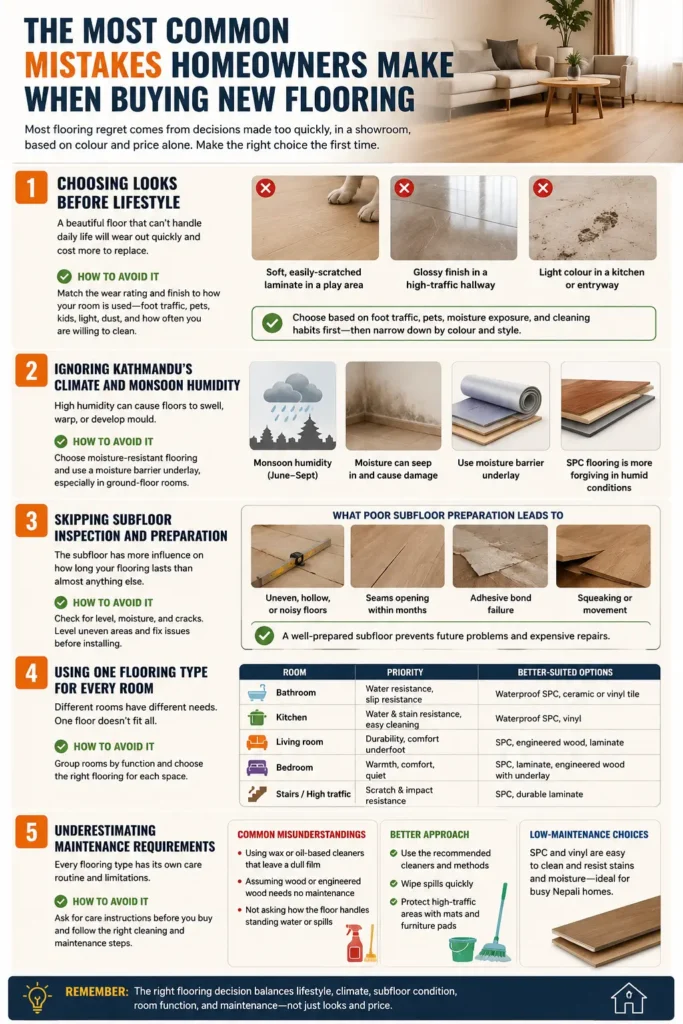
Most flooring regret comes from decisions made too quickly, in a showroom, based on colour and price alone. Climate, subfloor condition, room function, and installation quality matter just as much as the material itself. The sections below cover each mistake in detail, with practical steps to avoid it.
Mistake 1: Choosing Looks Before Lifestyle
Picking a floor because it photographs beautifully, without checking whether it can handle your household, is the single most common flooring mistake homeowners make. A high-gloss finish that looks stunning in a catalogue can show every scratch within months if you have children, pets, or a home office chair rolling across it daily.
What this mistake looks like in practice:
- Choosing a soft, easily-scratched laminate for a living room that doubles as a play area
- Picking a glossy finish for a hallway that sees constant foot traffic
- Selecting a light, pale colour for a kitchen or entryway where dust and mud track in easily
How to avoid it
Before comparing samples, write down how each room is actually used: how many people live there, whether there are pets, how much natural light and dust the room gets, and how often you are willing to clean it. Match the wear rating and finish of the flooring to that list, not the other way around.
The most common flooring mistake homeowners make is prioritising appearance over how a room is actually used. A floor should be chosen based on foot traffic, pets, moisture exposure, and cleaning habits first, then narrowed down by colour and style, since a beautiful floor that cannot handle daily life will wear out quickly and cost more to replace.
Mistake 2: Ignoring Kathmandu’s Climate and Monsoon Humidity
Flooring behaves differently depending on the climate it sits in, and this is where many homeowners in the Kathmandu Valley get caught out. The valley sees a distinct monsoon season from roughly June to September, with high humidity that can seep into ground floors, bathrooms, and rooms with poor ventilation. Flooring that is not rated for moisture can swell, warp, or develop mould underneath within a year or two.
Common oversights in Nepali homes:
- Installing standard laminate in ground-floor rooms that sit close to damp soil or poorly drained courtyards
- Skipping a moisture barrier under flooring in older buildings without a damp-proof course
- Choosing flooring for a rooftop room or sun-exposed balcony without checking UV and heat resistance
- Not accounting for temperature swings between winter mornings and hot pre-monsoon afternoons, which cause materials to expand and contract
How to avoid it
Ask directly whether the product is rated for high-humidity environments and whether it needs an underlayment with a moisture barrier. SPC (stone plastic composite) flooring is generally more forgiving in humid conditions than traditional laminate, because its rigid core resists swelling from ambient moisture, which is one reason it has become popular for homes across Kathmandu, Lalitpur, and Bhaktapur.
Mistake 3: Skipping Subfloor Inspection and Preparation
The subfloor rarely gets attention because it is invisible once the new flooring goes down, yet it has more influence on how long that flooring lasts than almost any other factor. Many homes in the valley, especially older buildings, have uneven concrete slabs, minor cracks, or leftover adhesive from previous flooring that was never fully removed.
What poor subfloor preparation leads to:
- Visible dips, high spots, or a hollow sound underfoot
- Planks or tiles that separate at the seams within months
- Adhesive bond failure, especially with vinyl and SPC click-lock systems
- Squeaking or movement on upper floors of timber-framed sections
How to avoid it
Have the installer check the subfloor for level, moisture content, and cracks before ordering material. In older Kathmandu homes, this often means self-levelling compound in low spots or a plywood underlayment over uneven concrete. This step adds a small amount to the budget upfront but prevents far more expensive repairs later.
Mistake 4: Using One Flooring Type for Every Room
It is tempting to order the same flooring for the entire home to keep things simple and get a bulk discount. But bedrooms, kitchens, bathrooms, and living rooms all place different demands on a floor, and treating them identically usually means one or two rooms end up with the wrong material.
| Room | Priority | Better-suited options |
|---|---|---|
| Bathroom | Water resistance, slip resistance | Waterproof SPC, ceramic or vinyl tile |
| Kitchen | Water and stain resistance, easy cleaning | Waterproof SPC, vinyl |
| Living room | Durability, comfort underfoot | SPC, engineered wood, laminate |
| Bedroom | Warmth, comfort, quiet | SPC, Laminate, engineered wood with underlay |
| Stairs/high traffic | Scratch and impact resistance | SPC, durable laminate |
How to avoid it
Group rooms by function rather than by floor plan. Bathrooms and kitchens should always prioritise water resistance first. Living rooms and hallways should prioritise durability. Bedrooms can prioritise warmth and comfort, since they see lighter, less frequent traffic.
Mistake 5: Underestimating Maintenance Requirements
Every flooring type comes with its own care routine, and mismatched expectations are a frequent source of disappointment. Some homeowners assume any modern flooring is maintenance-free, then are surprised when a natural wood or stone product needs periodic sealing or specific cleaning agents.
Common misunderstandings:
- Using standard floor cleaners with wax or oil on flooring that only needs a damp mop, which leaves a dull film over time
- Assuming parquet or engineered wood needs no attention beyond sweeping
- Not asking how a product handles standing water from a spill or a leaking pipe
How to avoid it
Ask the supplier for the specific cleaning instructions for your chosen product before you buy, not after installation. SPC and vinyl flooring generally need only a damp mop and neutral cleaner, while natural wood and some laminates require more careful, product-specific care.
Mistake 6: Focusing Only on the Price Per Square Foot
Comparing flooring purely by the price quoted per square foot is one of the costliest mistakes homeowners make when buying new flooring, because that number rarely includes underlayment, adhesive, skirting, transition strips, or labour. A lower quote can end up more expensive once these are added, or it can mean corners were cut on material thickness and wear layer.
What the full cost usually includes:
- Base material cost per square foot
- Underlayment or moisture barrier
- Adhesive or click-lock hardware
- Skirting boards and transition strips between rooms
- Installation labour
- Delivery and any old flooring removal
How to avoid it
Ask for a complete, itemised quote that separates material and installation costs, and compare the total project cost across suppliers rather than the headline per-square-foot price. A slightly higher-priced SPC or laminate with a thicker wear layer often costs less over ten years than a cheaper product that needs replacing in three.
Mistake 7: Overlooking Sound and Impact Noise
This mistake is especially relevant for apartment living, which is increasingly common in Kathmandu and Lalitpur. Hard flooring installed without an acoustic underlay can transmit footstep noise to the floor below, which becomes a real issue in shared buildings and multi-storey homes.
Where this matters most:
- Apartments and flats with neighbours below
- Multi-storey homes where bedrooms sit above living areas
- Open-plan layouts where sound travels further
How to avoid it
Ask specifically about acoustic underlay ratings when installing hard flooring above an occupied floor. A quality underlay adds only a small amount to the total cost and significantly reduces impact noise transfer.
Mistake 8: Skipping Professional Installation
DIY-friendly click-lock flooring has made self-installation more accessible, and for a small, simple room it can work well. But for full-home installations, stairs, transitions between rooms, or spaces with uneven subfloors, skipping professional installation is a common way to void a warranty and shorten the life of otherwise good material.
Risks of poor installation:
- Gaps at seams that let moisture in
- Incorrect expansion gaps at walls, leading to buckling as the material expands
- Voided manufacturer warranty due to non-approved installation methods
- Uneven finish around doorways, stairs, and room transitions
How to avoid it
Get installation quotes alongside material quotes from the start, and confirm whether the warranty requires professional installation. For SPC, laminate, and parquet flooring across full rooms or a full home, professional installation is generally worth the cost.
Mistake 9: Ignoring Material Quality and Supplier Reliability
Because much of the flooring sold in Nepal is imported, quality can vary significantly between suppliers even when products look nearly identical on the surface. Wear layer thickness, core density, and locking mechanism quality are not always visible to the eye, and a lower-grade product can be marketed with the same technical name as a premium one.
Questions worth asking before buying:
- What is the wear layer thickness, and is it suitable for residential or commercial use?
- Is there a written warranty, and what does it actually cover?
- Can the supplier provide a sample to test at home under your own lighting and foot traffic first?
- Does the supplier have a track record of installations you can see in person or in photos?
How to avoid it
Buy from a supplier who can show completed local projects, explain the specification sheet in plain terms, and stand behind the product with a clear warranty. A low price with no traceable quality standard is a common source of regret two or three years after installation.
Mistake 10: Forgetting Future Needs and Resale Value
Flooring is chosen for how the home feels today, but homes change. A young couple’s first flat may later house children, ageing parents, or a home business. Flooring decisions that ignore these future possibilities often need premature replacement.
Questions to consider before buying:
- Will this flooring still make sense if the household grows or changes?
- Is the colour and style broadly appealing if the property is sold or rented in the future?
- Does the flooring support easy mobility if accessibility needs arise later?
- Is the product still likely to be available for repairs or partial replacement in five years?
How to avoid it
Favour durable, neutral, widely available flooring for main living spaces, and reserve bold or highly specific styles for smaller, easily updated areas like a single bedroom or study.
Quick Comparison: Common Flooring Mistakes and Their Fixes
| Mistake | Consequence | Fix |
|---|---|---|
| Choosing looks over lifestyle | Fast wear, visible damage | Match wear rating to household use |
| Ignoring climate and humidity | Warping, mould, swelling | Choose moisture-rated products, add a barrier |
| Skipping subfloor prep | Uneven finish, seam failure | Level and inspect subfloor before installing |
| One flooring type everywhere | Wrong fit in wet or high-traffic rooms | Match material to each room’s function |
| Underestimating maintenance | Dull finish, damage from wrong cleaners | Confirm care instructions before buying |
| Focusing on price per square foot | Hidden costs, lower-grade material | Get a full itemised quote |
| Ignoring acoustic performance | Noise complaints in apartments | Add rated acoustic underlay |
| Skipping professional installation | Voided warranty, buckling | Budget for professional fitting |
| Ignoring supplier quality | Premature failure, no recourse | Buy from a supplier with a track record and warranty |
| Forgetting future needs | Premature replacement | Choose durable, broadly appealing options |
FAQ Section
1. What is the biggest mistake homeowners make when buying new flooring?
Choosing flooring based on appearance alone, without checking whether it can handle the household’s foot traffic, pets, moisture levels, and cleaning habits.
2. How do I choose the right flooring for a humid climate like Kathmandu’s?
Look for flooring rated for moisture resistance, such as SPC or waterproof vinyl, and ask whether a moisture barrier underlayment is recommended for your specific room.
3. Is SPC flooring better than laminate for Nepali homes?
SPC flooring generally handles humidity and moisture better than standard laminate because of its rigid, water-resistant core, which makes it a popular choice for the Kathmandu Valley’s monsoon climate.
4. Do I need a moisture barrier under my flooring?
In most ground-floor rooms, bathrooms, kitchens, and older buildings without a damp-proof course, a moisture barrier is recommended to prevent swelling and mould underneath the flooring.
5. Can I install the same flooring in every room of my house?
It is possible, but not usually advisable, since bathrooms and kitchens need water-resistant materials while bedrooms and living rooms can prioritise comfort and durability instead.
6. What flooring is best for a kitchen?
Waterproof SPC or vinyl flooring is generally best for kitchens, since it resists water, stains, and daily spills while remaining easy to clean.
7. What flooring is best for a bathroom?
Waterproof SPC, vinyl, or ceramic tile with slip resistance are the safest choices for bathrooms due to constant moisture exposure.
8. How important is subfloor preparation before installing new flooring?
It is critical. An uneven or damp subfloor can cause seam separation, squeaking, and premature wear no matter how good the flooring material is.
9. How do I know if my subfloor needs levelling?
A professional installer can check for high and low spots, cracks, and moisture content before installation; visible dips or a hollow sound underfoot are common signs it needs attention.
10. Should I choose flooring based on price per square foot?
No. Price per square foot often excludes underlayment, adhesive, skirting, and labour, so it is better to compare full, itemised project quotes.
11. What hidden costs are often left out of flooring quotes?
Underlayment, moisture barriers, adhesive or locking hardware, skirting boards, transition strips, old floor removal, and installation labour are commonly left out of headline pricing.
12. Does cheaper flooring cost more in the long run?
It often does, since lower-grade materials with a thin wear layer wear out and need replacing sooner, while a slightly higher upfront cost can mean a much longer lifespan.
13. How do I reduce noise from hard flooring in an apartment?
Install an acoustic-rated underlay beneath the flooring, which absorbs impact sound and reduces noise transfer to the floor below.
14. Is acoustic underlay necessary for ground-floor rooms?
It is less critical for ground-floor rooms without a room below, but still useful for reducing echo and improving comfort underfoot.
15. Can I install flooring myself?
Simple click-lock flooring in a small, level room can be a manageable DIY project, but full-home installations, stairs, and uneven subfloors are best left to professionals to avoid voiding the warranty.
16. Does DIY installation void the flooring warranty?
Many manufacturer warranties require installation according to specific guidelines, and non-compliant DIY installation can void coverage, so it is worth checking the warranty terms first.
17. How do I check if a flooring supplier is reliable?
Ask for completed local project examples, a clear written warranty, and a detailed specification sheet, rather than relying on price or marketing claims alone.
18. Why does flooring quality vary between suppliers even with similar product names?
Wear layer thickness, core density, and locking mechanism quality can differ significantly between manufacturers, even when products are marketed under similar technical names.
19. What should I ask before buying imported flooring?
Ask about the wear layer thickness, warranty coverage, whether a sample is available to test at home, and whether the supplier has a track record of local installations.
20. How long does SPC flooring typically last?
With proper installation and care, quality SPC flooring can last 15 to 25 years in a residential setting, depending on foot traffic and maintenance.
21. How long does laminate flooring typically last?
Laminate flooring typically lasts 10 to 20 years with proper care, though it is more sensitive to moisture than SPC.
22. What maintenance does SPC flooring need?
SPC flooring generally needs only regular sweeping and occasional damp mopping with a neutral cleaner, without wax or oil-based products.
23. Can flooring choice affect resale value?
Yes. Durable, neutral flooring tends to appeal to a broader range of buyers, while highly specific or trend-driven choices can limit appeal or require replacement before a sale.
24. Should I consider future household needs when choosing flooring?
Yes. Flooring that supports easy mobility, is broadly appealing, and remains available for repairs later helps avoid premature replacement as household needs change.
25. What flooring works best on stairs?
Durable SPC or laminate with good slip resistance tends to perform best on stairs, which see concentrated wear and impact.
27. What causes flooring to warp or buckle after installation?
Warping and buckling are most often caused by moisture exposure, insufficient expansion gaps at the walls, or a poorly prepared subfloor.
28. How do I test a flooring sample before committing to a full order?
Bring a sample home and view it under your own lighting at different times of day, place it near the room’s main traffic path, and check how it feels underfoot.
29. What is the expansion gap in flooring installation, and why does it matter?
The expansion gap is a small space left around the room’s perimeter to allow flooring to expand and contract with temperature and humidity changes; skipping it can cause buckling.
30. Who should I contact for flooring advice specific to Kathmandu homes?
A local flooring specialist familiar with the Kathmandu Valley’s climate, common subfloor conditions, and building types, such as Manasukh Flooring, can give advice suited to local conditions rather than generic guidance.
Avoiding these ten mistakes starts with a conversation, not a purchase. If you are planning new flooring for your home in Kathmandu, Lalitpur, or Bhaktapur, get a free estimate and on-site consultation from Manasukh Flooring before you order any material. Our team can check your subfloor, recommend the right product for each room, and walk you through a clear, itemised quote so there are no surprises later.
Final Thoughts
Most flooring regret is preventable. The homeowners who end up happiest with their choice are the ones who slow down before buying: they think about how each room is actually used, ask about moisture and subfloor conditions specific to their climate, get a full itemised quote instead of comparing price per square foot, and choose a supplier who can back up their product with a real warranty. Avoiding these ten mistakes when buying new flooring will not just protect your budget. It will protect how your home feels underfoot for the next fifteen to twenty-five years.