
Introduction
A flooring problem in Nepal rarely shows up on its own. Monsoon dampness loosens tile grout. Termites move into wooden floors left over from the last renovation. A cold concrete floor in Kathmandu’s winter makes a living room unusable without a rug. Most homeowners patch one issue, only to find another waiting a season later.
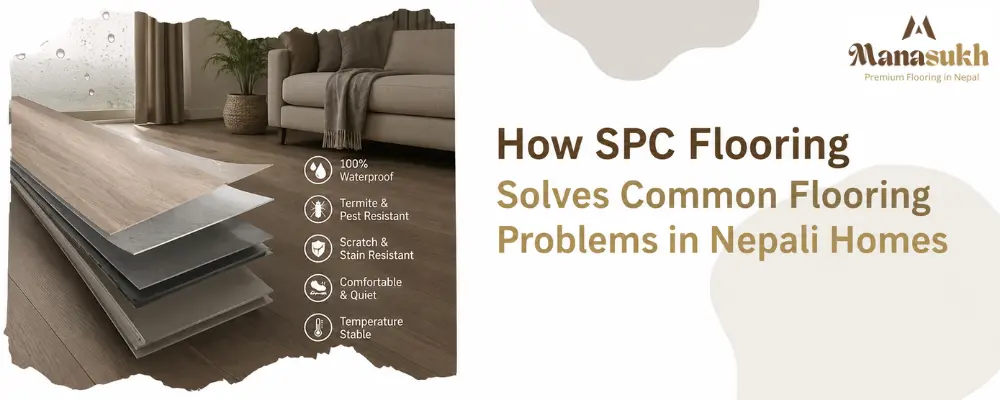
SPC flooring was built to handle exactly this combination of problems, not just one of them. It is a rigid, waterproof, click-lock floor made from a stone-polymer core, and it has become one of the most requested flooring materials in Kathmandu, Lalitpur, and Bhaktapur over the past few years. This guide walks through the specific flooring problems Nepali homes face, room by room and season by season, and explains exactly how SPC flooring addresses each one, with real prices, real limitations, and honest guidance on when it is and is not the right fit.
Why Flooring Fails in Nepali Homes
Before comparing materials, it helps to understand why floors fail here in the first place. Kathmandu Valley experiences a sharp climate swing every year: humid monsoon months from June to September, followed by a dry, cold winter with wide day-to-night temperature differences. Most conventional flooring materials, including solid wood, laminate, and even some tile installations, are not designed to move through that swing without warping, cracking, or loosening.
Add to this the age of Nepal’s housing stock. Many homes still have flooring laid ten, twenty, or even thirty years ago, often directly over brick or old cement screed that has since settled unevenly. Termite activity is common in the Terai belt and increasingly reported in the valley in homes with wooden fittings. And in a country where seismic safety is a genuine, everyday concern following the 2015 earthquake, homeowners are also more cautious about adding unnecessary weight to upper floors during renovation.
SPC flooring did not become popular in Nepal by accident. It happens to answer several of these problems at once, which is why it is increasingly the default recommendation for renovations rather than a niche option.
Problem 1: Monsoon Moisture and Water Damage
Water is the single biggest cause of flooring failure in Nepal, and SPC flooring solves it because its stone-polymer core does not absorb moisture at all, so it cannot swell, warp, or grow mould even during a heavy monsoon.
Every monsoon season, the same pattern repeats in homes across Kathmandu, Lalitpur, and Bhaktapur. Rising damp through ground floors, leaking window sills, and humidity trapped inside poorly ventilated rooms all find their way into flooring. Solid wood and laminate floors are especially vulnerable. Once moisture gets underneath the surface layer, boards begin to cup, edges lift, and a musty smell sets in that no amount of cleaning removes.
SPC flooring is built differently. Its core is a rigid composite of limestone powder and stabilisers, wrapped in a wear layer, a decorative film, and a UV-protective top coat. None of these layers are organic, so there is nothing for moisture to feed on and nothing for it to swell. This is why SPC is now the standard recommendation for ground-floor rooms, kitchens, bathrooms, and basements in homes across the valley, where dampness during monsoon has historically ruled out anything other than tile.
Where this matters most in a Nepali home:
- Ground-floor living rooms and bedrooms with rising damp
- Kitchens, where spills and steam are a daily occurrence
- Bathrooms and attached toilets
- Basement or semi-basement rooms used for storage or as a home office
- Balconies and covered verandas exposed to blown rain
Problem 2: Termites in Wood and Wood-Based Flooring
SPC flooring solves termite damage by removing the food source entirely. It contains no natural wood fibre, so termites have nothing to feed on and cannot nest inside it, unlike solid wood or many laminate floors.
Termite damage is one of the most frustrating flooring problems in Nepal because it is invisible until it is severe. Homeowners often only discover a termite colony after boards start sounding hollow underfoot or after a corner of the floor gives way. Laminate flooring, which uses a wood-fibre core (usually HDF or MDF), is only marginally more resistant than solid wood once moisture breaches the surface, since damp wood fibre is exactly what termites are drawn to.
Because SPC flooring’s core is stone and polymer rather than wood fibre, it is a genuinely termite-proof option, not just a termite-resistant one. This makes it particularly well suited to older homes being renovated after a termite problem has already been treated, since it removes the risk of recurrence in the new floor itself.
Problem 3: Cold, Hard Floors Through Winter
Kathmandu’s winter mornings can feel colder indoors than outdoors because most homes have no central heating, and SPC flooring solves this better than tile by trapping less cold and warming faster underfoot, especially when installed with a cushioned underlayment.
Tile and stone floors, while durable, are notorious for staying cold long after the sun comes up, since they conduct heat away from bare feet quickly. Many families deal with this by keeping thick carpets down for four or five months of the year, which then trap dust and are difficult to keep clean.
SPC flooring is not a heated floor, but its multilayer construction, particularly the underlayment layer at the base, insulates better than tile and feels noticeably warmer and softer underfoot. For homeowners who want an even bigger improvement in winter comfort, SPC flooring is also compatible with most underfloor radiant heating systems, which is worth discussing with an installer at the planning stage if this is a priority.
Problem 4: Cracked, Uneven, or Aging Tile and Concrete
SPC flooring solves the problem of an aging or slightly uneven subfloor because its rigid click-lock planks float above the surface and can often be installed directly over existing tile, cracked screed, or old flooring without full demolition.
Many homes in Kathmandu, Lalitpur, and Bhaktapur are twenty or more years old, and their original tile or cement floors have settled unevenly over time, developed hairline cracks, or simply gone out of style. Replacing this kind of floor conventionally means breaking out the old surface entirely, which is slow, dusty, and expensive in labour alone.
Because SPC planks click together into a floating floor rather than being fixed to the subfloor with adhesive, they can usually be laid straight over existing tile or a reasonably level old floor, as long as the surface is clean, dry, and free of major dips. This alone is one of the biggest reasons Nepali homeowners choose SPC over hardwood or fresh tile when renovating a home that already has flooring in place.
Problem 5: Renovation Without Demolition
For homeowners who cannot vacate a house for weeks during renovation, SPC flooring solves the timeline problem because a single room can typically be installed in a day, with no wet trades, no drying time, and no demolition dust.
Traditional tile or stone flooring involves multiple stages: removing the old floor, laying a fresh cement screed, waiting for it to cure, tiling, and grouting, often stretching a single room into a week-long job. This is disruptive for any household, and particularly difficult for families with young children, elderly members, or a home office that cannot be shut down for days at a time.
SPC flooring’s click-lock system removes almost all of this. There is no adhesive to cure and no wet cement to dry, so furniture can typically be moved back into a room the same day installation finishes. For a full home renovation done room by room, this often means the difference between a project that takes a weekend and one that stretches into a month.
Problem 6: Dust, Allergens, and Indoor Air Quality
SPC flooring solves the dust and allergen problem common in older Nepali homes by offering a completely sealed, non-porous surface that does not trap dust, dust mites, or mould spores the way carpet or aging grout lines do.
Carpets, which are still common in bedrooms across the valley for warmth, are difficult to keep genuinely clean, especially with Kathmandu’s dust levels during the dry season. Old tile with worn or cracked grout lines has the same problem in a different form, since grout is porous and gradually accumulates dust and mould over years of use.
SPC flooring is manufactured without formaldehyde or other harmful binding chemicals, and its sealed surface means dust sits on top rather than settling into the material. For households with children, elderly family members, or anyone managing allergies or asthma, this is a genuine health-related reason to consider replacing older carpet or grouted tile with SPC flooring.
Problem 7: Noise Transfer in Apartments and Flats
In multi-storey apartment buildings, SPC flooring solves excess noise transfer when installed with a proper acoustic underlayment, which absorbs footfall sound far better than bare tile laid directly on a concrete slab.
As apartment living has grown across Kathmandu and Lalitpur, noise between floors has become a common complaint, particularly in buildings where tile was laid directly onto the concrete slab with little to no sound insulation. Every footstep, dropped object, or dragged chair transmits straight through to the flat below.
SPC flooring is not silent flooring, and no click-lock floor fully eliminates footfall noise, but pairing SPC planks with a quality acoustic underlayment meaningfully reduces the sound transmitted through the slab compared with tile. This is worth specifying at the quotation stage if noise between floors is a known issue in the building.
Problem 8: Weight and Earthquake Considerations
SPC flooring solves the added-weight concern many Nepali homeowners have during renovation because it is significantly lighter per square foot than stone or ceramic tile, adding minimal dead load to upper floors.
Since 2015, many Nepali homeowners have become noticeably more cautious about adding weight to upper storeys during any renovation, and rightly so. Natural stone and thick ceramic tile, along with their cement bedding, add real weight across a large floor area. In older buildings, or those built before current seismic codes, this is a legitimate consideration.
SPC flooring is far lighter, since it is installed as a floating floor without a thick cement bed underneath. This does not replace a structural engineer’s assessment for a home with known structural concerns, but for homeowners simply looking to avoid adding unnecessary dead load during a cosmetic renovation, SPC flooring is a reasonable, lighter-weight alternative to tile.
Problem 9: Sun Fading in South-Facing Rooms
SPC flooring solves premature sun fading through its UV-coated top layer, which resists colour loss in south-facing rooms far better than uncoated laminate or painted wood floors exposed to direct sun for years.
Kathmandu Valley sits at altitude with strong, direct sunlight for much of the year, and rooms with large south-facing windows often show visible fading on flooring within a few years, especially where rugs or furniture have blocked the sun unevenly and left a two-tone floor behind.
The UV coating on SPC flooring is applied specifically to slow this process. It will not make a floor completely immune to sun exposure over decades, but it holds colour significantly longer than uncoated laminate or varnished wood, and it fades evenly rather than blotching under furniture.
Problem 10: Budget Constraints for Middle-Class Homes
For homeowners balancing durability against a fixed renovation budget, SPC flooring solves the trade-off by matching the durability of stone or hardwood at a fraction of the material and installation cost.
Natural stone and imported hardwood remain the most durable flooring options available in Nepal, but both carry a price that puts them out of reach for most household renovation budgets, especially once installation labour is included. Tile sits in the middle but requires skilled labour for a clean finish and takes longer to install, adding to total project cost.
SPC flooring offers a genuinely useful middle ground: near-tile durability and full waterproofing, at a price point closer to laminate, with lower installation labour costs because of the click-lock system. This is the main reason it has become the default recommendation for renovation budgets across income levels in Kathmandu, not just premium projects.
SPC Flooring Price in Nepal by Problem Type
Pricing depends on thickness, core quality, and design, and it is worth matching the grade of SPC flooring to the specific problem being solved rather than buying the cheapest option available.
| Flooring Problem Being Solved | Recommended SPC Grade | Typical Thickness | Approximate Price (NPR/sq.ft.) |
|---|---|---|---|
| Monsoon dampness, ground floor rooms | Standard to Premium SPC | 5 mm | 250 – 400 |
| Termite-affected room replacement | Standard SPC | 5 mm | 250 – 300 |
| Cold winter rooms, bedrooms | Premium SPC with cushioned underlayment | 5 mm – 7 mm | 300 – 400+ |
| Renovation over old tile, no demolition | Standard SPC | 5 mm | 250 – 300 |
| High-traffic living rooms, homes with kids or pets | Premium SPC | 5 mm | 300 – 400 |
| Noise-sensitive apartments | Premium SPC with acoustic underlayment | 5 mm | 300 – 400+ |
| Upscale or commercial-grade renovation | Luxury SPC | 7 mm | 400+ |
Prices are approximate and vary by vendor, design, and project size. Get an exact quote for your space with a free consultation.
Where SPC Flooring Is Not the Right Answer
A genuinely useful guide should also say where SPC is not the best fit, and there are a few honest limitations worth knowing before choosing it.
- Outdoor spaces with constant direct rain exposure, such as open terraces, are better suited to weatherproof tile, since SPC is designed for interior and covered-exterior use.
- Homes wanting a genuinely soft, warm underfoot feel without an underlayment upgrade may find WPC flooring more comfortable, since it uses a slightly softer core.
- Severely uneven subfloors with major dips or slopes need levelling work before any floating floor, including SPC, can be installed correctly.
- Homeowners who specifically want the natural grain and refinishing ability of solid hardwood should note that SPC cannot be sanded or refinished the way solid wood can; it is replaced rather than restored when a section is damaged beyond repair.
Being upfront about these limitations is part of choosing the right material for the right room, rather than treating one flooring type as the answer to every problem in the house.
How Manasukh Flooring Installs SPC Flooring
Manasukh Flooring, based in Patan, Lalitpur, and serving Kathmandu, Lalitpur, Bhaktapur, and surrounding areas, follows a straightforward four-step process for SPC flooring projects:
- Consultation: A visit or discussion to understand the specific problems in the space, whether that is dampness, an uneven old floor, noise, or a tight renovation timeline, and to measure the area accurately.
- Proposal: A detailed plan and transparent pricing based on the grade of SPC flooring that actually fits the problem being solved, not just the cheapest or most expensive option available.
- Installation: Professional click-lock installation, including subfloor preparation, underlayment selection, and edge finishing.
- Inspection: A final walkthrough to confirm the finished floor meets expectations before the job is considered complete.
SPC flooring installed through Manasukh Flooring comes with manufacturer-backed warranty coverage: a 25-year residential warranty on 5 mm SPC flooring and a lifetime residential warranty on 7 mm SPC flooring, both covering manufacturing defects and premature wear-layer failure under normal residential use.
Frequently Asked Questions
Does SPC flooring actually stop monsoon damage in ground-floor rooms?
Yes. SPC flooring’s stone-polymer core does not absorb water, so it will not swell or warp from rising damp or spills the way solid wood or laminate can during monsoon months.
Is SPC flooring termite-proof or just termite-resistant?
It is genuinely termite-proof, because the core contains no wood fibre or organic material for termites to feed on or nest inside.
Can SPC flooring be installed directly over old tile?
In most cases yes, as long as the existing tile is clean, structurally sound, and reasonably level, since SPC is installed as a floating floor rather than glued to the subfloor.
Will SPC flooring feel cold in winter like tile does?
It stays noticeably warmer underfoot than tile, especially with a cushioned underlayment, though it is not a heated floor on its own.
Can SPC flooring be used with underfloor heating?
Most SPC flooring products are compatible with radiant underfloor heating systems, but this should be confirmed with your installer before purchase.
Is SPC flooring heavy enough to be a concern in an earthquake-prone building?
No, it is significantly lighter than stone or tile with cement bedding, since it floats above the subfloor without a heavy mortar bed underneath.
How long does SPC flooring installation take for an average room?
A typical room can often be completed in a single day because the click-lock system requires no adhesive curing or cement drying time.
Does SPC flooring reduce noise between apartment floors?
It reduces footfall noise meaningfully when paired with an acoustic underlayment, though it does not eliminate sound transfer entirely.
Will SPC flooring fade in a south-facing room with strong sunlight?
It resists fading better than uncoated laminate or varnished wood thanks to its UV-protective top layer, though some gradual fading is normal after many years of direct sun.
Is SPC flooring a budget-friendly option compared to hardwood or tile?
Yes, it typically costs less than natural stone or hardwood and requires lower installation labour than tile, while matching much of their durability.
What is the SPC flooring price range in Nepal?
Prices generally range from NPR 250 to over NPR 400 per square foot depending on thickness and grade, with premium and luxury grades reaching higher for specialised needs.
Is SPC flooring suitable for kitchens with frequent spills?
Yes, its complete waterproofing and stain resistance make it well suited to kitchens, alongside bathrooms and other spill-prone areas.
Does SPC flooring need a special subfloor preparation?
The subfloor needs to be clean, dry, and reasonably level; beyond that, no special preparation like extensive cement work is typically required.
Can SPC flooring be installed in a rented apartment?
Yes, because it is a floating floor rather than glued down, it can be removed and reused elsewhere, making it a practical option for renters with landlord approval.
Is SPC flooring slippery when wet?
Most SPC flooring includes an anti-slip texture, though like any hard flooring it can become slippery if left wet, so wiping spills promptly is recommended.
How do I clean and maintain SPC flooring?
Regular sweeping and occasional damp mopping is enough; harsh chemical cleaners are not needed and can dull the surface over time.
Does SPC flooring work well in Kathmandu’s humid summer and dry winter cycle?
Yes, because it does not absorb moisture, it holds its shape and size across the seasonal humidity swing better than wood-based flooring.
Can SPC flooring support heavy furniture without denting?
Yes, it is rigid and dent-resistant, though protective pads under furniture legs are still recommended to avoid indentation over time.
Is SPC flooring a good option for old houses with cracked concrete floors?
Yes, as long as major cracks or dips are addressed first, SPC’s floating installation can bridge minor surface irregularities that would otherwise require a full concrete resurface.
How does SPC flooring compare to laminate for a damp-prone home?
SPC is fully waterproof due to its stone-polymer core, while laminate uses a wood-fibre core that can swell if moisture reaches it, making SPC the safer choice for damp-prone rooms.
What thickness of SPC flooring should I choose for a high-traffic living room?
A 5 mm to 7 mm thickness with a denser wear layer is generally recommended for living rooms and other high-traffic areas.
Does SPC flooring smell or release harmful chemicals?
Quality SPC flooring is manufactured without formaldehyde, so it does not carry the strong chemical smell sometimes associated with cheaper laminate products.
Can SPC flooring be repaired if one plank is damaged?
Individual planks in a click-lock SPC floor can often be replaced without redoing the entire floor, provided matching stock is available.
Is SPC flooring a good fit for a home office added during renovation?
Yes, its quick installation with no drying time makes it practical for converting an existing room into a home office with minimal downtime.
How does SPC flooring hold up in a house with pets?
Its scratch and dent resistance handles claws and daily pet traffic well, and its waterproof surface makes cleaning up accidents straightforward.
If dampness, termites, cold winters, or an aging floor are causing problems in your home, Manasukh Flooring can walk through your space, identify what is actually going wrong, and recommend the right SPC flooring grade to fix it, not just sell the most expensive option. Get a free estimate or call +977 9763395729 to schedule a consultation in Kathmandu, Lalitpur, or Bhaktapur.