
Introduction
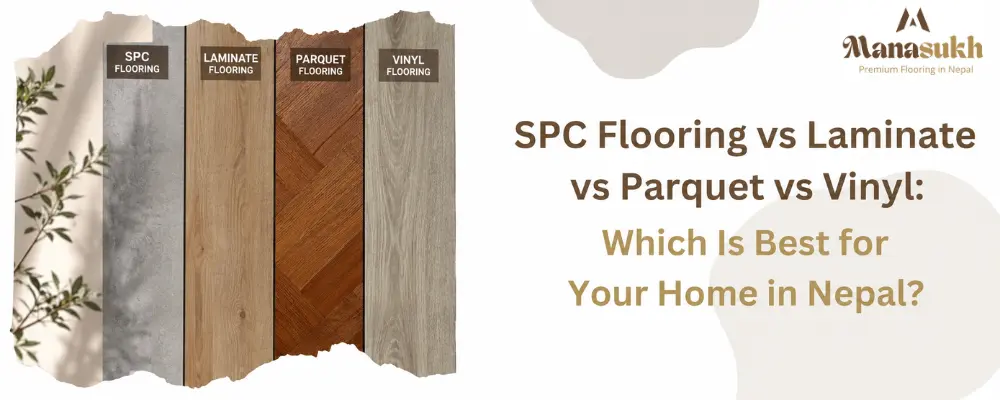
Choosing best flooring options in Nepal is one of those decisions that quietly shapes how a home feels for the next decade or more. Walk into any flooring showroom in Kathmandu and you will likely be shown four main contenders: SPC flooring in Nepal, laminate flooring in Nepal, parquet flooring in Nepal, and vinyl flooring in Nepal. Each looks similar in a glossy sample rack, but they behave very differently once they are underfoot in a real kitchen, a monsoon-soaked living room, or a busy home office.
This guide breaks down SPC flooring vs laminate vs parquet vs vinyl across the six factors that matter most: price, durability, waterproofing, looks, maintenance, and lifespan. We also cover installation, comfort, sustainability, and how each option holds up in Nepal’s humid summers and dusty, temperature-swinging winters. By the end, you will know exactly which flooring fits your budget, your household, and the room you are renovating.
SPC flooring is the most water-resistant and low-maintenance option, making it ideal for kitchens, bathrooms, and rental units. Laminate flooring offers the closest wood look for the lowest price in dry rooms. Parquet flooring delivers unmatched natural warmth and can last 50 years or more but needs careful upkeep. Vinyl flooring is the softest and most affordable for quick, budget-friendly upgrades.
Quick Comparison Table on SPC Flooring vs Laminate vs Parquet vs Vinyl
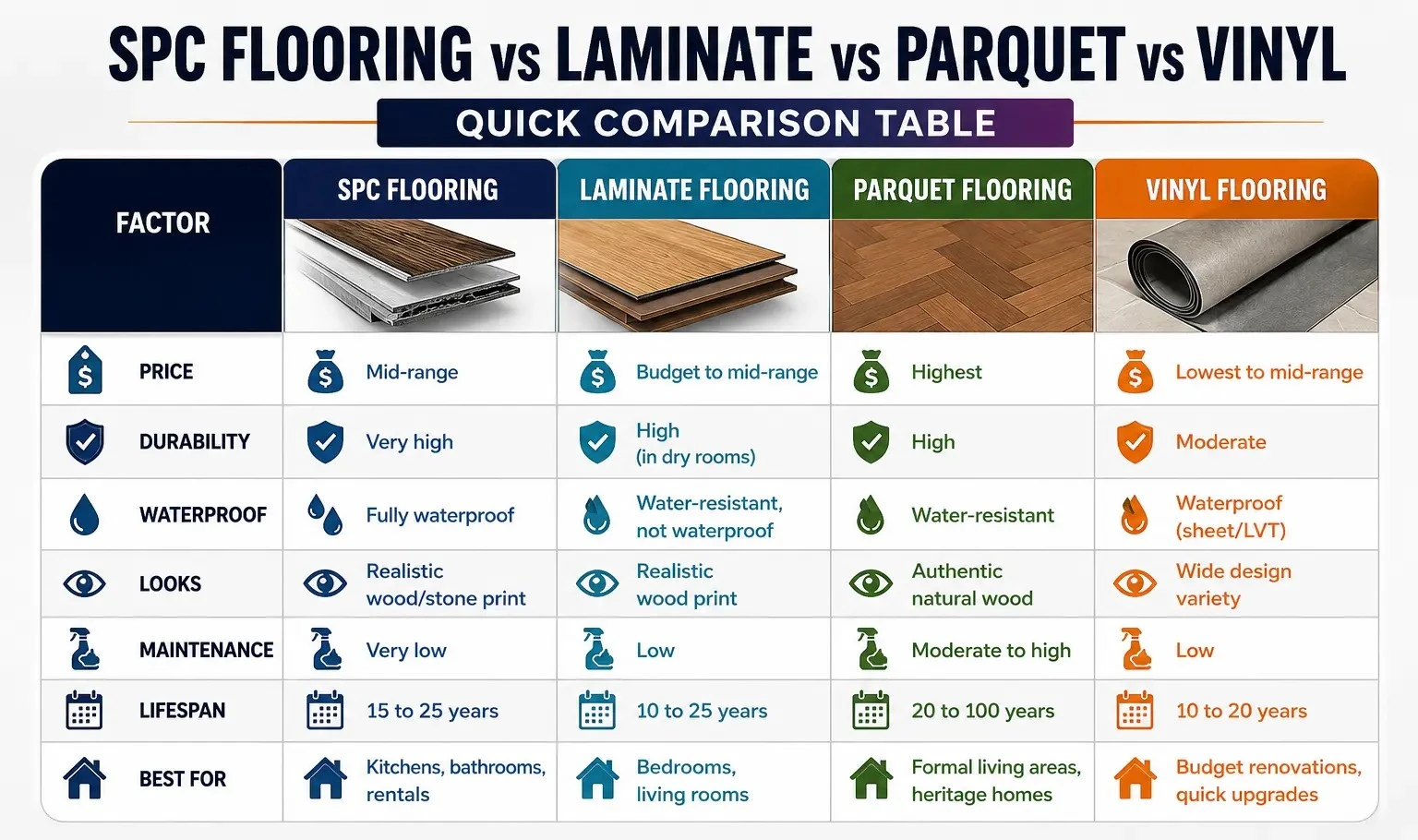
Here is the short version before we go deep into each category. Use this table to shortlist your top two options, then read the detailed sections below for the reasoning behind the ratings.
| Factor | SPC Flooring | Laminate Flooring | Parquet Flooring | Vinyl Flooring |
|---|---|---|---|---|
| Price | Mid-range | Budget to mid-range | Highest | Lowest to mid-range |
| Durability | Very high | High (in dry rooms) | High | Moderate |
| Waterproof | Fully waterproof | Water-resistant, not waterproof | Water-resistant | Waterproof (sheet/LVT) |
| Looks | Realistic wood/stone print | Realistic wood print | Authentic natural wood | Wide design variety |
| Maintenance | Very low | Low | Moderate to high | Low |
| Lifespan | 15 to 25 years | 10 to 25 years | 20 to 100 years | 10 to 20 years |
| Best for | Kitchens, bathrooms, rentals | Bedrooms, living rooms | Formal living areas, heritage homes | Budget renovations, quick upgrades |
What Is SPC Flooring
SPC stands for Stone Polymer Composite, and it refers to a rigid-core flooring made from limestone powder combined with PVC and stabilizers. The result is a dense, dimensionally stable plank that clicks together without glue and floats above the subfloor.
SPC is technically a category within luxury vinyl flooring, built with a stone-based core instead of a softer, purely plastic one. That stone core is what gives SPC its rigidity, its resistance to denting, and its full waterproof rating. A typical SPC plank has four layers: a UV-cured wear layer on top, a printed design layer beneath it, the stone-polymer core in the middle, and a backing layer for stability and sometimes acoustic cushioning.
Because the boards snap together with a click-lock system, SPC flooring is popular with homeowners who want a durable, waterproof floor without the cost or fragility of hardwood. It performs especially well in spaces where laminate would swell or hardwood would warp, such as kitchens, bathrooms, and basements.
What Is Laminate Flooring
Laminate flooring is a multi-layer synthetic floor built around a high-density fiberboard (HDF) core, topped with a photographic image layer that mimics wood, stone, or tile, and finished with a clear, scratch-resistant wear layer. A bottom layer called the backing keeps the plank stable and helps resist moisture from below.
Laminate has been a go-to choice for decades because it delivers a convincing wood look at a lower price than almost any other option. The tradeoff is the fiberboard core, which is far more sensitive to standing water and humidity than SPC or vinyl.
Laminate is click-lock or glue-down, installs relatively quickly over an underlayment, and works best in living rooms, bedrooms, and hallways where spills are rare and controllable.
What Is Parquet Flooring
Parquet flooring is not a material so much as a pattern: small blocks, strips, or tiles of real wood arranged in geometric designs such as herringbone, chevron, or basket weave. It can be made from solid wood blocks glued directly to the subfloor, or from engineered parquet, where a thin layer of real wood veneer sits on top of a plywood base for better stability.
What sets parquet apart is authenticity. Every plank is genuine timber, commonly oak, walnut, maple, or teak, with the natural grain, color variation, and texture that printed layers can only approximate.
The same wood construction that gives parquet its beauty also makes it the most demanding option on this list. It reacts to humidity, needs protection from standing water, and requires more careful, ongoing maintenance than any synthetic alternative.
What Is Vinyl Flooring
Vinyl flooring is a broad category of resilient, PVC-based flooring that includes sheet vinyl, luxury vinyl tile (LVT), and luxury vinyl plank (LVP). Unlike SPC, standard vinyl uses a flexible foam or felt-backed core rather than a rigid stone-polymer core, which makes it softer, thinner, and easier to cut and install, but also less dimensionally stable on an uneven subfloor.
Sheet vinyl comes in large rolls and is fully waterproof by design, which is why it has long been popular in bathrooms, kitchens, and rental apartments. LVT and LVP come in individual tiles or planks, either glued down, loose-laid, or click-locked, and can convincingly mimic wood, stone, or concrete finishes.
Vinyl’s biggest strengths are affordability, comfort underfoot, and ease of installation. Its main weakness is durability: standard vinyl dents and tears more easily than SPC and shows wear faster in high-traffic commercial-style use.
Price Comparison
Parquet is consistently the most expensive option because it uses real wood, while vinyl and laminate are the most budget-friendly. SPC sits in the middle, priced higher than basic laminate but usually below solid parquet and premium hardwood-look products.
Flooring pricing varies significantly by supplier, plank thickness, wear layer quality, and import costs, so treat the figures below as general international benchmarks rather than fixed local rates. For accurate pricing in Nepali rupees, request a quote from a local supplier such as flooringinnepal.com, since import duties and material grade affect the final cost per square foot.
| Flooring Type | Typical Relative Cost | What Drives the Price |
|---|---|---|
| Vinyl (sheet/LVT) | Lowest to mid | Thinner core, simpler manufacturing |
| Laminate | Low to mid | HDF core, AC rating, brand |
| SPC | Mid | Stone-polymer core, wear layer thickness |
| Parquet | Highest | Real wood species, pattern complexity, finish |
Installation cost also matters. Laminate and SPC are usually the fastest to install because they float over the subfloor with click-lock joints, keeping labor costs down. Sheet vinyl installs quickly too, but LVT and parquet, especially patterned parquet, take longer and often need a skilled installer, which adds to the total project cost even if the material itself is mid-priced.
A useful way to think about price is total cost of ownership rather than sticker price alone. Laminate is cheap to buy but may need replacing sooner in humid rooms.
Durability Comparison
SPC flooring is the most durable option for daily wear, scratches, and impacts because of its rigid stone core. Parquet is durable against foot traffic but vulnerable to scratches and moisture at the surface. Laminate performs well in dry conditions but weakens if the core gets wet. Vinyl is the least resistant to dents and tears among the four.
Scratch and impact resistance
SPC’s stone-polymer core resists denting from dropped objects and furniture far better than vinyl’s softer core. High AC-rated laminate can match or exceed SPC’s scratch resistance in dry rooms because its aluminum-oxide wear layer is extremely hard, but laminate is more prone to chipping at the edges if water gets into the seams. Solid parquet resists dents well because hardwood is naturally hard, but the finish can scratch from grit, pet claws, or dragged furniture.
Heavy traffic performance
For hallways, living rooms, and family areas with kids and pets, SPC and high-AC laminate both perform reliably. Parquet can absolutely handle heavy traffic too, and many commercial and heritage buildings prove this over decades. Standard vinyl is the least suited to constant heavy use since its surface layer is thinner and more prone to tearing under rolling loads like office chairs.
Structural stability
SPC and engineered parquet both use core layers designed to resist expansion and contraction, which helps them lie flat over time. Solid parquet and laminate are more sensitive to humidity swings, which can cause gapping in dry seasons or slight swelling in wet ones if moisture is not controlled.
Waterproof and Moisture Resistance Comparison
SPC flooring and sheet vinyl are genuinely waterproof and safe for kitchens, bathrooms, and basements. Laminate is only water-resistant at best and can swell if water sits on it. Parquet is pretty vulnerable to water damage (till date not found that water damages the product) of the four and should be kept away from wet areas.
This is often the single deciding factor for buyers in Nepal, where monsoon humidity and occasional water exposure from mopping, spills, or minor leaks are a real concern.
- SPC flooring: 100 percent waterproof core. Safe for kitchens, bathrooms, laundry areas, and basements. Standing water will not damage the plank itself, though grout-free seams should still be wiped promptly for hygiene.
- Vinyl flooring (sheet and LVT): Waterproof or highly water-resistant depending on construction. Sheet vinyl in particular is a traditional choice for wet-prone rooms.
- Laminate flooring: Water-resistant, not waterproof. Modern laminates with HDF cores and sealed edges tolerate light spills if wiped up quickly, but standing water or repeated mopping with excess water will cause the fiberboard core to swell and the surface to bubble.
- Parquet flooring: Real wood swells, warps, and can stain when exposed to water. Even engineered parquet, which is more stable than solid wood, is not designed for wet rooms. Spills need to be cleaned immediately, and parquet is generally not recommended for bathrooms or areas prone to flooding.
If waterproofing is your top priority, whether because of a young family, a pet, or Kathmandu’s monsoon season, SPC flooring or sheet vinyl are the safer long-term choices over laminate or parquet.
Maintenance Comparison
SPC and vinyl are the easiest to maintain, needing only regular sweeping and a damp mop. Laminate needs slightly more care to avoid excess water. Parquet requires the most consistent upkeep.
| Flooring Type | Daily Care | Special Care Needed |
|---|---|---|
| SPC | Sweep or vacuum, damp mop | None significant |
| Vinyl | Sweep or vacuum, damp mop | Avoid dragging heavy furniture that can tear the surface |
| Laminate | Sweep or vacuum, lightly damp mop | Wipe spills immediately, avoid steam mops |
| Parquet | Sweep or dust mop | Use wood-specific cleaner. |
Lifespan Comparison
Parquet (12 mm) lasts the longest by far, often 20 to 100 years for solid wood, while SPC, laminate, and vinyl typically last 10 to 25 years depending on quality and traffic.
- Solid parquet: Can last 50 to over 100 years with proper installation, and care.
- Engineered parquet: Typically lasts 20 to 60 years or more, depending on veneer thickness.
- SPC flooring: Generally rated for 15 to 25 years of residential use, with a thick wear layer being the main factor in longevity.
- Laminate flooring: Usually lasts 10 to 25 years, with higher AC-rated products lasting toward the upper end, especially in low-moisture rooms.
- Vinyl flooring: Typically lasts 10 to 20 years, with LVT often outlasting cheaper sheet vinyl if maintained well.
It is worth noting that lifespan estimates assume proper installation and reasonable care. A premium SPC floor installed well can easily outlast a cheap laminate installed poorly, and a neglected parquet floor left exposed to water will fail far sooner than these ranges suggest. Always weigh the manufacturer’s warranty and wear layer thickness rather than relying on flooring type alone.
Installation Comparison
SPC and laminate are the fastest and most DIY-friendly thanks to click-lock systems, vinyl sheet requires more precision but no special tools, and parquet is the most labor-intensive, usually requiring a professional installer, especially for patterned layouts.
Click-lock SPC and laminate planks float above the subfloor and connect without glue or nails, which keeps installation time and labor cost down and allows floors to be walked on almost immediately after laying. Sheet vinyl needs a smooth, well-prepped subfloor and careful seam work but does not require specialized joinery skills.
Parquet installation is more demanding. Solid parquet blocks are typically glued directly to a flat, dry subfloor in a chosen pattern, which takes longer and benefits from an experienced installer to keep lines straight and gaps consistent. Engineered parquet with click-lock edges has narrowed this gap somewhat, offering a faster install while retaining a real wood surface.
Comfort and Sound Comparison
Vinyl and cushioned laminate feel the softest and warmest underfoot, SPC is firmer due to its rigid core, and parquet’s comfort depends on the subfloor and any underlay used beneath it.
SPC’s stone-polymer core, while excellent for durability and stability, makes it harder underfoot than vinyl or laminate. Many suppliers address this by pairing SPC with an acoustic or foam underlay, which also helps reduce the hollow, clicking sound that floating floors can produce when walked on.
Laminate with a quality underlay offers a comfortable, warmer feel and is generally quieter than SPC. Vinyl, especially cushioned sheet vinyl, is the softest and most forgiving underfoot, which is one reason it remains popular in kitchens where people stand for long periods. Parquet’s comfort depends heavily on the subfloor; a solid wood parquet glued to concrete can feel firm and cool, while engineered parquet over an underlay feels warmer and slightly more forgiving.
Sustainability Comparison
Parquet, particularly FSC-certified solid wood, is the most renewable material of the four, while SPC, laminate, and vinyl rely more heavily on synthetic and mineral-based components. Parquet more resource-efficient over a long lifespan.
Wood is a renewable resource when sourced responsibly, and parquet’s ability for fewer full replacements over a building’s lifetime, which reduces long-term material waste.
SPC, laminate, and vinyl are manufactured products built around limestone powder, PVC, or wood-fiber composites, and their environmental footprint depends heavily on the manufacturer’s production standards, recycled content, and formaldehyde emission ratings. Laminate cores use wood fiber, often from recycled or fast-growing sources, giving it a somewhat lower environmental impact than pure PVC-based vinyl.
Best Flooring for Nepal’s Climate
Given Nepal’s humid monsoon months, dusty dry season, and temperature swings between the Terai and hill regions, SPC flooring generally performs most consistently across the country, while parquet needs more climate control and laminate needs moisture-conscious placement.
Kathmandu Valley and much of hill Nepal experience a pronounced monsoon from roughly June through September, with high humidity that can affect moisture-sensitive flooring like laminate and solid parquet if rooms are not well ventilated. In the dry winter months, low humidity can cause wood-based floors to contract slightly, which is why expansion gaps and proper acclimatization before installation matter for both laminate and parquet in this climate.
SPC flooring’s stone-polymer core is unaffected by humidity swings, making it a dependable choice for ground-floor rooms, kitchens, and bathrooms across Nepal’s varied climate zones, from the humid Terai to the drier hill districts. Vinyl performs similarly well in humid conditions. For homeowners who want the natural warmth of parquet, engineered parquet with a stable core generally handles Nepal’s seasonal humidity changes better than solid parquet, though it still needs more moisture management than SPC or vinyl.
Which Flooring Should You Choose By Room
Match the flooring to the room’s moisture exposure and foot traffic first, then choose based on budget and style. Wet and high-traffic areas favor SPC or vinyl, while dry, formal spaces suit parquet or laminate.
- Kitchen: SPC flooring or sheet vinyl, for full waterproofing against spills and mopping.
- Bathroom: SPC flooring, the only option here that is genuinely safe for constant moisture.
- Living room: SPC for a budget-friendly wood-style and Parquet for a premium, formal look, or laminate for alternative.
- Bedroom: SPC or Laminate for comfort and low maintenance; parquet if budget allows and the room stays dry.
- Home office: SPC or Laminate , both stand up well to rolling chairs when paired with a chair mat.
- Rental property: SPC or vinyl, for durability, waterproofing, and low maintenance between tenants.
- Basement or ground floor prone to dampness: SPC flooring, since its core will not swell or warp from residual moisture.
- Heritage or formal reception areas: Solid parquet, for the authentic natural wood character.
Full Side-by-Side Comparison Table
| Criteria | SPC Flooring | Laminate Flooring | Parquet Flooring | Vinyl Flooring |
|---|---|---|---|---|
| Core Material | Stone polymer composite | High-density fiberboard | Solid or veneered wood | PVC, foam or felt backing |
| Price Level | Mid-range | Budget to mid-range | Highest | Lowest to mid-range |
| Durability | Very high | High in dry rooms | High, scratch-prone at surface | Moderate |
| Waterproof | Yes | No, water-resistant only | No ( Till Date no Complain on this) | Yes (sheet/LVT) |
| Looks | Realistic wood/stone print | Realistic wood print | Authentic natural wood | Wide design range |
| Maintenance | Very low | Low, avoid excess water | Moderate to high | Low |
| Lifespan | 15 to 25 years | 10 to 25 years | 20 to 100 years | 10 to 20 years |
| Comfort Underfoot | Firm | Comfortable with underlay | Firm to warm, depends on subfloor | Soft |
| Installation | Click-lock, fast | Click-lock, fast | Glued/click, labor-intensive | Sheet or click, moderate |
| Refinishable | No | No | Yes, multiple times | No |
| Best Rooms | Kitchen, bathroom, rentals | Bedroom, living room | Formal living areas | Any budget-conscious room |
FAQ Section
1. What is the difference between SPC flooring and vinyl flooring? SPC flooring is a type of luxury vinyl flooring built with a rigid stone-polymer core, while standard vinyl uses a softer foam or felt-based core. SPC is more durable and dimensionally stable, while standard vinyl is softer, thinner, and generally more affordable.
2. Is SPC flooring better than laminate flooring? SPC is better for wet rooms and long-term moisture resistance, while high-quality laminate can match or exceed SPC’s scratch resistance in dry rooms at a lower price. The right choice depends on the room’s moisture exposure and your budget.
3. Which flooring is the most waterproof: SPC, laminate, parquet, or vinyl? SPC flooring and sheet vinyl are the most waterproof options and are safe for kitchens and bathrooms. Laminate is only water-resistant, and parquet is the least tolerant of moisture among the four.
4. Is parquet flooring more expensive than SPC flooring? Yes, parquet is typically the most expensive of the four because it uses genuine wood, while SPC uses a stone-polymer composite that costs less to manufacture and install.
5. How long does SPC flooring last? SPC flooring generally lasts 15 to 25 years with normal residential use, depending on the thickness of the wear layer and how well it is maintained.
6. How long does parquet flooring last? Solid parquet flooring can last 50 to over 100 years with proper installation, care, and periodic refinishing. Engineered parquet typically lasts 20 to 60 years or more.
7. Can laminate flooring get wet? Laminate can tolerate light, quickly wiped-up spills, but standing water or heavy mopping will cause its fiberboard core to swell and the surface to bubble over time.
8. Is SPC flooring good for bathrooms? Yes, SPC flooring is fully waterproof and is one of the safest flooring choices for bathrooms, along with sheet vinyl.
9. Which flooring is best for a humid climate like Nepal’s monsoon season? SPC flooring performs most consistently in humid conditions because its stone-polymer core is unaffected by moisture, making it well suited to Nepal’s monsoon months.
10. Does parquet flooring need to be refinished? Yes, parquet flooring typically needs sanding and refinishing every 10 to 20 years depending on traffic, which restores its finish and helps it last for decades.
11. Is vinyl flooring durable enough for high-traffic areas? Standard vinyl is moderately durable but wears faster than SPC or high-AC-rated laminate in very high-traffic or commercial-style settings, since its wear layer is generally thinner.
12. Can you install SPC flooring over an uneven subfloor? SPC’s rigid core handles minor subfloor imperfections better than standard vinyl, but a level, clean subfloor is still recommended for the best long-term results.
13. What is the cheapest flooring option: SPC, laminate, parquet, or vinyl? Vinyl and basic laminate are generally the most budget-friendly, while parquet is the most expensive due to its real wood construction.
14. Does laminate flooring look as good as real wood? Modern high-resolution laminate with embossed-in-register texturing can closely resemble real wood visually and to the touch, though it does not have the natural color variation of genuine timber like parquet.
15. Which flooring is easiest to install yourself? Click-lock SPC and laminate planks are the easiest for DIY installation because they float over the subfloor without glue, nails, or specialized tools.
16. Is SPC flooring safe for kitchens with pets? Yes, SPC’s waterproof, scratch-resistant surface makes it a strong choice for kitchens with pets, since it resists water from spills and scratches from claws better than laminate or parquet.
17. Can parquet flooring be installed in a kitchen? Parquet is not recommended for kitchens because it is vulnerable to water damage from spills, splashes, and mopping, which can cause warping and staining.
18. What is the most comfortable flooring to stand on for long periods? Vinyl flooring, especially cushioned sheet vinyl, tends to feel the softest and most comfortable underfoot, followed by laminate with a quality underlay.
19. Does SPC flooring fade in sunlight? Quality SPC flooring includes a UV-cured wear layer designed to resist fading, though prolonged direct sunlight can still affect any flooring type over many years, including SPC.
20. Which flooring adds the most resale value to a home? Parquet, particularly solid wood parquet, tends to add the most resale value due to its authenticity and longevity, though well-maintained SPC or laminate can still improve a home’s appeal over worn carpet or old vinyl.
Call to Action
Every home has different moisture levels, foot traffic, and style goals, so the right flooring is rarely a one-size-fits-all answer. If you are still deciding between SPC, laminate, parquet, or vinyl for your space, the team at flooringinnepal.com can walk you through samples, current pricing, and installation options suited to your specific rooms and budget. Reach out for a consultation before you commit, so your new floor is one you will still love in ten years.