
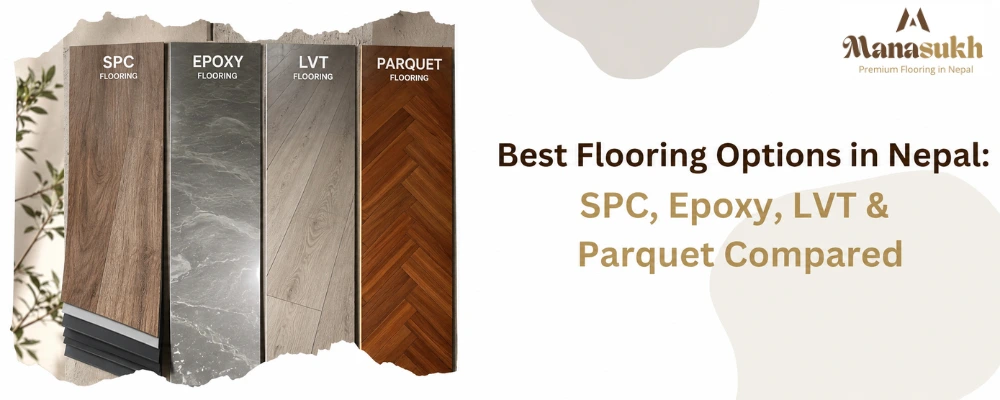
Choosing flooring in Nepal is not just about looks. Kathmandu’s dusty dry winters, the monsoon’s relentless humidity, and the Terai’s summer heat all put different demands on a floor. A material that performs beautifully in Delhi or Dubai can warp, stain, or crack within two years in Kathmandu Valley if it was never built for this climate.
This guide focuses on the four flooring options for homes, offices, and commercial spaces right now: SPC flooring in Nepal, epoxy flooring in Nepal, LVT (Luxury Vinyl Tile) flooring in Nepal, and parquet flooring in Nepal. You will get real price ranges, honest pros and cons, room-by-room recommendations, and answers to the questions Nepali homeowners actually search for before they buy.
Why Flooring Choice Matters in Nepal’s Climate
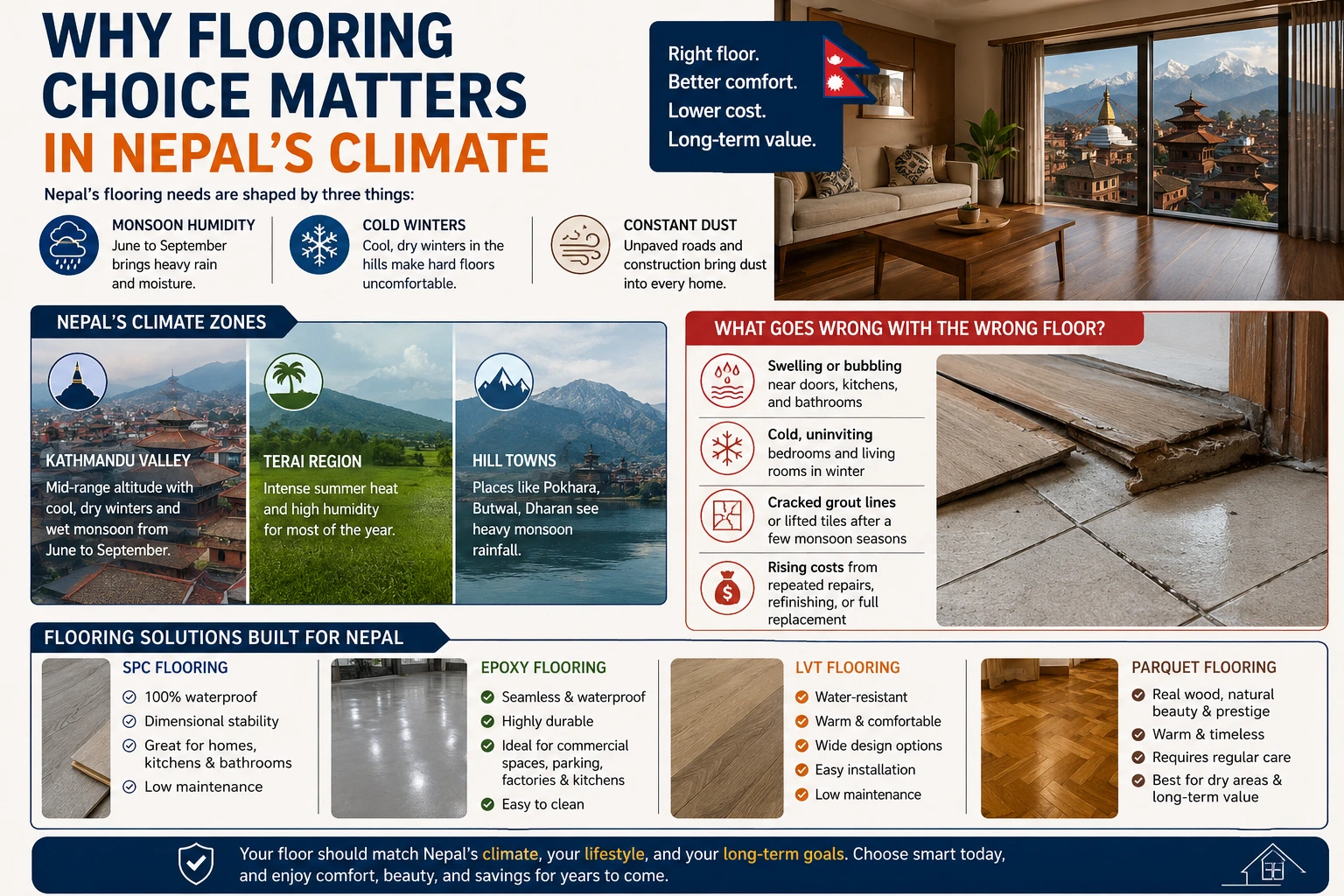
Nepal’s flooring needs are shaped by three things: monsoon humidity, cold winters in the hills, and constant dust from unpaved roads and construction. A floor that cannot handle moisture will swell or grow mold during Ashad and Shrawan. A floor with a cold, hard surface makes winter mornings in Kathmandu genuinely uncomfortable. And a floor that is hard to clean quickly looks tired under daily dust.
Kathmandu Valley sits at a mid-range altitude with cool, dry winters and a wet monsoon from June to September. The Terai region deals with intense summer heat and high humidity for most of the year. Hill towns like Pokhara, Butwal, and Dharan sit somewhere in between, but still see heavy monsoon rainfall.
A poor flooring decision usually shows up as one of these problems:
- Swelling or bubbling near doors, kitchens, and bathrooms
- Cold, uninviting bedrooms and living rooms in winter
- Cracked grout lines or lifted tiles after a few monsoon seasons
- Rising costs from repeated repairs, refinishing, or full replacement
This is exactly why SPC, epoxy, and LVT flooring have grown so quickly in Nepal over the last few years. They were engineered for moisture resistance and dimensional stability, which matters far more here than in drier climates. Parquet still holds its place for homeowners who want the warmth and prestige of real wood and are willing to manage its extra care needs.
Quick Comparison: SPC vs Epoxy vs LVT vs Parquet
For most Nepali homes, SPC flooring offers the best overall balance of waterproofing, durability, and price. Epoxy flooring is unmatched for garages, warehouses, and commercial floors that face heavy chemical or foot traffic. LVT flooring suits budget-conscious renovations that still want a premium look, and parquet remains the top choice for buyers who want genuine wood warmth and are prepared for higher maintenance.
| Flooring Type | Best For | Water Resistance | Typical Price (installed) |
|---|---|---|---|
| SPC | Homes, offices, rental units | Fully waterproof | NPR 250 – 900 / sq ft |
| Epoxy | Garages, warehouses, hospitals, industrial floors | Fully waterproof (seamless) | NPR 210 – 900 / sq ft |
| LVT | Bedrooms, living rooms, offices on a budget | Waterproof | NPR 210 – 600 / sq ft |
| Parquet | Living rooms, bedrooms, premium interiors | Poor to moderate (varies by type) | NPR 150 – 2,500+ / sq ft |
Prices are general market ranges gathered from multiple Nepal flooring suppliers as of 2026. Actual rates depend on brand, thickness, subfloor condition, and installation complexity, so always confirm with a personal consultation before budgeting.
SPC Flooring in Nepal
SPC stands for Stone Plastic Composite. It is a rigid, fully waterproof flooring made from a core of limestone powder and PVC compound, topped with a printed design layer and a scratch-resistant wear layer. It has become one of the fastest-growing flooring choices in Kathmandu because it survives moisture, temperature swings, and daily wear far better than laminate or basic vinyl.
How SPC Flooring Is Built
SPC flooring is made of four layers working together:
- Base/backing layer — adds stability and sound dampening
- Rigid core — the limestone-and-PVC layer that resists warping and moisture
- Design layer — a high-resolution print that mimics wood, stone, or tile
- Wear layer — a clear top coating measured in mils that resists scratches and stains
Advantages of SPC Flooring
- 100% waterproof core, so spills, mopping, and monsoon humidity will not damage it
- Dimensionally stable, meaning it does not expand or contract with Kathmandu’s temperature swings the way laminate can
- Scratch and dent resistant, which suits homes with kids, pets, or heavy furniture
- Click-lock installation is fast, mess-free, and can go directly over most existing hard floors
- Warmer underfoot than tile, and quieter to walk on
- 25 years of Warranty
Disadvantages of SPC Flooring
- Higher upfront cost than basic vinyl or ceramic tile
- Requires a reasonably flat subfloor for the click-lock system to sit well
- Lower-quality imports with thin wear layers can scratch faster, so brand matters
SPC Flooring Price in Nepal
Material costs typically range from NPR 200 to 450 per square foot, with installation adding roughly NPR 35 to 100 per square foot, depending on subfloor prep. Premium SPC with thicker wear layers, sound-dampening underlay, or designer finishes can run higher. Get a written quote that separates material and labor so you can compare suppliers fairly.
Best Use Cases for SPC Flooring
- Living rooms and bedrooms in apartments and independent homes
- Rental units where durability with low maintenance matters
- Offices and clinics that need a professional look without tile’s cold feel
- Kitchens (paired with proper seam sealing at wet zones)
Epoxy Flooring in Nepal
Epoxy flooring is a resin-based coating applied as a liquid over a prepared concrete floor, where it cures into a seamless, rock-hard, chemical-resistant surface. In Nepal, it is the standard choice for garages, warehouses, hospitals, food processing units, and commercial kitchens where floors face constant abrasion, spills, or heavy loads.
None of the flooring guides currently online for Nepal cover epoxy in real depth, even though it solves problems SPC, LVT, and parquet simply cannot: heavy vehicle traffic, chemical exposure, and large seamless industrial areas.
Types of Epoxy Flooring
- Self-leveling epoxy — creates a smooth, uniform surface ideal for showrooms and commercial spaces
- Flake/broadcast epoxy — decorative colored flakes broadcast into the coating for texture and slip resistance, popular in garages
- Metallic epoxy — pigments create a 3D, marbled visual effect, often used in feature areas, cafes, and retail floors
- Industrial/heavy-duty epoxy — thicker builds designed for warehouses, factory floors, and vehicle traffic
Advantages of Epoxy Flooring
- Fully seamless and waterproof, so there are no grout lines or seams for moisture or bacteria to collect in
- Extremely durable against abrasion, impact, and chemical spills
- Easy to clean, which makes it a strong fit for hospitals, kitchens, and food-handling spaces
- Highly customizable in color, pattern, and finish for showrooms or branded commercial spaces
- Long lifespan when properly applied, often 8 to 12+ years in residential use and longer with industrial-grade systems
Disadvantages of Epoxy Flooring
- Requires proper surface preparation; skipping crack repair or moisture testing on old concrete leads to peeling
- Can be slippery when wet unless an anti-slip additive is used
- Curing takes time, so the space is unusable for a day or two during installation
- Not typically used as a standalone finish for bedrooms and living rooms, since it lacks the warmth of SPC or parquet
Epoxy Flooring Price in Nepal
Basic single-color epoxy systems start around NPR 210 to 250 per square foot. Standard residential and light commercial systems fall between NPR 250 and 500 per square foot. Decorative metallic or flake systems, and heavy-duty industrial coatings, can run NPR 500 to 900+ per square foot, largely driven by surface preparation and design complexity. Older or damaged concrete adds NPR 30 to 80 per square foot for grinding and crack repair.
Best Use Cases for Epoxy Flooring
- Garages and basements
- Warehouses, factories, and workshops
- Hospitals, clinics, and laboratories that need hygienic, seamless floors
- Commercial kitchens and food processing areas
- Showrooms, retail stores, and cafes wanting a decorative statement floor
LVT (Luxury Vinyl Tile) Flooring in Nepal
LVT stands for Luxury Vinyl Tile, a flexible, layered vinyl flooring that replicates the look of wood, stone, or ceramic tile at a lower cost than SPC or parquet. It is fully waterproof and easy to install, which makes it one of the most budget-friendly ways to get a premium look in rental units, offices, and quick renovations.
SPC vs LVT: What Is the Difference?
This is one of the most confused terms in Nepal’s flooring market, and most competitor guides do not clarify it. Both are PVC-based and waterproof, but they differ in construction:
- SPC has a rigid stone-composite core, making it firmer, more dent-resistant, and better at hiding minor subfloor imperfections
- LVT is more flexible and typically thinner, which lowers material and installation cost but makes it slightly less forgiving on uneven subfloors and more prone to denting under heavy furniture
In short, SPC is the tougher, pricier option built for long-term heavy use. LVT is the lighter, more affordable option for spaces where budget matters more than maximum durability.
Advantages of LVT Flooring
- Fully waterproof, safe for kitchens and bathrooms
- Lower cost than SPC and parquet, making it accessible for larger projects
- Wide range of wood-look and stone-look designs
- Comfortable underfoot and quieter than tile
- Fast installation, often with peel-and-stick or click-lock systems
- 5-7 years of warranty
Disadvantages of LVT Flooring
- Less rigid than SPC, so it shows subfloor imperfections more easily
- Can dent under heavy furniture without protective pads
- Lower-end LVT products have thinner wear layers that scratch sooner
- Not biodegradable, an environmental factor some buyers weigh against its practicality
LVT Flooring Price in Nepal
LVT typically costs NPR 210 to 350 per square foot for standard grades. Installation adds roughly NPR 30 to 70 per square foot depending on the method and subfloor condition.
Best Use Cases for LVT Flooring
- Rental apartments and budget renovations
- Bedrooms and living rooms where cost matters more than maximum wear resistance
- Offices, especially cabins and low-traffic zones
- Quick flooring upgrades before a sale or lease
Parquet Flooring in Nepal
Parquet flooring uses small pieces of wood or engineered wood arranged in geometric patterns like herringbone or basketweave. It remains the premium choice in Nepal for buyers who want the warmth, texture, and prestige of real wood, most often in living rooms, bedrooms, and high-end offices.
Types of Parquet Flooring in Nepal
- Solid wood parquet — made from real hardwood such as teak, sal, or walnut; the most premium and the most sensitive to moisture
- Engineered wood parquet — a real wood top layer bonded to a stable plywood or HDF base, more resistant to humidity swings than solid wood
- Laminate parquet — a printed wood-look layer over an HDF core, the most affordable parquet option
- Vinyl parquet — a waterproof, budget-friendly option styled in classic parquet patterns
Advantages of Parquet Flooring
- Warm and comfortable underfoot, especially valuable in Kathmandu’s cold winters
- Adds genuine long-term property value in the premium segment
- Timeless, elegant patterns that suit both traditional and modern interiors
- Engineered and laminate versions offer better moisture tolerance than solid wood
- For 12mm parquet – 25 years of warranty
Disadvantages of Parquet Flooring
- Solid wood parquet is sensitive to moisture and needs careful sealing and climate control
- Higher cost, especially for imported hardwood species
- Requires periodic polishing or refinishing to keep its shine
- Professional installation is essential to avoid gaps and uneven patterns
Parquet Flooring Price in Nepal
- Laminate parquet: NPR 150 – 600 per sq ft
- Engineered wood parquet: NPR 400 – 1,200 per sq ft
- Solid wood parquet: NPR 1,200 – 2,500+ per sq ft
Installation typically adds NPR 80 to 200 per square foot depending on the pattern’s complexity; herringbone and chevron layouts cost more in labor than straight-plank installs.
Best Use Cases for Parquet Flooring
- Living rooms and formal spaces in premium homes
- Bedrooms where warmth and comfort matter most
- Executive offices and hotel suites
- Heritage-style or classic interior projects
Full Comparison Table
| Feature | SPC | Epoxy | LVT | Parquet |
|---|---|---|---|---|
| Water Resistance | Excellent | Excellent (seamless) | Excellent | Poor (solid) to Good (engineered) |
| Durability | Very High | Very High | Moderate to High | High (with care) |
| Comfort Underfoot | High | Low to Moderate | High | Very High |
| Installation Time | Fast (1–3 days) | Moderate (curing time needed) | Fast (1–2 days) | Moderate to Slow |
| Maintenance | Low | Very Low | Low | Moderate to High |
| Winter Warmth | Warm | Neutral | Warm | Very Warm |
| Best Lifespan | 15–25 years | 8–15+ years (residential); longer industrial | 10–15 years | 20–30+ years (with refinishing) |
| Price Range (installed) | NPR 250–900/sq ft | NPR 210–900/sq ft | NPR 210–600/sq ft | NPR 300–2,500+/sq ft |
| Ideal Setting | Homes, offices | Garages, industrial, hospitals | Budget renovations, rentals | Premium homes, hotels |
Best Flooring by Nepal’s Climate Zones
Kathmandu Valley homes generally do best with SPC or engineered parquet in living areas and epoxy in garages, since both handle the valley’s monsoon humidity and cold, dry winters well. The Terai region favors SPC, LVT, or epoxy over solid wood parquet because of sustained heat and humidity. Hill towns like Pokhara benefit from SPC or engineered parquet, which balance warmth with moisture tolerance.
Kathmandu, Lalitpur, Bhaktapur (Valley Climate)
- Living rooms and bedrooms: SPC or engineered parquet
- Kitchens and bathrooms: SPC or epoxy
- Garages and basements: Epoxy
- Budget renovations: LVT
Terai Region (Hot, Humid)
- Solid wood parquet is not recommended without strict climate control
- SPC and LVT handle the heat and moisture reliably
- Epoxy is ideal for commercial and industrial spaces
Hill Towns (Pokhara, Butwal, Dharan)
- SPC or engineered parquet for a warm, moisture-tolerant living space
- Epoxy for garages, shops, and ground-floor commercial units
Monsoon-Prone, Low-Lying Areas
- Avoid solid wood parquet at ground level
- SPC, LVT, and epoxy are the safest choices due to full waterproofing
Best Flooring by Room and Space Type
Homes and Apartments
- Living room: SPC, engineered parquet, or LVT
- Bedroom: Parquet or SPC for warmth and comfort
- Kitchen: SPC or epoxy for full water resistance
- Bathroom: Epoxy or SPC with sealed seams
- Balcony/terrace: SPC rated for outdoor use, or tile as an alternative
Offices
- Executive cabins: Parquet or premium SPC
- Open workspace: SPC or LVT for cost-effective durability
- Reception/lobby: Epoxy (decorative finish) or SPC
Hotels and Resorts
- Guest rooms: Parquet or SPC for a premium, warm feel
- Common areas and lobbies: Epoxy or SPC for heavy foot traffic
Commercial and Industrial
- Warehouses and factories: Epoxy, always
- Showrooms and retail floors: Decorative epoxy or SPC
- Hospitals and clinics: Epoxy for its seamless, hygienic surface
- Restaurants and commercial kitchens: Epoxy
Garages and Basements
- Epoxy is the clear winner for oil resistance, chemical resistance, and heavy vehicle loads
Cost and Long-Term Value Comparison
On upfront cost, LVT is the cheapest, followed by SPC, epoxy, and then parquet. On long-term value, epoxy and SPC tend to offer the best return for high-traffic spaces because of their low maintenance costs, while solid parquet holds the highest resale and prestige value in premium residential markets.
| Flooring | Upfront Cost | Maintenance Cost | Long-Term Value |
|---|---|---|---|
| SPC | Medium | Very Low | Strong for daily-use homes |
| Epoxy | Medium | Very Low | Strongest for commercial/industrial |
| LVT | Low | Low | Good for short-to-mid-term use |
| Parquet | High | Moderate to High | Strongest for premium resale value |
A practical approach many Nepali homeowners take is mixing flooring types by function: SPC or parquet in the living areas, epoxy in the garage, and LVT in secondary rooms or rental units. This “combination flooring” approach balances budget with performance far better than using one material throughout the entire property.
How to Choose the Right Flooring
Before comparing specific brands, walk through these questions:
- What is the room’s exposure to water? Kitchens, bathrooms, and garages need fully waterproof options like SPC or epoxy.
- How much foot or vehicle traffic will the floor see? High-traffic commercial spaces favor epoxy; moderate home traffic works well with SPC or LVT.
- What is your budget per square foot, including installation? LVT and laminate parquet fit tighter budgets, while solid parquet and premium epoxy systems suit higher budgets.
- Do you want warmth underfoot in winter? Parquet and SPC feel warmer than epoxy or tile.
- How much maintenance are you willing to do? Epoxy and SPC need the least upkeep; solid parquet needs the most.
- Is the subfloor level and dry? Uneven or damp subfloors need proper preparation regardless of flooring choice, and this affects both cost and installation timeline.
The Installation Process: What to Expect
A typical flooring installation in Nepal moves through site consultation, subfloor preparation, material installation, and final inspection, usually completed within one to five days depending on the flooring type and room size.
- Site visit and consultation — measurements, subfloor assessment, and material recommendation based on the space and climate exposure
- Subfloor preparation — leveling, moisture testing (especially important for epoxy and solid parquet), and cleaning
- Installation
- SPC and LVT: click-lock or glue-down, usually completed in 1–3 days for an average home
- Epoxy: primer, base coat, decorative layer if applicable, and topcoat, with curing time between coats; full cure can take several days before heavy use
- Parquet: plank-by-plank or pattern-based laying, which takes longer for herringbone or chevron designs
- Finishing and inspection — trims, transition strips, skirting, and a final walkthrough with the client
Ask your installer for a written timeline and confirm which rooms will be unusable during curing or drying, particularly for epoxy projects.
Maintenance Tips for Each Flooring Type
SPC and LVT flooring need only regular sweeping and occasional damp mopping. Epoxy flooring needs simple mopping with a pH-neutral cleaner and prompt cleanup of chemical spills. Parquet needs the most care, including dry cleaning, occasional polishing, and avoiding standing water.
- SPC/LVT: Sweep or vacuum regularly; damp mop with a mild cleaner; use floor protectors under heavy furniture; wipe spills promptly
- Epoxy: Mop with a pH-neutral cleaner; avoid abrasive scrubbers on decorative finishes; reapply a topcoat every few years in heavy-traffic industrial settings
- Parquet: Use a dry or slightly damp mop only; avoid standing water; use furniture pads; refinish or re-polish every several years depending on traffic and wear
- All types: Place doormats at entrances to reduce grit and dust, which is a major cause of scratching in Kathmandu’s dusty environment
Common Mistakes to Avoid
- Choosing solid wood parquet for bathrooms or kitchens. Even sealed solid wood struggles with sustained moisture.
- Skipping subfloor preparation. Uneven or damp subfloors cause SPC and LVT to shift, and cause epoxy to peel or bubble.
- Picking flooring by photo alone. Always ask for physical samples, since lighting and screen colors distort how a finish will actually look in your space.
- Ignoring wear layer thickness on SPC and LVT. A thin wear layer scratches faster, even if the design looks identical to a premium product.
- Assuming all epoxy systems are the same. Decorative epoxy and industrial heavy-duty epoxy use different formulations; using a decorative-grade product in a warehouse leads to premature failure.
- Underestimating installation labor cost. Material price alone does not reflect the final budget; always request an all-inclusive quote.
Sustainability Considerations
Flooring choices in Nepal increasingly factor in longevity and resource use, not just aesthetics. Engineered parquet uses less solid hardwood than traditional plank flooring, which reduces pressure on timber resources while still delivering a natural wood surface. SPC’s long lifespan, often 15 to 25 years, means fewer replacement cycles compared to shorter-lived materials, which reduces long-term material waste. Epoxy’s durability similarly extends the useful life of a floor in high-traffic commercial settings, reducing how often a space needs to be renovated. If sustainability is a priority, ask suppliers directly about the sourcing of their wood products and the VOC (volatile organic compound) content of epoxy resins, since formulations vary by manufacturer.
FAQ Section
1. What is the best flooring option in Nepal overall? There is no single best option for every space. SPC suits most homes, epoxy suits garages and commercial floors, LVT suits tight budgets, and parquet suits premium interiors.
2. Is SPC flooring good for Nepal’s climate? Yes. SPC is fully waterproof and dimensionally stable, which makes it well suited to Kathmandu’s humid monsoons and cold, dry winters.
3. What does SPC stand for in flooring? SPC stands for Stone Plastic Composite, referring to its limestone-and-PVC composite core.
4. Is epoxy flooring suitable for homes, or only commercial spaces? Epoxy works well in home garages, basements, and utility areas, though it is less common in bedrooms and living rooms because it lacks the warmth of SPC or parquet.
5. How long does epoxy flooring last in Nepal? Residential epoxy typically lasts 8 to 12+ years with proper care, while industrial-grade systems can last significantly longer under heavy use.
6. What is LVT flooring? LVT stands for Luxury Vinyl Tile, a flexible, waterproof vinyl flooring that mimics wood, stone, or tile at a lower cost than SPC.
7. What is the difference between SPC and LVT flooring? SPC has a rigid stone-composite core that is firmer and more dent-resistant. LVT is more flexible, generally thinner, and more budget-friendly, but slightly less forgiving on uneven subfloors.
8. Is parquet flooring suitable for Nepal’s climate? Yes, especially engineered and laminate parquet. Solid wood parquet needs careful sealing and is best avoided in consistently humid or wet areas.
9. Which flooring is best for a monsoon-prone home in Nepal? SPC, LVT, and epoxy are the safest choices since all three are fully waterproof.
10. Which flooring feels warmest in Kathmandu’s winter? Parquet feels the warmest underfoot, followed closely by SPC. Epoxy and tile stay cooler.
11. How much does SPC flooring cost in Nepal? Material costs generally range from NPR 180 to 450 per square foot, with installation adding NPR 35 to 100 per square foot.
12. How much does epoxy flooring cost in Nepal? Basic systems start around NPR 190 to 250 per square foot, while decorative or industrial-grade systems can reach NPR 500 to 900+ per square foot.
13. How much does LVT flooring cost in Nepal? Standard LVT typically costs NPR 150 to 350 per square foot, with premium imported options reaching NPR 400 to 600 per square foot.
14. How much does parquet flooring cost in Nepal? Laminate parquet ranges from NPR 250 to 600 per square foot, engineered wood from NPR 400 to 1,200, and solid wood from NPR 1,200 to 2,500 or more per square foot.
15. Can SPC flooring be installed over existing tiles? Yes, as long as the existing surface is clean, level, and structurally sound.
16. Can epoxy flooring be applied over old, cracked concrete? Yes, but it requires proper surface preparation, including grinding and crack filling, which adds to the total cost.
17. Is LVT flooring waterproof? Yes, LVT is fully waterproof, making it suitable for kitchens and bathrooms.
18. How long does parquet flooring last? With proper care, parquet flooring can last 15 to 30 or more years, especially engineered and solid wood varieties that are periodically refinished.
19. Which flooring is easiest to maintain? SPC, LVT, and epoxy all require minimal maintenance, mainly regular sweeping and occasional mopping.
20. Which flooring is the most durable for high-traffic commercial spaces? Epoxy flooring is the most durable choice for warehouses, factories, and heavy-traffic commercial floors.
21. Is epoxy flooring slippery? Standard glossy epoxy can be slippery when wet, but adding an anti-slip additive during application solves this.
22. Can I mix different flooring types in one house? Yes. Many Nepali homeowners use SPC or parquet in living areas, epoxy in the garage, and LVT in secondary rooms to balance budget and performance.
23. What is the best flooring for a rental apartment in Nepal? LVT is popular for rentals because of its low cost, quick installation, and waterproof durability.
24. Does SPC flooring scratch easily? Quality SPC with a thick wear layer resists scratches well. Lower-grade imports with thin wear layers scratch more easily, so brand and wear layer thickness matter.
25. Is parquet flooring expensive to maintain? Solid wood parquet needs more maintenance, including periodic polishing and avoiding standing water. Engineered and laminate parquet need less upkeep.
26. What is the difference between engineered and solid wood parquet? Solid wood parquet is made entirely of hardwood and is more sensitive to moisture. Engineered parquet has a real wood top layer over a stable plywood or HDF base, making it more moisture-tolerant.
27. Which flooring adds the most resale value to a home in Nepal? Solid wood parquet typically adds the strongest resale value in the premium residential segment, though quality SPC also adds appeal due to its durability.
28. How long does SPC flooring installation take? A typical home installation takes 1 to 3 days depending on room size and subfloor condition.
29. Is epoxy flooring good for kitchens? Yes, epoxy’s seamless, water-resistant surface works well in commercial kitchens. In homes, SPC is more commonly chosen for its warmer, more residential look.
30. How do I choose between SPC, epoxy, LVT, and parquet for my space? Consider water exposure, foot traffic, budget, desired warmth underfoot, and how much maintenance you are willing to do. A site consultation with a flooring specialist is the most reliable way to match the material to your space.
Every space has different flooring needs, and the right choice depends on your rooms, budget, and how you actually use the space day to day. If you are weighing SPC, epoxy, LVT, or parquet flooring for your home or business in Kathmandu, Lalitpur, or Bhaktapur, book a free consultation with Manasukh Flooring and get a clear, no-obligation quote tailored to your project.