
Introduction
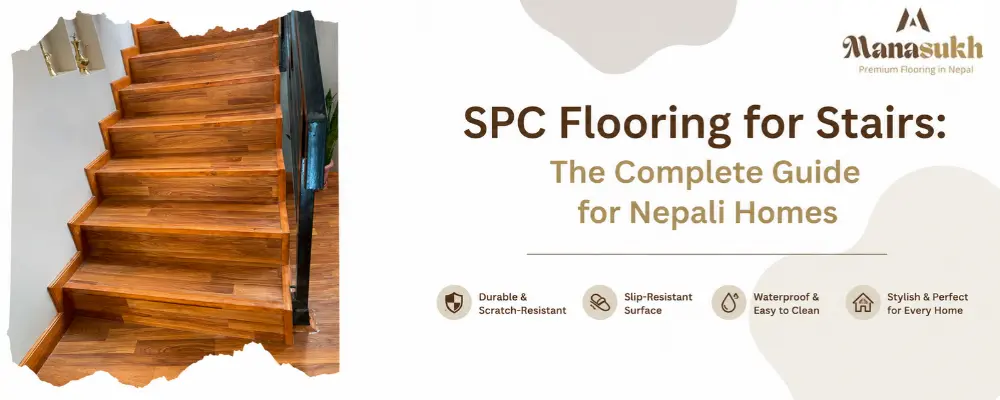
Stairs take more daily abuse than almost any other surface in a house. Every step scuffs, scrapes, or pounds the same narrow strip of tread, and in a Nepali home that strip also has to survive monsoon humidity, dusty winters, and years of school bags being dragged up and down. SPC flooring in Nepal for stairs has become one of the most requested upgrades among Kathmandu homeowners because it solves the two biggest stair problems at once: it resists water and it resists wear, without the cost or maintenance burden of solid wood or the coldness of tile.
This guide walks through what SPC flooring actually is, why it holds up on stairs specifically, how stair nosing and edge profiles work, and what you should budget for in Nepal. It also covers the safety questions most homeowners ask before committing, along with an honest comparison against wood, tile, laminate, and carpet.
What Is SPC Flooring
SPC stands for Stone Plastic Composite, a rigid-core flooring made by combining limestone powder with PVC and stabilizers under high pressure, then finishing it with a printed decorative layer and a clear wear layer on top. The result is a plank that looks like wood, stone, or tile but behaves like plastic underneath, which is exactly why it holds up so well on high-traffic surfaces like stairs.
Unlike laminate, which uses a compressed wood-fiber core that swells when wet, SPC’s core is 100 percent waterproof. Unlike solid hardwood, it will not expand, contract, or warp with Kathmandu’s seasonal humidity swings. Most SPC planks sold in Nepal are between 4mm and 6mm thick, with an additional wear layer measured separately, and they connect using a click-lock mechanism that snaps planks together without glue or nails on the flat run of a floor.
Why SPC Flooring Works Well on Stairs
SPC flooring suits stairs because its rigid limestone-composite core resists impact, moisture, and daily foot traffic better than wood or laminate, while its thin profile keeps step height changes minimal. Stairs see concentrated pressure on a small area with every footstep, and SPC’s dense core spreads that load instead of denting under it.
Durability Under Repeated Impact
Stair treads absorb thousands of footfalls a month, often from shoes carrying grit and small stones from outside. A soft surface like carpet crushes over time, and laminate’s fiberboard core can chip at the tread edge. SPC’s stone-composite core is significantly harder, so it resists denting, scratching, and the rounding-off of edges that makes old stairs look shabby within a year or two.
Water and Moisture Resistance
Stairwells near entryways, kitchens, or bathrooms take splashes, wet umbrellas, and monsoon humidity. Because SPC’s core contains no wood fiber, it will not swell, delaminate, or grow mold the way laminate or engineered wood can when moisture gets into the seams. This matters even more on stairs than on flat floors, since spilled water on a step is also a slip hazard until it’s mopped up.
Dimensional Stability
Kathmandu Valley swings between a humid monsoon and a dry winter, and that seasonal moisture change is exactly what makes timber stair treads creak, cup, or develop gaps over a few years. SPC’s plastic-composite core barely reacts to humidity, so a staircase installed in July should still fit tightly in January.
Noise Reduction
Bare stairs, especially tile or stone ones, amplify every footstep into a sharp echo through a stairwell. SPC flooring, especially when paired with an underlayment pad, dampens that impact sound noticeably compared to hard stone or ceramic stair surfaces.
Thin Profile, Easier Retrofit
Because SPC planks run 4mm to 6mm thick rather than the 10mm to 18mm of solid wood, they add minimal height to an existing tread. That keeps the rise-to-run ratio of the staircase close to its original dimensions, which matters for both comfort and building code compliance when you are covering an existing structure rather than building new.
Is SPC Flooring Safe for Stairs
Yes, SPC flooring is safe for stairs when installed with a textured or embossed wear layer and paired with a proper stair nosing profile that includes a contrasting or grooved edge for grip. Slip resistance comes primarily from the surface texture manufacturers apply to the wear layer, not from the base material itself, so the finish you choose matters more than the fact that it’s SPC.
Slip Resistance
Most SPC planks sold for residential use come in one of three finishes: smooth gloss, matte, or embossed-in-register texture that mimics real wood grain. For stairs, matte or embossed textures are strongly preferred over gloss, since a glossy finish becomes noticeably slicker when even slightly damp. Look for planks with a published slip resistance rating where available, and ask your supplier directly if a rating isn’t listed on the product sheet.
Children and Elderly Household Members
Households with young children or older family members should prioritize textured finishes and stair nosing with a visible or grooved edge, since the leading edge of a step is where most stair falls happen. A nosing strip in a slightly darker or contrasting tone also helps depth perception on the top and bottom steps, which are statistically where most missteps occur.
Fire and Slip Standards
SPC flooring generally meets standard residential fire ratings comparable to other PVC-based floors, and it is not considered a significant fire risk in typical home use. If you are flooring a commercial staircase, such as in an office or retail space, ask your supplier for the specific slip-resistance and fire-rating documentation for the exact product line, since commercial code requirements can differ from residential ones.
SPC Flooring vs Other Stair Materials
Choosing a stair surface usually comes down to weighing durability against comfort, cost, and maintenance. Here is how SPC stacks up against the materials most commonly used on Nepali stairs.
| Feature | SPC Flooring | Solid Wood | Tile / Marble | Laminate | Carpet |
|---|---|---|---|---|---|
| Water resistance | Fully waterproof core | Poor, warps with moisture | Excellent | Poor, core swells | Poor, absorbs and holds moisture |
| Slip safety (with texture) | Good with matte/embossed finish | Moderate, can be slick when polished | Poor when wet, unless textured | Moderate | Good grip, poor when wet or worn |
| Durability on high-traffic treads | High, resists dents and scratches | High, but shows wear over years | Very high, but chips and cracks | Moderate, edges chip over time | Low, crushes and stains |
| Noise on stairs | Low with underlayment | Moderate, can creak | High, echoes | Low to moderate | Very low |
| Maintenance | Simple sweep and damp mop | Needs periodic refinishing | Simple, but grout needs cleaning | Simple, avoid excess water | Requires vacuuming, deep cleaning |
| Comfort underfoot | Firm but not cold | Warm, comfortable | Cold, hard | Firm | Soft, warm |
| Typical lifespan | 20 to 30 years | 20+ years with care | 20+ years | 8 to 15 years | 5 to 10 years |
| Retrofit-friendly (low height gain) | Yes, thin profile | No, needs thicker treads | No, needs mortar bed | Yes | Yes |
SPC’s strongest advantage on stairs is the combination of waterproofing and dent resistance in a thin, retrofit-friendly plank, something none of the other four materials offer together. Tile matches its durability but loses badly on slip safety and noise. Carpet wins on comfort and quiet but fails quickly under heavy stair traffic and traps moisture and odor. If your household has already ruled out tile for stairs specifically because of slip concerns, our comparison ofSPC flooring vs tiles goes deeper into that specific trade-off.
Stair Nosing and Edge Profiles
Stair nosing is the finishing edge piece that caps the front lip of each tread, and it is the single most important safety component in an SPC stair installation. Without a proper nosing, the front edge of an SPC-covered step is a sharp, unsupported plank edge that can chip, lift, or create a trip hazard.
Why Nosing Matters
The front edge of a stair tread takes the most direct impact of any point on the staircase, since it’s where the ball of the foot lands first. A dedicated nosing profile, usually made from the same SPC material or a matched PVC extrusion, wraps that edge in a rounded, reinforced strip that resists chipping and gives the foot a clear visual and tactile reference point.
Common Nosing Options
| Nosing Type | Best For | Notes |
|---|---|---|
| Matching-color SPC nosing | Most residential stairs | Blends seamlessly with the plank finish |
| Contrasting-color nosing | Homes with children or elderly residents | Improves depth perception on each step |
| Anti-slip grooved nosing | High-traffic or commercial stairwells | Adds ridges for extra grip in wet conditions |
| Metal edge trim with SPC insert | Stairs with heavy footfall, offices, shops | Longer-lasting edge in commercial settings |
Installing Nosing Correctly
Nosing pieces should be glued and, where the profile allows, mechanically fixed at the tread edge so they cannot lift with repeated foot pressure. A poorly seated nosing is one of the most common causes of complaints about SPC stairs, so this step deserves as much attention as the plank installation itself, if not more.
Cost of SPC Flooring for Stairs in Nepal
SPC flooring for stairs in Nepal typically costs more per step than flat-floor SPC installation, because stair work requires more precise cutting, individual tread and riser pieces, and dedicated nosing profiles that add both material and labor time. Exact pricing depends on plank thickness, nosing type, and the number and shape of steps, so it is best to get a site-specific quote rather than relying on a flat per-square-foot estimate. You can estimate the price as Rs. 399 per sq feet with labour cost.
What Drives the Price
| Cost Factor | Why It Matters |
|---|---|
| Plank thickness and wear layer | Thicker planks and heavier wear layers cost more per square foot |
| Nosing profile type | Metal-reinforced or anti-slip nosing costs more than matching-color SPC nosing |
| Number of steps and landings | More cuts and joints mean more labor time |
| Staircase shape | Straight staircases are simpler than curved, winding, or spiral designs |
| Subsurface condition | Repairing an uneven or damaged existing staircase adds to the job |
| Installer labor rates | Stair work requires more skill than flat-floor installation and is priced accordingly |
For a general sense of SPC pricing per square foot in Nepal before stair-specific labor is added, see our detailed SPC flooring price in Nepal guide. Because stair quotes vary significantly by staircase shape and nosing choice, we recommend requesting a measured quote for an exact figure rather than assuming a flat per-step rate.
Getting an Accurate Quote
A useful quote should break out material cost, nosing cost, and labor separately, rather than bundling everything into a single lump sum per step. This makes it easier to compare quotes from different suppliers and to see exactly where your budget is going if you decide to upgrade the nosing profile or plank thickness later. It also helps to ask whether the quote includes subsurface repair, since an uneven or damaged existing staircase can add cost that only becomes visible once the old surface is removed. Getting two or three quotes for the same staircase, with the same nosing specification requested each time, is the most reliable way to judge whether a price is reasonable for your specific job.
Maintenance and Cleaning
SPC stairs need only regular sweeping and occasional damp mopping with a pH-neutral cleaner, since the waterproof core and wear layer resist both moisture and most household stains without special treatment. This is one of the biggest long-term advantages over wood or carpeted stairs, which need refinishing or deep cleaning on a regular schedule.
Daily and Weekly Care
- Sweep or vacuum (on the bare floor setting, not the beater brush) to remove grit before it scratches the surface
- Wipe spills promptly, especially near the nosing edge where liquid can pool
- Use a slightly damp mop rather than a soaking wet one for routine cleaning
What to Avoid
- Steel wool, abrasive scouring pads, or harsh solvents, which can dull the wear layer
- Wax-based floor polishes, which are unnecessary on SPC and can leave the surface slippery
- Standing water left on any step for extended periods, particularly along seams and nosing edges
Long-Term Upkeep
Because SPC does not need sanding, refinishing, or resealing, ongoing maintenance costs stay low over the life of the staircase. Periodically check that nosing strips remain firmly seated, since this is the one component most likely to need occasional re-gluing after years of heavy use.
Common Stair Flooring Problems SPC Solves
SPC flooring directly addresses the three complaints most common on Nepali stairs: water damage near entryways, creaking or shifting treads, and dulled or chipped surfaces from years of foot traffic. Homeowners replacing tile, wood, or laminate stairs are usually trying to solve one of these three issues specifically.
Water Damage Near Entrances and Bathrooms
Stairs positioned near a main entrance or bathroom door take moisture that wood and laminate simply cannot handle long term. SPC’s waterproof core removes this risk entirely, since there is no wood fiber to swell or delaminate.
Creaking and Shifting
Old timber stairs often develop creaks as the wood dries, shrinks, and works loose from its fasteners over years of humidity cycles. A properly glued SPC installation over a solid, repaired subsurface eliminates this movement, since the plank is bonded flat rather than resting loosely.
Surface Wear and Dulling
Tile grout stains, wood finishes wear thin, and laminate chips at the edges. SPC’s dense wear layer resists this kind of surface degradation far longer under the same daily traffic, keeping the staircase looking presentable for years without refinishing.
Cold, Hard Surfaces
Stone and tile stairs are notoriously cold underfoot during Kathmandu winters. SPC feels noticeably warmer and softer to bare feet than stone or ceramic, without sacrificing the durability those materials are chosen for in the first place.
Choosing SPC Flooring for Nepal’s Climate
In Nepal’s climate, prioritize SPC planks with a fully waterproof rigid core, a matte or embossed anti-slip finish, and UV-stable pigments if the staircase gets direct sunlight, since monsoon humidity and seasonal temperature swings are the two biggest stressors on any stair surface here. Not every SPC product sold locally is built to the same standard, so checking these three specifications before purchase matters more than brand names alone.
Monsoon Humidity
The monsoon season pushes indoor humidity higher for months at a time, and stairwells near open doors or windows feel this most directly. A genuine waterproof SPC core handles this without issue, but always confirm the core composition with your supplier rather than assuming every product labeled “SPC” meets the same standard.
Dust and Grit From Outdoor Access
Stairs connecting to an entrance or a rooftop terrace collect more dust and small grit than interior floors, which accelerates surface scratching if the wear layer is thin. Choosing a slightly heavier wear layer for entrance-adjacent staircases is a worthwhile upgrade.
Sunlight Exposure on Open Staircases
Homes with open or semi-open staircases exposed to direct sun for part of the day should ask specifically about UV-stable finishes, since prolonged sun exposure can fade lower-quality SPC surfaces over several years.
For homeowners renovating an older Kathmandu property where the existing staircase may already show water or humidity damage, our guide on renovating an old Kathmandu covers related structural and moisture considerations worth addressing before flooring goes down.
Mistakes to Avoid
The most common SPC stair mistakes are skipping the nosing profile, choosing a glossy finish for safety-critical steps, and installing directly over an unrepaired or uneven subsurface. Each of these is avoidable with the right planning before installation day.
- Skipping or under-fixing the nosing strip. This is the single most frequent cause of complaints, since a loose or missing nosing turns the front edge of a step into a trip hazard.
- Choosing a glossy finish for safety. A high-gloss SPC surface looks striking on a showroom floor but becomes noticeably slicker on a stair tread, especially near an entrance where feet may be damp.
- Installing over a damaged or uneven subsurface. SPC will not hide major dips, cracks, or loose tiles underneath it, and irregularities can telegraph through the plank or stress the adhesive bond over time.
- Using flat-floor click-lock planks without stair-specific tread and riser pieces. Floating planks are not designed to handle the point-loading and edge stress of a step.
- Rushing the adhesive cure time. Using the staircase heavily before the adhesive has fully set can shift tread pieces out of alignment before the bond cures.
- Ignoring contrast at the top and bottom step. Most stair missteps happen at the very top or bottom step, and a contrasting nosing color there measurably improves visibility.
FAQ
1. Is SPC flooring good for stairs?
Yes, SPC flooring is well suited to stairs because its rigid, waterproof core resists dents, moisture, and daily foot traffic better than laminate or solid wood, provided it is installed with a proper stair nosing profile.
2. Is SPC flooring slippery on stairs?
A glossy SPC finish can feel slippery, especially when damp, but matte or embossed textured finishes combined with a grooved or contrasting nosing profile provide reliable grip for stair use.
3. Can SPC flooring be installed on curved or spiral staircases?
Yes, but curved and spiral staircases require more precise custom cutting for each tread and riser, which increases both material waste and labor time compared to a straight staircase.
4. How thick should SPC flooring be for stairs?
Most residential stairs use SPC planks between 4mm and 6mm thick, with a heavier wear layer recommended for busier households or shared stairwells in apartment buildings.
5. Does SPC flooring need underlayment on stairs?
Underlayment is typically used on flat floating floors rather than glued stair installations, though a thin acoustic underlayment can help reduce impact noise on some stair designs when the installer confirms it fits the installation method.
6. How long does SPC flooring last on stairs?
SPC flooring on stairs generally lasts 10 to 20 years with proper installation and care, though heavily trafficked stairwells may see wear sooner on the nosing edges than on the flat tread surface.
7. Can SPC flooring be installed over existing tile stairs?
In many cases yes, provided the existing tile is stable, level, and free of loose or cracked pieces, since SPC can bond directly over a sound tile surface after proper cleaning and preparation.
8. What is stair nosing and why is it necessary for SPC flooring?
Stair nosing is the finishing edge piece that caps the front lip of each tread, protecting the exposed plank edge from chipping and giving users a clear visual reference point for each step.
9. Is SPC flooring waterproof enough for stairs near an entrance?
Yes, genuine SPC flooring has a fully waterproof core, making it well suited to entrance-adjacent stairs that see splashes, wet shoes, and monsoon humidity.
10. How much does SPC flooring cost for stairs in Nepal?
Stair-specific SPC installation costs more per step than flat-floor SPC due to individual tread and riser cutting and nosing profiles, so a site-measured quote is the most reliable way to get an accurate figure.
11. Can I install SPC stair flooring myself?
It is possible for an experienced DIYer, but stair installation requires precise measuring, cutting, and adhesive work per step, and a poorly seated nosing can create a safety hazard, so professional installation is generally recommended.
12. Does SPC flooring reduce noise on stairs?
SPC flooring reduces stair noise compared to bare tile or stone, especially when combined with an appropriate underlayment where the installation method allows it.
13. What is the difference between SPC and WPC for stairs?
SPC has a denser stone-composite core suited to the point-loading of stair treads, while WPC (Wood Plastic Composite) is generally softer and more flexible, making SPC the more common choice for stair applications.
14. Can SPC flooring be used on outdoor or semi-open stairs?
Standard interior SPC is not designed for prolonged direct weather exposure, so outdoor or semi-open staircases need a product specifically rated for UV stability and outdoor use, which your supplier can confirm.
15. How do I clean SPC flooring on stairs?
Regular sweeping or vacuuming followed by occasional damp mopping with a pH-neutral cleaner is sufficient, and abrasive pads or wax-based polishes should be avoided.
16. Will SPC flooring chip at the edge of the stairs?
The plank edge itself can chip under repeated impact if left unprotected, which is exactly why a dedicated nosing profile is used to cap and reinforce the front edge of every tread.
17. Is SPC flooring good for stairs with pets?
Yes, SPC’s scratch-resistant wear layer holds up well against pet claws, and its waterproof core handles accidents better than carpet or wood.
18. What color SPC flooring works best for stairs?
Matching-tone nosing gives a seamless look, while a slightly contrasting nosing color, particularly on the top and bottom steps, improves visibility and safety for households with children or elderly members.
19. Can SPC flooring be repaired if a stair plank is damaged?
Individual damaged tread or riser pieces can often be replaced without redoing the entire staircase, provided matching plank stock from the same batch is available
20. Is SPC flooring a good option for rental or shared apartment stairs?
Yes, its low maintenance, water resistance, and durability against heavy shared-use traffic make it a practical choice for rental properties and shared apartment stairwells where upkeep needs to stay simple.
Call to Action
Stairs are not the place to guess at flooring specifications. If you are considering SPC flooring for a staircase in Kathmandu or anywhere in Nepal, reach out to Flooring in Nepal for a measured, step-by-step quote that accounts for your staircase shape, nosing needs, and household requirements before any material is cut. <a href=”https://flooringinnepal.com/contact-us/”>Contact our team