
Introduction
SPC flooring doesn’t guarantee a higher sale price on its own, but it consistently improves how buyers perceive a home’s condition, cuts the “deferred maintenance” red flags that make buyers negotiate down, and holds up better than laminate or wood in Nepal’s climate. That combination makes it one of the more cost-effective flooring upgrades for homeowners preparing to sell, especially compared to hardwood or natural stone.
If you’re renovating before a sale, you’ve probably asked yourself: does new flooring actually pay you back? SPC flooring keeps coming up in that conversation because it looks like hardwood or stone, survives Kathmandu’s monsoon humidity, and costs a fraction of natural materials. But “looks good” and “increases home value” are two different claims, and homeowners deserve a straight answer, not a sales pitch.
This guide breaks down what actually drives resale value, where SPC (Stone Plastic Composite) flooring genuinely helps, where it doesn’t move the needle, and how to get the most out of the investment if you install it before listing your home. You’ll also find real pricing for Nepal, a side-by-side comparison with other flooring types, and answers to the questions homeowners ask most often.
What Is SPC Flooring?
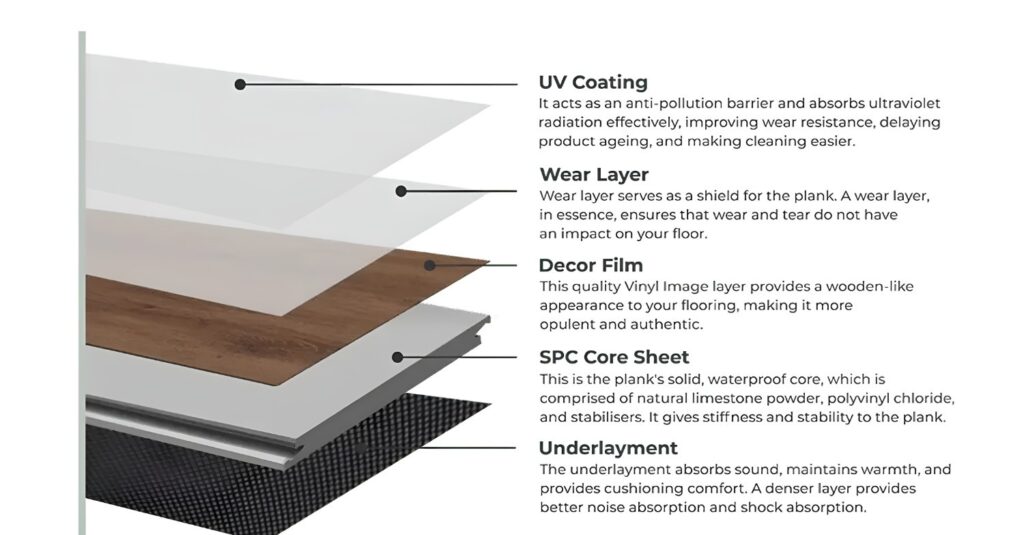
SPC stands for Stone Plastic Composite (also called stone polymer composite or rigid core vinyl). It’s a rigid-core flooring built from limestone powder and stabilizers, topped with a printed design layer and a wear-resistant coating, and finished with a click-lock edge that snaps together without glue or nails.
Five layers make up a typical SPC plank:
| Layer | What It Does |
|---|---|
| UV Coating | Blocks sun fading and adds surface shine |
| Wear Layer | Resists scratches, stains, and daily foot traffic |
| Decor Film | Prints the wood, stone, or tile pattern |
| SPC Core | Rigid limestone-composite base that gives waterproofing and structural stability |
| Underlayment | Adds cushioning, sound dampening, and extra moisture protection |
Because the core is stone-based rather than wood-based, SPC flooring doesn’t swell, warp, or rot when it gets wet, which matters a lot during Kathmandu Valley’s monsoon months. It also doesn’t attract termites, a problem that affects both solid wood and some laminate subfloors in Nepal.
Does Flooring Actually Affect Resale Value?
Yes, but not in the way most marketing implies. Flooring rarely adds value on its own the way a kitchen renovation or an added bathroom does. What it does is remove objections. Worn, outdated, or water-damaged flooring signals neglect to a buyer, and buyers price that risk into their offer, even if they never say so out loud.
Real estate data backs this up, though it’s worth being upfront that most published return-on-investment figures come from Western housing markets and there isn’t an equivalent formal study for Nepal’s resale market yet. The National Association of REALTORS 2022 Remodeling Impact Report found that new hardwood flooring recovers around 118% of its cost at resale in the US market, while rigid-core resilient flooring such as SPC and luxury vinyl plank typically recoups a smaller but still meaningful share, generally in the 50 to 70 percent range, according to industry ROI breakdowns from remodeling contractors.
The pattern that shows up across nearly every source is consistent even without hard Nepal-specific numbers:
- Fresh, consistent flooring photographs better and shows better in person, which shortens time on market.
- Damaged or dated flooring gives buyers a negotiating point, even in a hot market.
- Flooring type matters less than flooring condition. A clean, modern SPC floor will usually outperform a scuffed hardwood floor in buyer perception.
So the honest framing is: SPC flooring supports resale value by protecting the home’s first impression and removing red flags, not by adding a guaranteed dollar amount the way a new kitchen might.
How SPC Flooring Can Increase Your Home’s Value
1. It Survives Nepal’s Climate Without Warping
SPC flooring’s stone-based core doesn’t absorb moisture, so it holds its shape through Kathmandu’s humid summers and monsoon season, something wood and laminate floors struggle with.
Kathmandu Valley swings between damp, humid summers and cold, dry winters. Solid wood and even some laminate products expand and contract with that shift, which eventually leads to gaps, cupping, or peeling at the seams. A buyer touring a home during a home inspection will notice those defects, and an inspector will flag them. SPC flooring’s rigid limestone core stays dimensionally stable across that temperature and humidity range, so there’s less to worry about when a buyer’s engineer walks through with a flashlight.
2. It Removes a Buyer’s Water-Damage Worry
BLUF: Because SPC flooring is fully waterproof, it eliminates one of the most common deal-breakers buyers look for: water stains, swelling, or mold near kitchens, bathrooms, and entryways.
Water damage is one of the fastest ways to lose negotiating leverage as a seller. A buyer who sees a warped board near the kitchen sink starts wondering what else has been neglected. SPC flooring’s waterproof core means spills, leaks, and monsoon humidity don’t leave visible damage, so that objection simply doesn’t come up during a walkthrough.
3. It Signals a Modern, Move-In-Ready Home
BLUF: SPC flooring is available in realistic wood-look and stone-look finishes that match current buyer preferences, which helps a home feel updated without a full renovation.
Buyers consistently respond better to homes that feel finished and current. SPC’s printed decor layer replicates oak, walnut, or natural stone convincingly enough that most buyers won’t clock it as a budget material during a showing, unlike older sheet vinyl. That “does this feel move-in ready” impression is one of the biggest, if hardest to quantify, factors in how quickly a home sells and how close it gets to asking price.
4. It’s Termite-Proof, Which Matters in Nepal
BLUF: SPC flooring contains no organic wood material, so it can’t be damaged by termites, a real concern for wood and some laminate flooring in many parts of Nepal.
Termite damage is a common and costly problem for solid wood and wood-fiber laminate floors in Nepal’s climate. Because SPC’s core is stone and polymer rather than wood pulp, it removes that risk entirely. For a buyer comparing two similar homes, one with a documented termite history is a much harder sell, so avoiding that risk upfront protects value rather than adding it after the fact.
5. It Costs Less to Install Than Hardwood or Natural Stone
BLUF: SPC flooring delivers a comparable high-end look to hardwood or natural stone tiles at a fraction of the material and installation cost, which improves the return relative to what you spend.
Even if SPC recoups a smaller percentage of its cost than hardwood at resale, the math can still favor SPC because the upfront spend is so much lower. Spending less to get most of the visual and durability benefit means your net cost, not just your recoup percentage, ends up smaller. That’s a meaningfully different calculation than ROI percentage alone.
6. Low Maintenance Reduces a Buyer’s Future Cost Concerns
BLUF: SPC flooring only needs regular sweeping and occasional damp mopping, which reassures buyers who don’t want to inherit high-upkeep surfaces.
Buyers increasingly factor ongoing maintenance into their decision, not just the purchase price. A floor that needs periodic refinishing, sealing, or careful cleaning products adds a mental line item to a buyer’s future budget. SPC’s low-maintenance profile removes that consideration entirely, which quietly supports a smoother, faster sale.
Where SPC Flooring Won’t Increase Value
Honesty matters more than a sales pitch here. SPC flooring has real limits when it comes to resale value:
- It won’t outperform genuine hardwood in a luxury market. High-end buyers in premium neighborhoods often specifically want solid or engineered hardwood, and no amount of realistic printing fully replaces that expectation.
- It won’t fix a structurally troubled home. New flooring over a damp, unrepaired subfloor or a foundation issue doesn’t solve the underlying problem, and inspectors will still catch it.
- It underperforms in mismatched installs. SPC flooring installed inconsistently with the rest of the home (one room updated, the rest left dated) can actually highlight the contrast rather than help.
- Poor installation erases the benefit. Gaps, uneven transitions, or visible seams from a rushed installation undercut the “move-in ready” impression the material is supposed to create.
- There’s no guaranteed dollar figure. Nepal doesn’t yet have a formal, published resale-ROI study specific to SPC flooring, so any number promising an exact price increase should be treated with skepticism.
SPC Flooring vs. Other Flooring Types for Resale
| Feature | SPC Flooring | Hardwood | Laminate | Ceramic/Porcelain Tiles | Standard Vinyl (LVT) |
|---|---|---|---|---|---|
| Waterproof | 100% waterproof | Not waterproof | Partial, swells with moisture | Fully waterproof | Water-resistant |
| Termite resistance | Fully termite-proof | Vulnerable | Vulnerable (wood-fiber core) | Termite-proof | Termite-proof |
| Durability | High | High, but scratches/dents | Moderate | High, but can crack | Moderate |
| Buyer perception | Modern, move-in ready | Premium, top-tier | Budget-associated | Traditional, cold underfoot | Budget-associated |
| Installation | Easy click-lock, 1-2 days | Skilled labor, days to weeks | Moderate skill required | Skilled labor, slower | Easy glue-down |
| Comfort underfoot | Firm, slightly warmer than tile | Warm | Firm | Cold, hard | Soft |
| Typical cost in Nepal (NPR/sq. ft., installed) | 250 – 1,200 | 800 – 2,500+ | 200 – 600 | 600 – 2,500 | 200 – 500 |
| Best suited for resale in | Kitchens, bathrooms, whole-home consistency | Living rooms, premium listings | Dry bedrooms, budget refresh | Bathrooms, exteriors | Rentals, budget refresh |
For most Nepali homes preparing to sell, SPC flooring offers the strongest combination of durability, water resistance, and buyer appeal per rupee spent, though hardwood still wins in premium, high-budget listings.
Pros and Cons of SPC Flooring
Pros:
- 100% waterproof core, ideal for kitchens, bathrooms, and monsoon-prone areas
- Termite-proof, unlike wood and some laminate products
- Realistic wood-look and stone-look finishes
- Click-lock installation with no glue, often finished in a day or two
- Low, inexpensive maintenance
- More affordable than hardwood or natural stone with a similar visual impact
Cons:
- Feels harder underfoot than wood or WPC flooring
- Less heat insulation than carpet or engineered wood, so it can feel cold in winter without rugs
- Doesn’t carry the same premium cachet as solid hardwood in luxury listings
- Quality varies significantly between suppliers, so a cheap, thin plank can wear out faster and undercut the value benefit
- No refinishing option; a damaged plank has to be replaced, not sanded down
SPC Flooring Cost in Nepal vs. Expected Value Return
BLUF: SPC flooring in Kathmandu Valley typically runs NPR 250 to NPR 1,200 per square foot installed, depending on thickness and grade, with mid-range products offering the best balance of durability and cost for resale purposes.
| Grade | Price (NPR/sq. ft.) | Thickness | Core Type | Best For |
|---|---|---|---|---|
| Budget SPC | 250 | 5 mm | Recycled SPC core | Rental units, low-traffic rooms |
| Premium SPC | 700 – 1,200 | 7 mm | High-grade virgin SPC core | Whole-home renovations before sale, high-traffic areas |
Prices vary by vendor, plank thickness, and design; get a written quote before committing.
If you’re renovating specifically to sell, standard-grade SPC flooring usually makes the most financial sense. It has enough thickness and wear-layer quality to look and perform well during showings and the buyer’s post-sale ownership, without the added cost of premium-grade planks the eventual buyer may not fully value. Warranty coverage is worth checking too. Reputable installers in Nepal, including Manasukh Flooring, back 5 mm SPC flooring with a 25-year residential warranty and 7 mm flooring with a lifetime residential warranty against manufacturing defects and premature wear-layer failure, which is a detail worth passing along to a buyer as proof of quality.
Factors That Determine How Much Value You Get Back
The material itself is only one variable. Installation quality, design consistency, and how well the flooring matches your local market’s expectations all shape whether SPC flooring helps or barely registers with buyers.
- Installation quality. Tight seams, straight lines, and properly finished transitions between rooms create the polished impression that supports value. A rushed or DIY installation with visible gaps undercuts it.
- Design and color choice. Neutral, timeless finishes (light oak, warm grey stone) appeal to the widest range of buyers. Bold or trend-specific patterns can narrow your buyer pool.
- Whole-home consistency. A single upgraded room next to worn flooring elsewhere draws attention to the contrast instead of elevating the whole home.
- Thickness and wear-layer grade. Thin, budget-grade planks can show wear within a year or two, which undermines the durability story you’re trying to sell.
- Documentation. Keeping your invoice, warranty certificate, and product specification sheet gives your real estate agent something concrete to show serious buyers.
- Local market expectations. In premium neighborhoods where hardwood is the norm, SPC flooring may read as a downgrade even if it performs better functionally. Match the material to what buyers in your specific area expect.
How to Maximize Resale Value When Installing SPC Flooring
- Prioritize high-visibility, high-moisture rooms first. Kitchens, bathrooms, and entryways carry the most weight in a buyer’s first impression and benefit most from waterproofing.
- Choose a neutral, wood-look or stone-look finish rather than a bold pattern, to appeal to the broadest range of buyers.
- Use a mid-to-standard grade (5 mm) rather than the cheapest option. It holds up through the listing period and the buyer’s first years of ownership.
- Hire an experienced installer. Uneven seams and gaps are one of the fastest ways to make new flooring look like a shortcut rather than an upgrade.
- Keep the flooring consistent across connected living spaces. A unified floor plan reads as more spacious and better maintained than a patchwork of materials.
- Save your paperwork. Warranty documents and product spec sheets give buyers and their inspectors confidence in what they’re looking at.
- Pair it with basic touch-ups elsewhere. Fresh paint and clean baseboards next to new flooring compound the “well cared for” impression.
Common Mistakes That Waste the Investment
- Buying the cheapest SPC available. Thin, low-grade planks can dent or discolor within a year, which erases the durability argument entirely.
- Skipping subfloor prep. Installing over an uneven or damp subfloor can cause the click-lock seams to separate over time.
- Mixing too many flooring types across the home. It fragments the visual flow and can make the home feel smaller and less cohesive.
- Over-investing in ultra-premium SPC for a modest home. The extra cost rarely gets recovered if it’s out of step with the rest of the property’s value.
- Ignoring ventilation during installation. Rushed installs without letting planks acclimate to room temperature and humidity can lead to gaps later.
FAQ Section
1. Can SPC flooring increase my home’s resale value?
SPC flooring doesn’t guarantee a fixed price increase, but it improves buyer perception, removes water and wear-related objections, and helps a home show as move-in ready, all of which support a stronger sale price and faster time on market.
2. Is SPC flooring a good investment before selling a house in Nepal?
Yes, particularly if your current flooring is worn, damaged, or outdated. SPC flooring’s low cost relative to hardwood, combined with its waterproof and termite-proof properties, makes it a practical pre-sale upgrade for most Nepali homes.
2. Is SPC flooring a good investment before selling a house in Nepal?
Yes, particularly if your current flooring is worn, damaged, or outdated. SPC flooring’s low cost relative to hardwood, combined with its waterproof and termite-proof properties, makes it a practical pre-sale upgrade for most Nepali homes.
3. How much does SPC flooring cost per square foot in Kathmandu?
SPC flooring in Kathmandu Valley typically costs between NPR 250 and NPR 1,200 per square foot installed, depending on thickness, core quality, and design.
4. Is SPC flooring better than tiles for resale value?
SPC flooring is warmer underfoot, easier and faster to install, and often more budget-friendly than ceramic or porcelain tiles, while still being fully waterproof. Tiles remain a strong choice for exteriors and heavy-traffic commercial areas.
5. Does SPC flooring add more value than laminate flooring?
SPC flooring generally holds up better in resale terms because it’s fully waterproof and dimensionally stable, while laminate can swell or peel with moisture exposure, something buyers and inspectors notice.
6. Do buyers pay more for a home with SPC flooring?
There’s no fixed premium tied specifically to SPC flooring, but homes with fresh, damage-free flooring consistently show better and negotiate less than homes with worn or water-damaged floors.
7. Is SPC flooring worth it compared to hardwood for resale?
In premium, hardwood-driven markets, solid hardwood still carries more prestige. In most everyday Nepali homes, SPC flooring delivers a comparable look and better moisture performance at a fraction of the cost.
8. How long does SPC flooring last?
Quality SPC flooring typically lasts 15 to 25 years with normal use and basic maintenance, and thicker, premium-grade planks can last even longer.
9. Is SPC flooring 100% waterproof?
Yes. The stone-polymer composite core doesn’t absorb water, which makes it suitable for kitchens, bathrooms, and basements without risk of warping.
10. Is SPC flooring termite-proof?
Yes. Because it contains no organic wood material, SPC flooring can’t be damaged by termites, unlike solid wood and some wood-fiber laminate products.
11. What is SPC flooring made of?
SPC flooring is made from limestone powder combined with polymer stabilizers, forming a rigid core, topped with a printed decor layer, a wear-resistant coating, and often a cushioned underlayment.
12. Does SPC flooring look cheap to buyers?
Modern SPC flooring uses high-resolution printing to replicate real wood grain and stone texture convincingly, and most buyers won’t identify it as a budget material during a standard showing.
13. Is SPC flooring good for Nepal’s climate?
Yes. SPC flooring resists the humidity swings of Kathmandu Valley’s monsoon season and doesn’t warp or expand the way wood and laminate can in fluctuating temperatures.
14. What thickness of SPC flooring is best before selling a home?
A standard 5 mm SPC plank offers a good balance of durability and cost for most rooms. High-traffic areas or premium listings may benefit from 6 to 8 mm planks.
15. Does SPC flooring need special maintenance?
No. Regular sweeping and occasional damp mopping are enough. It doesn’t require sealing, waxing, or refinishing like hardwood does.
16. Can SPC flooring be installed over old tiles or concrete?
Yes, as long as the existing surface is level and structurally sound. SPC’s click-lock system floats over most existing subfloors without adhesive.
17. Does SPC flooring crack or dent easily?
No. SPC flooring is highly resistant to cracking and denting under normal residential use. Extreme impacts or improper installation can still cause damage.
18. Is SPC flooring slippery?
Most SPC flooring includes a textured, anti-slip surface, making it safe for homes with children, elderly residents, or pets, though it can be slicker when wet like most hard flooring.
19. Will SPC flooring pass a home inspection more easily than wood flooring?
Generally yes, because it’s less prone to the moisture damage, warping, and pest issues that commonly show up as flagged items on wood flooring during inspections.
20. What rooms benefit most from SPC flooring before a sale?
Kitchens, bathrooms, entryways, and basements benefit most, since these are the areas most prone to moisture damage and the most scrutinized by buyers.
21. Should I install SPC flooring throughout the whole house or just key rooms?
Whole-home consistency generally creates a stronger impression of care and cohesion, but budget-limited sellers can prioritize high-visibility and high-moisture rooms first.
22. Is cheap SPC flooring a bad idea before selling?
Very low-grade SPC flooring can wear, dent, or discolor quickly, which can undercut the durability story you’re trying to present to buyers. Mid-range, standard-grade flooring is usually the better trade-off.
23. Does SPC flooring come with a warranty in Nepal?
Reputable suppliers, including Manasukh Flooring, typically back 5 mm SPC flooring with a 25-year residential warranty and 7 mm flooring with a lifetime residential warranty against manufacturing defects.
24. How is SPC flooring different from WPC flooring?
SPC flooring has a more rigid, stone-based core, making it firmer and more impact-resistant, while WPC flooring has a wood-plastic composite core that feels softer and slightly warmer underfoot.
25. Can SPC flooring be used with underfloor heating?
Many SPC products are compatible with radiant underfloor heating systems, but this should always be confirmed with the specific product’s technical specification before installation.
26. Is SPC flooring eco-friendly?
SPC flooring is generally formaldehyde-free and doesn’t rely on cutting timber, and many manufacturers use recycled material in the core, though eco-credentials vary by supplier and should be verified with product certifications.
27. How long does SPC flooring installation take?
Because it uses a click-lock system without glue or nails, a standard room can typically be installed in a single day, and most homes are completed within one to three days depending on size.
28. Does new SPC flooring help a home sell faster?
Fresh, damage-free flooring generally helps homes show better in person and in listing photos, which can shorten time on market, though speed of sale also depends on pricing, location, and overall market conditions.
29. Is SPC flooring a smart choice for rental or investment properties in Nepal?
Yes. Its durability, waterproofing, and low maintenance make it well suited for rental units, where tenant wear and tear and moisture exposure are common concerns for owners.
30. What should I check before choosing an SPC flooring supplier before selling my home?
Compare wear-layer thickness, core quality (virgin vs. recycled), warranty terms, and installation experience. A written quote and product specification sheet help you compare suppliers fairly.
Thinking about upgrading your flooring before you list your home? Manasukh Flooring installs premium SPC flooring across Kathmandu, Lalitpur, and Bhaktapur, backed by a 25-year residential warranty on 5 mm planks and a lifetime residential warranty on 7 mm planks. Get a free, no-obligation estimate and find out what standard-grade SPC flooring would cost for your home before you renovate or sell.