
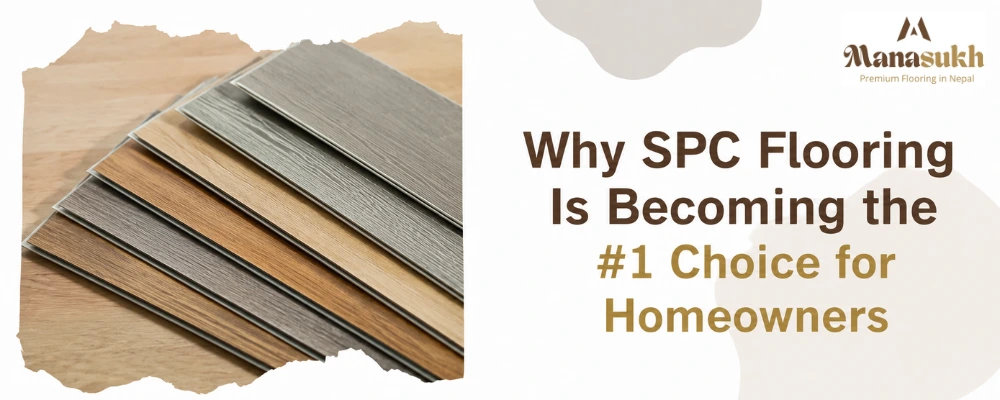
Short answer: SPC (Stone Plastic Composite) flooring is fast becoming Nepal’s go-to flooring choice because it is 100% waterproof, termite-proof, handles Kathmandu Valley’s humid monsoons and hill-region temperature swings without warping, needs almost no maintenance, and can be laid over your old tile floor in a single day. Depending on brand and thickness, warranties range from 10 years to a lifetime. In Nepal, a good quality 5mm SPC floor with labour typically costs around NPR 250 per sq. ft., while a thicker, tougher 7mm SPC floor with labour runs around NPR 500 per sq. ft. a price bracket that’s now competing directly with tile and laminate across Kathmandu, Lalitpur, Bhaktapur, Pokhara, and beyond.
If you’ve ever seen a wooden floor swell and lift after a monsoon leak, or spent a weekend scrubbing tile grout in a Kathmandu apartment, you already understand why SPC flooring exists. This guide breaks down exactly why it’s taking over homes, offices, clinics, and shops across Nepal with real pricing, real warranty terms, and honest advice on what to expect.
What Is SPC Flooring, Exactly?
SPC stands for Stone Plastic Composite (also called Stone Polymer Composite). It’s a rigid-core flooring plank made by combining limestone powder (calcium carbonate), PVC resin, and stabilizers into a dense core, then finishing it with a printed design layer and a protective wear layer on top.
A typical SPC plank has four layers:
- Wear layer (UV-coated, usually 0.3mm–0.7mm) — protects against scratches, stains, and fading
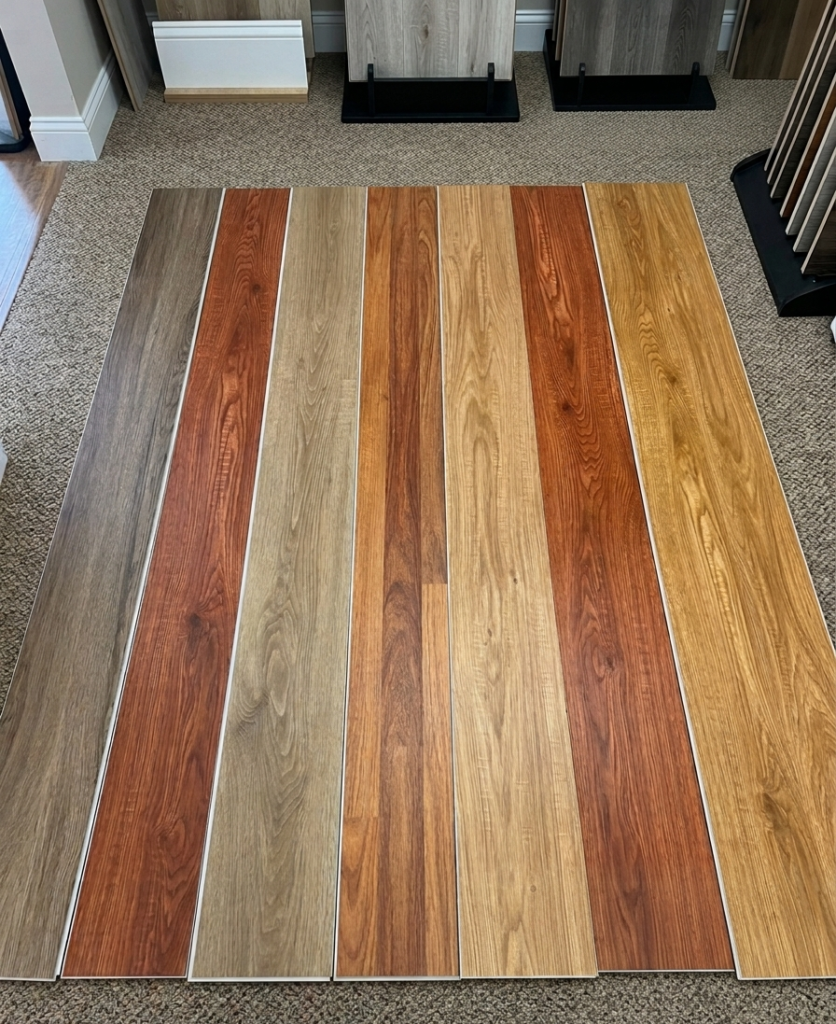
- Design/print layer — the wood, marble, or stone pattern you see, from warm saal-wood tones to cool marble finishes
- SPC rigid core — the limestone-PVC layer that gives the plank its strength and waterproofing
- Underlayment/backing — often foam, IXPE, or cork, added for comfort and sound absorption
This rigid core is what separates SPC from ordinary vinyl or PVC sheet flooring. It barely expands or contracts with temperature change, so the floor stays flat and tight-fitting for years a real advantage in a country where a single household might experience Terai heat, hill-region humidity, or mountain-region cold depending on the region.
Why SPC Flooring Is Becoming the #1 Choice for Nepali Homeowners
1. It’s Built for Nepal’s Monsoon and Humidity
This is the single biggest reason SPC is winning over Nepali homeowners. Unlike solid wood or laminate, which swell and warp the moment moisture gets into the core, SPC’s limestone-PVC core doesn’t absorb water at all. During monsoon season, when humidity spikes and leaks or splashes are common in kitchens, bathrooms, and entryways, SPC simply doesn’t care it won’t buckle, swell, or grow mold at the seams the way wood-based flooring does.
For homes in the Kathmandu Valley that deal with humid summers and chilly winters in the same year, this stability matters. SPC also handles temperature swings across Nepal’s varied geography Terai heat, hill-region humidity, and mountain-region cold — without the gaps or buckling you’d expect from natural wood.
2. It’s Termite-Proof: A Real Concern in Much of Nepal
Termites are a genuine, ongoing problem for wooden flooring and furniture across many parts of Nepal, especially in the Terai and warmer hill districts. Because SPC’s core is limestone and PVC rather than organic wood fiber, termites simply have nothing to eat. This alone has pushed a lot of homeowners who once wanted a “wood floor look” to choose SPC instead they get the appearance of saal or teak without the years-long termite risk.
3. It Survives Real Daily Wear and Tear
SPC’s protective wear layer is typically rated using the same hardness scale as laminate flooring — good commercial-grade SPC carries a 7H pencil hardness rating, meaning it resists scratches from keys, pet claws, dragged chairs, and daily foot traffic far better than painted wood, basic vinyl, or PVC sheet flooring.
Commercial case studies back this up: restaurant chains that installed thicker, commercial-grade SPC (around 20–22 mil wear layer) reported that after seven years of constant foot traffic, spills, and heavy cleaning, the floors showed no visible scratching and kept their original finish. For a Nepali household, that same wear layer easily shrugs off pet claws, dragged furniture, and kids’ toy cars for well over a decade.
4. The Warranty Is a Genuine Game-Changer
This is where SPC pulls far ahead of the flooring options traditionally sold in Nepal. Tile rarely comes with any real “wear” warranty, PVC sheet flooring is typically sold with no warranty at all, and laminate flooring warranties are usually short. SPC breaks that pattern.
Here’s what’s realistically available in the market today (terms vary by brand, so always get it in writing):
| Warranty Type | Typical Range Offered |
|---|---|
| Residential (light/normal use) | 10–30 years, with some premium ranges offering lifetime or 50-year limited coverage |
| Light commercial use | 5–15 years |
| Structural/manufacturing defects | Lifetime (residential), 5 years (commercial) |
| Installation labour warranty | 1 year (from most professional installers) |
Several established international manufacturers now offer a 25-year limited residential warranty as their standard tier, noticeably longer than the typical 7–15 year warranty on laminate, or the effectively-zero wear warranty you get on standard PVC/vinyl sheet flooring. Premium residential lines go further still, with some brands advertising 30-year or even lifetime coverage against wear-through, staining, and fading.
Keep in mind: warranty coverage is always conditional. Manufacturers typically exclude damage from improper installation, unprotected furniture legs, standing water left un-mopped, and harsh cleaning chemicals. Always ask your Nepali supplier for the written warranty document not just a verbal assurance before you pay.
5. It Installs Fast, With Minimal Mess
SPC uses a click-lock (floating floor) system planks snap together without glue or nails in most residential jobs. If your existing tile or concrete floor is flat and structurally sound, installers can float SPC directly on top of it, skipping demolition entirely.
For renovations in occupied Kathmandu apartments, or shopkeepers who can’t afford a week of downtime, this is a major practical advantage. A typical installation sequence looks like this:
- Site inspection — checking subfloor flatness and moisture
- Subfloor prep — securing loose tiles, filling gaps, adding a moisture barrier if needed
- Acclimatization — planks rest flat in the room for 24–48 hours to adjust to local temperature and humidity
- Underlayment placement — foam or cork, if not pre-attached to the planks
- Click-lock installation — planks locked edge to edge, starting from the straightest wall, staggering joints for stability
- Expansion gap — a 6–10mm gap left along the walls, later hidden by skirting
- Final inspection — checking for gaps, lifted edges, or uneven planks before handover
Most crews can finish an average room in a single day a real advantage over tile, which needs days for adhesive and grout to cure properly.
6. Maintenance Is Almost Nothing
There’s no polishing, sealing, waxing, or re-coating required ever. The full maintenance routine is genuinely this simple:
- Daily: sweep or vacuum with a soft brush attachment (avoid a beater bar, which can scratch the surface)
- Weekly: damp-mop with a mild, pH-neutral cleaner
- As needed: wipe spills within the day, use felt pads under furniture legs, and skip steel wool or wax-based polish entirely
That’s it the entire care routine for a floor expected to look presentable for 15–25+ years.
7. It’s More Comfortable and Quieter Than Tile
Because SPC planks usually come with an attached foam, IXPE, or cork underlayment, they absorb impact sound far better than bare tile laid straight onto concrete a genuine benefit in Kathmandu’s apartment buildings, where sound travels easily between floors. SPC also feels noticeably less cold underfoot during Nepal’s chilly winters compared to plain ceramic tile, which is one of the most common reasons homeowners give for switching once they’ve tried it.
8. Pricing Is Now Genuinely Competitive in the Nepali Market
SPC sits in a useful middle ground: pricier than basic PVC sheet flooring, but far cheaper than natural stone, marble, or solid hardwood, while lasting considerably longer than most of the budget options.
Typical Nepal market pricing (material + labour):
| SPC Thickness | Price (Material + Labour) | Best Suited For |
|---|---|---|
| 5mm | NPR 250 per sq. ft. | Bedrooms, living rooms, low-to-medium traffic residential spaces |
| 7mm | NPR 500 per sq. ft. | High-traffic homes, offices, shops, clinics, commercial spaces |
These figures line up with the broader Nepal market, where total installed SPC costs generally fall somewhere between roughly NPR 200 and NPR 800 per sq. ft. depending on brand, wear layer thickness, and design, with premium imported ranges going even higher. Prices in Kathmandu, Lalitpur, and Pokhara tend to run slightly higher than smaller towns because of import and transport costs, since most SPC sold in Nepal is imported.
The jump from 5mm to 7mm roughly doubles the cost, but you’re paying for a thicker rigid core (better dent and impact resistance), often a thicker wear layer, and frequently an upgraded warranty tier. For a rented flat you’ll leave in a couple of years, 5mm is usually the smarter spend. For a family home you’re building to last, or a shop with constant foot traffic, the 7mm option pays for itself in durability.
(Prices vary by supplier, city, brand, and plank design always get a written, itemized quote covering both material and installation before booking.)
SPC Flooring vs. Other Flooring Options Common in Nepal
| Feature | SPC Flooring | PVC/Vinyl Sheet | HDF Laminate | Ceramic Tile | Solid Wood |
|---|---|---|---|---|---|
| Waterproof | Yes, 100% | Mostly, but thinner core | No—weakx in wet areas | Yes | No |
| Termite-proof | Yes | Yes | No | Yes | No |
| Warranty (typical) | 10–30 yrs (up to lifetime on premium lines) | Rarely offered | Short, if any | Rarely a wear warranty | Varies, needs upkeep |
| Installation time | Fast (float-over possible) | Fast | Fast | Slow (curing needed) | Slow |
| Feels warm underfoot | Yes | Somewhat | Yes | No, cold | Yes |
| Scratch resistance | High (7H rating common) | Low–Moderate | Moderate | High, but grout stains | Low–Moderate |
| Maintenance | Very low | Low | Moderate | Moderate (grout cleaning) | High |
| Typical Nepal price (installed) | NPR 250–550/sq.ft | NPR 140–350/sq.ft | NPR 230–500/sq.ft | NPR 160–500/sq.ft | NPR 300–1,200+/sq.ft |
Why SPC Is Growing Fast Across Nepal Right Now
This isn’t just a sales pitch the trend is visible on the ground and backed by the wider regional market picture:
- SPC flooring is a relatively new category in Nepal but is described by suppliers across Kathmandu, Pokhara, and Biratnagar as one of the fastest-growing segments in the local building materials market, driven by renovation demand and rising awareness of its waterproof, termite-proof qualities.
- Across the wider South Asian region, the broader stone-plastic-composite flooring category has been growing at double-digit annual rates in recent years, with residential renovation not new construction as the single biggest driver of demand.
- In Nepal specifically, SPC is now sold through building material suppliers, dedicated flooring showrooms, and online marketplaces like Daraz and HamroBazar, reflecting how mainstream the product has become in just a few years.
- Suppliers report that homeowners increasingly compare SPC directly against HDF laminate and tile before choosing a sign that SPC has moved from a niche import to a default option people actively consider during renovation.
In plain terms: SPC isn’t a passing trend in Nepal. It’s steadily replacing laminate and, in many renovation projects, competing directly with tile as the default flooring recommendation.
How to Choose Between 5mm and 7mm SPC Flooring
Ask yourself three quick questions:
How much foot traffic will the floor see? Bedrooms and guest rooms rarely need more than 5mm. Living rooms, kitchens, hallways, and commercial spaces benefit from 7mm’s added impact resistance.
Are you renting or building for the long term? Rented flats or short-stay properties in Kathmandu rarely justify the extra cost of 7mm. If you own the home and plan to stay for a decade or more, the thicker option earns back its cost in reduced wear.
Is this a home or a commercial space? Offices, clinics, showrooms, and shops in busy areas like New Road, Durbar Marg, or Pokhara’s Lakeside should default to 7mm (or a thicker commercial-grade SPC) because of constant footfall and rolling chairs or carts.
Common Myths About SPC Flooring in Nepal: Debunked
“It’s the same as PVC sheet flooring.” Not quite. The rigid limestone-PVC core is what gives SPC its dimensional stability and impact resistance. Standard PVC or vinyl sheet flooring lacks this rigid core, so it flexes, dents more easily, and shows every bump in the subfloor beneath it.
“Tile lasts longer, so it’s the safer bet.” Tile itself can last decades, but grout lines crack, stain, and discolor far sooner than a quality SPC wear layer wears through especially with 20–30 year warranties now common on branded SPC ranges.
“You can’t install SPC over old flooring.” In most cases you can float SPC directly over existing tile or a level concrete floor, as long as the surface is flat and sound. This “float-over” approach is common practice in Nepal and cuts both cost and installation time significantly.
“All SPC sold in Nepal is the same quality.” Far from it. Wear layer thickness, core density, and warranty terms vary a lot between brands like Gerflor, Inovar, Dura, Mannington, and various locally distributed options always ask for the technical specification sheet, not just the per-square-foot price.
Frequently Asked Questions
Is SPC flooring good for Kathmandu’s monsoon and humidity?
Yes. Its waterproof, non-porous core handles monsoon humidity and occasional splashes far better than solid or laminate wood flooring, which can swell and warp under the same conditions.
Can SPC flooring be installed in bathrooms and kitchens?
Yes — SPC is one of the few plank-style flooring types genuinely rated as fully waterproof, making it suitable for bathrooms, kitchens, and entryways, provided seams and edges are properly sealed during installation.
How long does SPC flooring actually last in Nepal?
With proper installation and normal residential use, a good quality SPC floor commonly lasts 15–25 years, and premium ranges with extended warranties are built to perform well beyond that.
Is SPC flooring termite-proof?
Yes. Because the core is limestone and PVC rather than organic wood fiber, termites have nothing to feed on a real advantage over solid wood flooring in Nepal’s warmer regions.
Is 5mm or 7mm SPC better for a Kathmandu apartment living room?
For a busy family living room, 7mm is the safer choice thanks to its higher impact and dent resistance. 5mm works well for lower-traffic bedrooms.
What voids an SPC flooring warranty?
Common exclusions include improper installation, standing water left unattended, dragging furniture without protective pads, and using abrasive or wax-based cleaners not approved by the manufacturer. Always keep your purchase invoice you’ll need it for any warranty claim.
The Bottom Line
SPC flooring is becoming Nepal’s #1 flooring choice because it solves the exact problems Nepali homeowners have dealt with for years monsoon moisture damage, termite risk, high maintenance, and slow, messy tile installation while staying genuinely affordable. With warranties now regularly reaching 25 years or more on quality residential ranges; growing availability across Kathmandu, Pokhara, Lalitpur, and beyond, and pricing starting around NPR 250 per sq. ft. for 5 mm and NPR 500 per sq. ft. for 7mm (material + labour), it’s easy to see why more Nepali households and businesses are choosing it over tile, laminate, and traditional PVC sheet flooring.
Before you buy, always ask your supplier for the written warranty document, confirm the wear layer thickness, and get a detailed quote that separates material and labour costs that’s the difference between a floor that performs beautifully for 20+ years and one that disappoints within a few monsoons.