
1. Introduction
Your kitchen and bathroom floors take a beating every single day. Think about it: dishwasher leaks, steamy showers, splashing children, cooking spills, wet feet rushing across the tiles. Over time, those floors that seemed stylish and sturdy start to swell, crack, grow mold, or turn dangerously slippery. Sound familiar?
Nepal’s homes face an even greater challenge. Kathmandu’s humid summers, the relentless monsoon rains between June and September, and temperature swings from cold mountain mornings to warm afternoons mean that ordinary flooring materials simply give up far too soon. Laminate buckles. Hardwood warps. Poorly sealed tiles let moisture creep underneath, breeding mold and loosening grout.
This is where SPC flooring, Stone Plastic Composite, steps in as a game-changer. With a 100% waterproof rigid core, realistic designs that mimic real wood and marble, and a price point far below solid hardwood, SPC is rapidly becoming the most popular flooring choice for kitchens and bathrooms across Nepal.
So can one flooring type handle water, heavy traffic, and still look luxurious?
Read on—the answer might surprise you.
2. What Is SPC Flooring?
SPC stands for Stone Plastic Composite (also called Stone Polymer Composite). It is a next-generation rigid core vinyl flooring that was engineered specifically to overcome the greatest weaknesses of traditional flooring: water damage and instability.
Unlike wood-based products that can absorb moisture or ceramic tiles that crack and have difficult-to-clean grout lines, SPC flooring is built around a dense core of limestone powder (calcium carbonate), PVC resin, and stabilizing additives. The result is a plank that is harder than most vinyl, dimensionally stable in both heat and cold, and completely impervious to water.
The Four Layers of SPC Flooring
1. Wear Layer: The clear protective top coat. Typically 0.3mm to 0.5mm thick (12–20 mil), it guards against scratches, scuffs, stains, and UV fading. Premium wear layers extend floor life significantly in high-traffic kitchens.
2. Vinyl Design Layer: A high-definition printed film that gives SPC its realistic wood-grain, marble, or stone appearance. Modern digital printing technology makes it almost indistinguishable from the real thing.
3. SPC Rigid Core: The heart of the plank a dense limestone-PVC composite that provides structural rigidity, prevents warping, and forms a complete waterproof barrier. This is what sets SPC apart from flexible vinyl or laminate.
4. Underlayment (Attached): Many premium SPC products include a pre-attached IXPE or cork foam backing that provides sound insulation, slight underfoot comfort, and helps bridge minor subfloor imperfections.
SPC vs Traditional Vinyl
Traditional sheet vinyl or LVT (Luxury Vinyl Tile) has a flexible core that can dent under heavy furniture and shift slightly underfoot. SPC’s rigid stone core eliminates both problems. It is dimensionally stable across temperature swings, a critical advantage in Nepal’s varied climate, and carries significantly higher load-bearing capacity.
3. Why Waterproof Flooring Matters in Kitchens and Bathrooms
Kitchens and bathrooms are, by definition, the wettest rooms in any home. Understanding the specific water challenges in each space helps explain why material selection is so critical.
Daily Water Exposure in Kitchens
The average kitchen floor faces multiple moisture events every single day. A dripping dishwasher door, a pot boiling over, a sink full of soapy water, and the constant humidity from cooking steam all combine to create a persistently damp environment. Non-waterproof floors in this setting absorb moisture at the edges and seams, eventually leading to the following:
- Swelling and buckling of laminate or engineered wood planks
- Mold and bacteria growth under flooring, causing health hazards and bad odour
- Tile grout discolouring and cracking, allowing water to seep underneath
- Expensive floor replacement within 5–10 years
Humidity and Steam in Bathrooms
Bathrooms present a different but equally serious challenge. Steam from hot showers raises ambient humidity to near-saturation levels repeatedly throughout the day. This repeated moisture cycling causes wooden floors to swell and contract, eventually cracking and splitting. Unsealed grout becomes a breeding ground for black mold.
Real-Life Scenarios Where Waterproofing Counts
- Dishwasher seal fails; overnight a non-waterproof floor soaks up water and swells by morning
- Toddler splashes bath water onto the floor; daily moisture seeps under tiles, loosening adhesive
- Wet feet from the shower walk across bathroom floor dozens of times a day
- Oil spill during cooking — staining on porous tiles or laminate that cannot be reversed
In each of these scenarios, SPC flooring simply does not react. Its sealed, rigid core stops water before it penetrates full stop.
Slip Resistance: A Safety Priority
Wet floors kill. Falls in bathrooms and kitchens are among the most common household accidents, especially for children and elderly family members. While many floor types become dangerously slippery when wet, quality SPC flooring features embossed, textured wear layers engineered to maintain grip even with standing water. Look for an R10 or higher slip-resistance rating when selecting SPC for these rooms.
4. Benefits of Waterproof SPC Flooring for Kitchens and Bathrooms
100% Waterproof Performance
The most important distinction to understand: SPC flooring is waterproof, not merely water-resistant. Water-resistant flooring can tolerate brief spills if wiped quickly. Waterproof flooring with a solid SPC rigid core will not absorb or be damaged by standing water, even if left for hours. The core does not swell, warp, or delaminate. You can install it in wet-room bathrooms, and it will not be harmed. We give the guarantee of 25 years of the material.
Scratch and Dent Resistance
Kitchens are high-traffic zones. Heavy appliances like refrigerators and washing machines, dragged chairs, dropped cutlery, and pet claws all test a floor’s durability daily. SPC’s rigid limestone core and scratch-resistant wear layer handle these challenges with ease. A 20-mil (0.5mm) wear layer provides excellent protection against everyday kitchen use, making SPC ideal where hardwood or laminate would scratch and dent quickly.
Easy Cleaning and Maintenance
In the kitchen and bathroom, hygiene is non-negotiable. SPC flooring’s sealed, non-porous surface means that bacteria, cooking grease, soap residue, and stains cannot penetrate beneath the surface. Cleaning is as simple as the following:
- Daily: Dry sweep or vacuum to remove dust and debris
- Weekly: Damp mop with a neutral pH cleaner or mild soapy water
- Spills: Wipe immediately with a cloth — no staining, no absorption
Unlike tile grout, there are no porous lines to scrub. Unlike hardwood, no sealing or polishing is ever required.
Slip Resistance and Safety
Premium SPC flooring products carry a slip-resistance rating of R10 or higher, which is specifically recommended for bathrooms and kitchens. The embossed wood-grain or stone textures on the wear layer provide tactile grip underfoot, significantly reducing the risk of slipping on a wet floor, a major safety advantage over polished ceramic tiles, which can be extremely slippery when wet.
Stylish Designs and Realistic Finishes
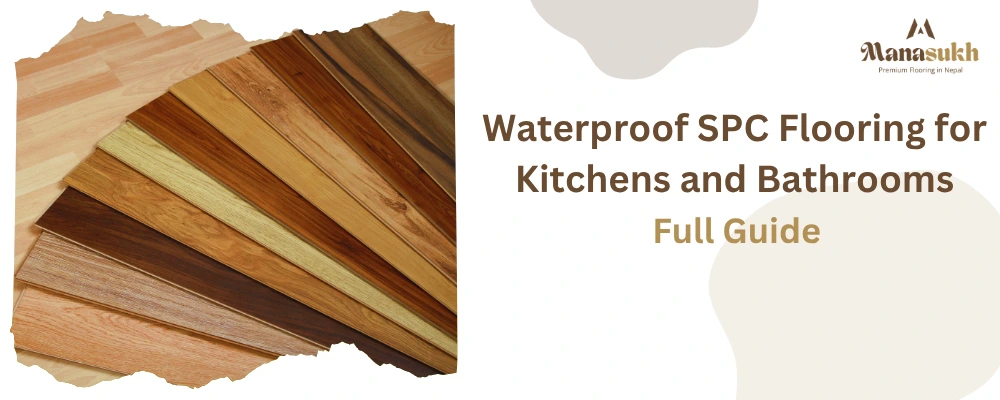
One of the biggest misconceptions about waterproof flooring is that functionality must come at the cost of beauty. Modern SPC flooring demolishes that myth entirely. High-definition digital printing technology allows SPC manufacturers to replicate the following:
- Natural wood grains light oak, walnut, saal wood, teak, and more
- Marble and travertine looks white Carrara, dark emperador, beige travertine
- Stone and slate textures ideal for bathroom floors
- Concrete and industrial finishes trending in modern Kathmandu apartments
The embossed texture matches the printed design, creating a surface that not only looks but also feels like real wood or stone underfoot.
Comfort Underfoot
Ceramic and porcelain tiles are notoriously hard and cold uncomfortable to stand on for extended cooking sessions and unpleasant to step on with bare feet on a cold Kathmandu morning. SPC flooring, especially with an attached IXPE underlayment, provides a softer, warmer feel underfoot while still being firm enough for heavy furniture. It is also compatible with underfloor heating systems, making it an excellent choice for Nepal’s colder months.
5. SPC Flooring vs Other Flooring Options
Not all flooring is created equal. Here is a comprehensive side-by-side comparison to help you make an informed decision:
| Feature | SPC | Ceramic Tile | Laminate | Hardwood | WPC | LVT/LVP |
| Waterproof | ✅ 100% | ✅ Yes | ✅Yes | ❌ No | ✅ Yes | ✅ Yes |
| Slip Resistance | ✅ High | ⚠️ Medium | ⚠️ Medium | ⚠️ Medium | ✅ High | ✅ High |
| Durability | ✅ Excellent | ✅ Good | ⚠️ Medium | ✅ Good | ⚠️ Medium | ⚠️ Medium |
| Comfort | ✅ Comfortable | ❌ Hard | ✅ Soft | ✅ Warm | ✅ Softest | ✅ Comfortable |
| Maintenance | ✅ Easy | ⚠️ Grout | ⚠️ Medium | ❌ High | ✅ Easy | ✅ Easy |
| Installation | ✅ Click-lock | ❌ Complex | ✅ Click | ❌ Nailing | ✅ Click | ✅ Click |
| Cost (NPR/sqft) | 250–700 | 300–900 | 200–500 | 800–2000+ | 350–800 | 200–600 |
Key takeaway: SPC flooring is the only option that is simultaneously 100% waterproof, highly durable, slip-resistant, easy to install, and available at a mid-range price point in Nepal. It outperforms ceramic tile in comfort and installation ease and outperforms laminate and hardwood in all moisture-related metrics.
6. Is SPC Flooring Good for Nepal’s Climate?
Nepal’s climate is uniquely demanding for flooring materials. From the humid subtropical heat of the Terai to the temperate monsoon climate of Kathmandu Valley and the cold dry winters of high-altitude regions, flooring needs to perform across a wide range of conditions.
Monsoon Season: The Ultimate Flooring Test
From June to September, Nepal receives some of the highest rainfall in Asia. Indoor humidity soars, damp footprints track into every room, and flood-prone basements and ground-floor spaces face direct water contact. This is where non-waterproof flooring materials suffer most: laminate swells at the joints, hardwood warps and cups, and poorly sealed grout lets water seep beneath tiles.
SPC flooring does not react to any of these conditions. Its 100% waterproof core will not swell, warp, or delaminate regardless of humidity levels or accidental flooding. Nepal-based flooring experts consistently recommend SPC as the top choice for monsoon-season resilience.
Temperature Stability in Kathmandu
Kathmandu’s temperatures range from around 2°C in January to 30°C in June and July. Many flooring materials expand and contract significantly across this temperature range, creating unsightly gaps, buckling, or noise. SPC flooring’s rigid stone-plastic composite core has excellent dimensional stability — it expands and contracts far less than wood-based products, maintaining a flat, gap-free surface year-round.
Why SPC Thrives in Nepali Homes
- 100% waterproof — perfect for monsoon moisture and humidity
- Thermally stable — handles Kathmandu’s cold winters and warm summers without buckling
- Low maintenance — no waxing, sealing, or special cleaning products required
- Locally available in Kathmandu, Pokhara, Lalitpur, and Biratnagar from reputable suppliers
SPC flooring in Nepal is priced between NPR 200 and NPR 800 per square foot for standard residential grades, with premium options going up to NPR 1,200 per square foot — making it competitive with mid-range tile and far more affordable than hardwood.
7. SPC Flooring Installation for Kitchens and Bathrooms
One of SPC flooring’s greatest practical advantages is its installation simplicity. The click-lock floating system makes it one of the fastest and cleanest flooring installations available.
The Click-Lock System Explained
SPC planks feature precision-engineered tongue-and-groove edges that click together firmly without adhesive or nails. The floor “floats” above the subfloor, held in place by the interlocking planks and perimeter expansion gap. This method:
- Reduces installation time significantly compared to tiling
- Requires no chemical adhesives or their associated fumes and drying time
- Allows the floor to be removed and reinstalled without damage if needed
- Delivers a professional-quality result even for experienced DIY installers
Can SPC Be Installed Over Existing Tiles?
Yes, this is one of SPC flooring’s most practical advantages. In Nepal, many homes have existing ceramic or stone tile floors. SPC click-lock planks can be installed directly over existing tiles, provided the tiles are level, firmly adhered, and free of major height variations. This eliminates costly and messy tile removal—saving both time and money on renovation projects.
Subfloor Preparation
- Ensure the subfloor is flat — maximum 3mm variation per 1.8m span
- Fill low spots with floor-levelling compound; sand down high spots
- Ensure the subfloor is clean, dry, and free of oil or wax
- For concrete subfloors with high moisture, install a moisture barrier first
- Acclimate SPC planks in the room for 24–48 hours before installation
Expansion Gaps
Always leave a 6–10mm expansion gap around the perimeter of the room, around door frames, and at any fixed obstacles. This gap is essential even though SPC expands far less than wood—it compensates for minor building movement. Cover the gap with matching skirting boards or T-molding transitions.
Common Installation Mistakes to Avoid
- Skipping subfloor leveling—even small humps cause planks to flex and eventually click joints to fail
- Forgetting expansion gaps — planks may buckle if locked tightly against walls
- Installing over a wet or freshly laid concrete subfloor—moisture vapour from new concrete can cause problems even with waterproof planks
- Mixing paint batches—always check batch numbers for colour consistency
8. Maintenance Tips for Waterproof SPC Flooring
One of SPC flooring’s most appreciated qualities is its near-effortless upkeep. Here is a complete maintenance guide to keep your kitchen and bathroom SPC floors looking new for decades:
Daily Cleaning
- Dry sweep or vacuum to remove dust, grit, and debris (use a soft-bristle attachment)
- Wipe up spills immediately—though SPC is waterproof, prompt clean-up prevents residue buildup
- Use a damp microfibre mop for quick cleanups after cooking or bathing
Weekly Cleaning
- Damp mop with a neutral-pH floor cleaner diluted in warm water
- Wring the mop thoroughly—excess standing water on joints, while harmless to SPC itself, should still be avoided for general hygiene
- Rinse with clean water if using any soap-based cleaner
What to Avoid
- Steam mops — the high heat can damage the wear layer over time
- Abrasive scrubbing pads or steel wool — will scratch the wear layer
- Harsh chemical cleaners, bleach, or ammonia-based products
- Wax or polish—SPC has a factory finish that does not require or benefit from waxing
- Oil-based soaps—can leave a residue that dulls the finish
Preventing Scratches
- Place felt pads or rubber cups under all furniture legs
- Use a mat at kitchen entry points to trap grit and sand
- Trim pet nails regularly
- Use a proper floor protector mat under rolling office chairs
Long-Term Maintenance
Unlike hardwood, SPC flooring never needs sanding, sealing, staining, or polishing. With basic daily and weekly care, a quality SPC floor with a 0.5mm wear layer can maintain its original appearance for 20–25 years in residential use. The only occasional maintenance required is wiping down and re-securing any transition strips at doorways.
9. Common Myths About SPC Flooring
Myth 1: “SPC Flooring Feels Cheap”
Modern SPC flooring especially with an attached underlayment has a solid, substantial feel underfoot that is nothing like the thin, hollow-sounding vinyl of 20 years ago. The rigid core gives it a firmness comparable to hardwood, and the embossed surface textures make it feel authentically natural. Visit any showroom in Kathmandu and walk on a quality SPC plank before judging.
Myth 2: “SPC Is Slippery When Wet”
This is the opposite of the truth. Quality SPC flooring is specifically engineered with textured, embossed wear layers to provide grip on wet surfaces. Ceramic tiles which many assume to be the safe option — are far more slippery when wet unless they carry a specific anti-slip rating. SPC with R10 rating is safer than most standard bathroom tiles.
Myth 3: “SPC Is Only for Commercial Use”
While SPC’s durability makes it an excellent commercial flooring choice, it is equally well-suited for residential applications. The click-lock installation system, realistic residential-oriented designs, and variety of thickness options make it ideal for homes particularly kitchens, bathrooms, and living areas in Nepal.
Myth 4: “SPC Fades Quickly”
Low-quality SPC can fade over time in direct sunlight, but premium SPC with UV-resistant wear layer coatings maintains its colour for decades. Look for products that specify UV protection in their product data sheets. As a practical note, most bathrooms and kitchens in Nepal receive indirect light, making fading even less of a concern.
10. How to Choose the Best SPC Flooring for Kitchens and Bathrooms
With dozens of brands and specifications available in Nepal, here is a structured buyer’s guide to make the right decision:
Ideal Thickness for Kitchens and Bathrooms
- 4mm: Suitable for low-traffic bathrooms or as an overlay on very flat subfloors
- 5mm: The most popular residential choice balances cost, comfort, and durability
- 6mm+: Recommended for busy family kitchens, heavy appliances, or over slightly uneven subfloors
Wear Layer Recommendations
- 0.3mm (12 mil): Adequate for bathrooms with light foot traffic
- 0.5mm (20 mil): Recommended for kitchens and family bathrooms — excellent scratch resistance
- 0.7mm+ (28 mil): Commercial-grade protection for very high-traffic areas
Complete Buyer Checklist:
| Factor | What to Look For |
| Thickness | 4mm–6mm for residential kitchens/bathrooms; 6mm+ for heavy use |
| Wear Layer | Minimum 0.3mm (12 mil); 0.5mm (20 mil) or above for best protection |
| Waterproof Rating | Ensure 100% waterproof core not just water-resistant |
| Slip Rating | Look for R10 or higher slip-resistance class |
| Click-lock System | Confirms easy, glue-free floating installation |
| Underlayment | Attached IXPE/cork pad for sound dampening & comfort |
| VOC Certification | FloorScore or ISO certified for healthy indoor air quality |
| Warranty | Minimum 10-year residential warranty; 15–25 years is premium |
Budget Considerations in Nepal
SPC flooring in Nepal is available across a wide price range, allowing homeowners to find a product that suits both their performance needs and budget:
- Entry-level SPC (NPR 200–350/sq ft): Basic click-lock planks suitable for low-traffic bathrooms
- Mid-range SPC (NPR 350–700/sq ft): 5 mm thickness, 0.5mm wear layer the best value bracket for most homes
- Premium SPC (NPR 700–1,200/sqft): International brands, thicker planks, superior wear layers, and designer finishes
11. Frequently Asked Questions (FAQ)
Q: Is SPC flooring really waterproof?
A: Yes — SPC flooring is 100% waterproof. Its rigid limestone-PVC core is completely impervious to water. Unlike water-resistant flooring that can handle brief spills, SPC can withstand prolonged water exposure, standing water, and high humidity without swelling, warping, or delaminating.
Q: Can SPC flooring be used in bathrooms?
A: Absolutely. SPC is one of the very best flooring choices for bathrooms. It is fully waterproof, available with slip-resistant (R10+) surface textures, resistant to mold and mildew, and easy to clean. It outperforms ceramic tile in comfort and installation ease while matching it in water resistance.
Q: Does SPC flooring get damaged by water?
A: No. The SPC core and the sealed vinyl layers above it are completely unaffected by water. If water sits on the floor or gets into seams, it will not cause any structural damage to the planks. Standard installation leaves minimal seam gaps, and proper perimeter sealing prevents water from reaching the subfloor.
Q: Is SPC flooring better than tiles?
A: For most residential applications, SPC has significant advantages over tiles: it is warmer and more comfortable underfoot, significantly easier and faster to install, has no porous grout lines to clean, is softer to walk on, produces a warmer aesthetic, and costs less to install when labour is included. Tiles have the edge in extreme heat resistance (near stoves and ovens) and in certain traditional aesthetics.
Q: How long does SPC flooring last?
A: A quality SPC floor with a 0.5mm (20-mil) wear layer typically lasts 20–25 years in residential use with basic maintenance. SPC floors in commercial settings under heavy continuous use typically last 10–15 years. Many manufacturers in Nepal offer 10–15 year residential warranties.
Q: Is SPC flooring slippery when wet?
A: Premium SPC flooring is not slippery when wet. Quality products carry a slip-resistance rating of R10 or higher, achieved through embossed textured surfaces on the wear layer. This makes SPC significantly safer on wet bathroom and kitchen floors than most polished ceramic tiles.
Q: What thickness is best for kitchens?
A: For most Nepali kitchens, 5mm to 6mm SPC thickness with a 0.5mm wear layer is the optimal choice. It provides enough rigidity to withstand heavy appliances, covers minor subfloor imperfections, and delivers excellent scratch resistance for daily kitchen traffic.
Q: Can SPC flooring be installed over existing tiles?
A: Yes — this is one of SPC’s greatest practical advantages for renovations. SPC click-lock planks can be installed directly over sound, level existing tiles without removal. This saves the cost, time, and mess of tile demolition. The existing tiles must be firmly adhered, level (less than 3mm variation), and free of cracked or loose sections.
12. Conclusion
Waterproof SPC flooring has earned its place as the leading choice for kitchens and bathrooms in modern Nepali homes — and with good reason. It is the only flooring type that simultaneously delivers 100% waterproofing, outstanding durability, slip resistance, realistic aesthetic designs, and easy low-maintenance care at a price point accessible to most homeowners in Nepal.
In a country where monsoon humidity, temperature swings, and daily water exposure put enormous strain on flooring materials, SPC’s stone-plastic composite core offers the stability and resilience that laminate, hardwood, and even standard vinyl simply cannot match. Whether you are renovating a Kathmandu apartment bathroom, upgrading a kitchen in Pokhara, or designing a new home from scratch, SPC flooring deserves serious consideration.
The myths have been debunked. The comparison data speaks clearly. The real-world performance in Nepal’s climate has been proven.
Ready to transform your kitchen or bathroom floor?
Request a free quote | Explore SPC designs