
Every business owner knows that floors take a beating. Foot traffic, spills, dragged furniture, and daily cleaning wear a floor down fast, and the bill for keeping it presentable adds up quietly in the background. SPC flooring changes that equation. Because of its waterproof, scratch-resistant core, it needs far less cleaning product, fewer repairs, and almost no refinishing over its lifespan, which is why so many offices, restaurants, retail stores, and hotels across Kathmandu are switching to it.
This guide breaks down exactly where those savings come from, how SPC flooring compares to hardwood, tile, carpet, and standard vinyl, what it actually costs in Nepal, and how to get the most value out of it once it’s installed.
What Is SPC Flooring and Why Does It Matter for Businesses?
SPC flooring is a rigid, waterproof floor covering made from a stone and plastic composite core topped with a printed design layer and a wear layer. That rigid core is what sets it apart from ordinary vinyl and laminate, and it is the main reason SPC flooring holds up under heavy commercial use while needing so little upkeep.
In short: SPC (Stone Plastic Composite) flooring is a waterproof, rigid-core floor covering built for heavy foot traffic. It resists scratches, stains, and moisture, so businesses spend less on cleaning products, repairs, and early replacement compared to hardwood, tile, or carpet.
What SPC flooring is made of
SPC stands for Stone Plastic Composite. Each plank is built in layers:
- Rigid core: a dense mix of limestone powder and stabilizers, which resists dents and keeps the plank flat under heavy loads
- Design layer: a high-resolution print that mimics wood, stone, or concrete
- Wear layer: a clear protective coating, usually measured in mil thickness, that resists scratches and stains
- Underlayment (often pre-attached): adds sound dampening and a bit of underfoot comfort
This layered build is why SPC flooring behaves so differently from traditional materials once it is in daily commercial use. It does not need waxing, sealing, or periodic refinishing, and it does not swell or warp when it gets wet.
Why this matters more for businesses than homeowners
A home floor might see a handful of people walking on it each day. A retail floor, restaurant, or clinic floor can see hundreds. That difference changes the math on maintenance completely. Every extra hour of scrubbing, every early repair, and every premature replacement is a direct cost to the business, not just an inconvenience. SPC flooring is built to shrink each of those cost categories at once.
How SPC Flooring Cuts Maintenance Costs
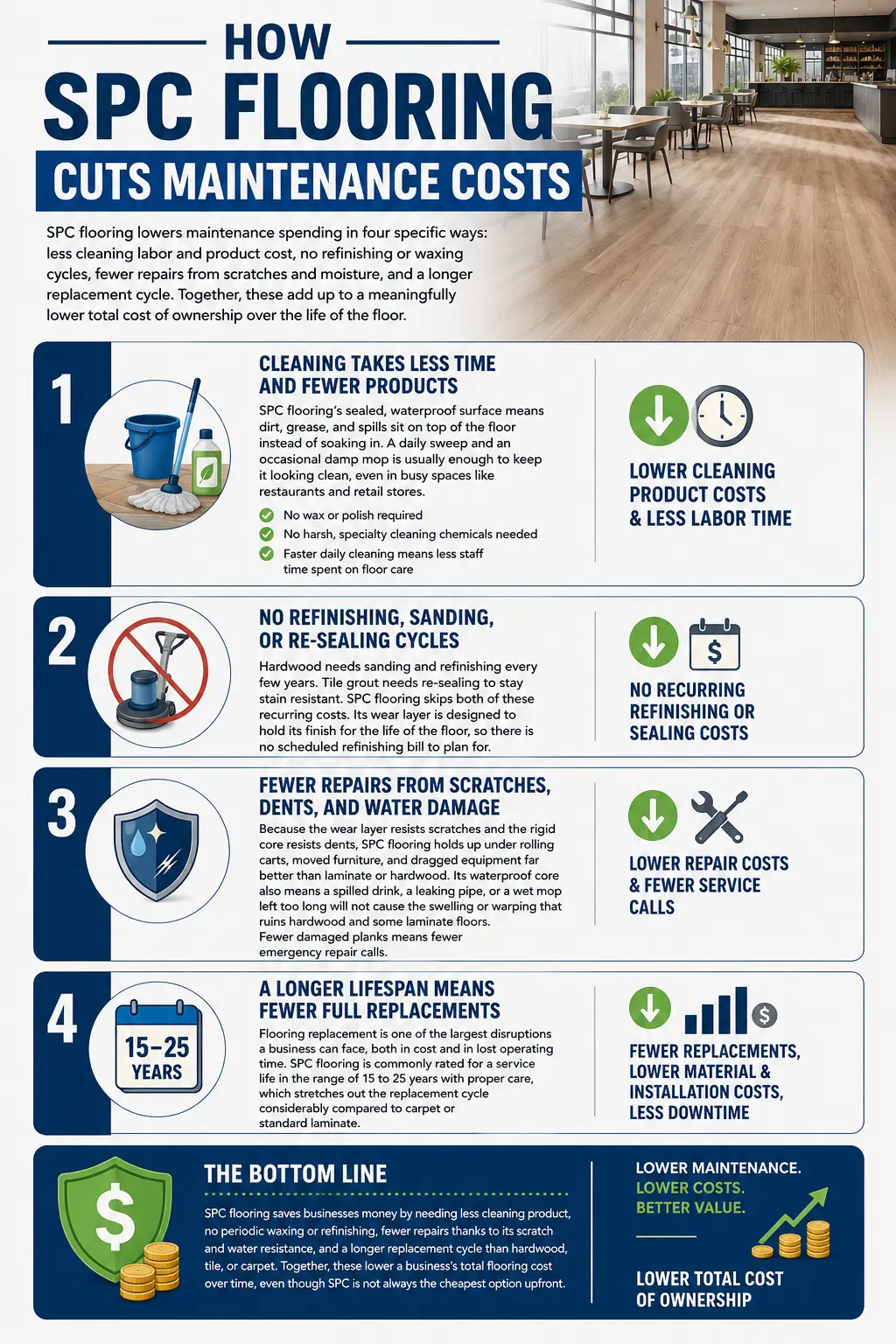
SPC flooring lowers maintenance spending in four specific ways: less cleaning labor and product cost, no refinishing or waxing cycles, fewer repairs from scratches and moisture, and a longer replacement cycle. Together, these add up to a meaningfully lower total cost of ownership over the life of the floor.
1. Cleaning takes less time and fewer products
SPC flooring’s sealed, waterproof surface means dirt, grease, and spills sit on top of the floor instead of soaking in. A daily sweep and an occasional damp mop is usually enough to keep it looking clean, even in busy spaces like restaurants and retail stores. Businesses that previously bought floor wax, sealants, or specialty tile cleaners can often drop those line items from their cleaning budget entirely.
- No wax or polish required
- No harsh, specialty cleaning chemicals needed
- Faster daily cleaning means less staff time spent on floor care
2. No refinishing, sanding, or re-sealing cycles
Hardwood needs sanding and refinishing every few years. Tile grout needs re-sealing to stay stain resistant. SPC flooring skips both of these recurring costs. Its wear layer is designed to hold its finish for the life of the floor, so there is no scheduled refinishing bill to plan for.
3. Fewer repairs from scratches, dents, and water damage
Because the wear layer resists scratches and the rigid core resists dents, SPC flooring holds up under rolling carts, moved furniture, and dragged equipment far better than laminate or hardwood. Its waterproof core also means a spilled drink, a leaking pipe, or a wet mop left too long will not cause the swelling or warping that ruins hardwood and some laminate floors. Fewer damaged planks means fewer emergency repair calls.
4. A longer lifespan means fewer full replacements
Flooring replacement is one of the largest disruptions a business can face, both in cost and in lost operating time. SPC flooring is commonly rated for a service life in the range of 15 to 25 years with proper care, which stretches out the replacement cycle considerably compared to carpet or standard laminate. Fewer replacements over a decade means fewer rounds of material cost, installation labor, and closed-for-renovation days.
SPC flooring saves businesses money by needing less cleaning product, no periodic waxing or refinishing, fewer repairs thanks to its scratch and water resistance, and a longer replacement cycle than hardwood, tile, or carpet. Together, these lower a business’s total flooring cost over time, even though SPC is not always the cheapest option upfront.
SPC Flooring vs Other Commercial Flooring Types
SPC flooring generally costs less to maintain than hardwood, ceramic tile, and carpet, though its upfront material cost can sit above basic vinyl or laminate. The table below compares the factors that matter most for a business’s long-term flooring budget.
| Factor | SPC Flooring | Hardwood | Ceramic Tile | Carpet | Standard Laminate |
|---|---|---|---|---|---|
| Water resistance | Fully waterproof | Poor, prone to warping | Excellent (grout can stain) | Poor, absorbs spills | Water resistant, not waterproof |
| Daily cleaning | Sweep and damp mop | Special wood cleaner needed | Mop, grout needs scrubbing | Vacuum, periodic deep clean | Sweep and light mop |
| Recurring upkeep | None (no wax or seal) | Sanding and refinishing every few years | Grout re-sealing every 1 to 2 years | Professional shampooing | Minimal, but swells if wet |
| Scratch and dent resistance | High | Moderate | High (but chips) | Wears and stains visibly | Moderate |
| Typical lifespan | 15 to 25 years | 20 to 30 years, with refinishing | 20+ years | 5 to 10 years | 10 to 15 years |
| Installation disruption | Low, click-lock system | High, needs curing time | High, needs setting and curing | Moderate | Low to moderate |
| Best suited for | Retail, offices, restaurants, clinics | Upscale offices, boutiques | Wet zones, kitchens | Low-traffic offices, hospitality | Budget-conscious offices |
Where SPC pulls ahead
SPC flooring’s biggest advantage is that it combines the durability of tile with the ease of installation of laminate, without the ongoing cost of either. Hardwood looks premium but demands scheduled refinishing that most tile and carpet floors never need at all. Carpet is comfortable underfoot but wears and stains quickly in commercial settings, which shortens its usable life.
Where SPC is not automatically the best fit
For spaces built purely around a premium, natural-material look, such as a high-end boutique wanting genuine hardwood, SPC is a durable and cost-effective alternative but will not fully replicate the exact feel of solid wood. It is also a firmer surface underfoot than carpet, which matters in spaces where staff stand for long shifts, such as retail counters.
Image idea: Side-by-side photo comparison of SPC flooring, tile, hardwood, and carpet in similar commercial settings. Alt text: Comparison of SPC flooring versus tile hardwood and carpet in commercial spaces Filename: spc-flooring-vs-other-flooring-comparison.jpg
SPC Flooring Cost in Nepal: A Realistic Breakdown
SPC flooring in Nepal generally runs from around NPR 200 to NPR 1,500 per square foot depending on brand, thickness, and design, with commercial-grade planks typically landing between NPR 800 and NPR 1,500 per square foot. Installation usually adds another NPR 30 to NPR 80 per square foot.
Material cost by brand tier (Nepal market)
| Brand Tier | Approximate Price (per sq. ft.) | Notes |
|---|---|---|
| Budget (e.g., Dura) | NPR 300 to NPR 700 | Good for lower-traffic offices and back-of-house areas |
| Mid-range (e.g., Inovar) | NPR 700 to NPR 1,100 | Common choice for retail and general commercial spaces |
| Premium (e.g., Gerflor, Mannington) | NPR 1,200 to NPR 1,500 | Suited to high-traffic or design-forward commercial spaces |
What drives the price up or down
- Wear layer thickness: thicker wear layers cost more but hold up longer under heavy foot traffic
- Plank design and finish: wood-look and stone-look textures with realistic embossing usually sit at the higher end
- Import and shipping: most SPC flooring sold in Nepal is imported, so international shipping and duties affect the final price
- Installation complexity: subfloor preparation, cutting around fixtures, and large open-plan layouts affect labor cost
Why the higher upfront cost still saves money
A business comparing sticker prices alone might assume tile or basic laminate is cheaper. Once cleaning labor, refinishing cycles, repairs, and replacement frequency are added in, SPC flooring’s total cost over 10 to 15 years is often lower, particularly in spaces with heavy foot traffic or frequent moisture exposure, such as restaurants, salons, and clinics.
Image idea: Simple bar chart comparing estimated 10-year total cost of ownership for SPC, tile, hardwood, and carpet in a commercial setting. Alt text: Ten year total cost comparison chart for SPC flooring versus other commercial flooring Filename: spc-flooring-10-year-cost-chart.jpg
Which Businesses Save the Most with SPC Flooring
Businesses with high foot traffic, frequent moisture exposure, or tight operating hours tend to see the largest maintenance savings from SPC flooring, since these are exactly the conditions that wear out other flooring types the fastest.
Restaurants and cafes
Spills, dropped food, and constant kitchen-to-dining foot traffic are hard on floors. SPC flooring’s waterproof core means a spilled drink or dropped sauce does not risk long-term damage, and quick mopping keeps service areas presentable between rushes.
Retail stores and shopping spaces
Retail floors deal with heavy daily footfall, dragged fixtures, and dropped merchandise. SPC flooring’s scratch resistance keeps aisles looking new for longer, which matters for brand image as much as for the maintenance budget.
Offices and coworking spaces
Rolling chairs, foot traffic near entrances, and spilled coffee are constant low-level stress on office floors. SPC flooring handles all three without the scuffing that shows up quickly on softer laminate.
Hotels and guesthouses
Guest turnover means floors need to look fresh at all times, and housekeeping teams benefit from a floor that cleans quickly between checkouts. SPC flooring’s moisture resistance is especially useful in bathrooms, entryways, and lobby areas.
Clinics, salons, and gyms
Frequent cleaning and disinfecting, along with moisture from sinks, showers, or sweat, make waterproof flooring almost essential. SPC flooring’s non-porous surface also makes it easier to keep hygienic.
Warehouses and light industrial spaces
Rolling carts, pallet jacks, and dropped tools call for a rigid, dent-resistant surface. SPC flooring’s stone-composite core handles this kind of daily abuse better than standard vinyl.
Maintenance Tips That Stretch the Savings Even Further
Even a naturally low-maintenance floor performs better with the right daily habits. Sweeping or vacuuming daily, wiping spills promptly, and using entrance mats are the three habits that protect an SPC floor’s finish the longest and keep replacement costs pushed further out.
- Sweep or dust-mop daily to keep grit from scratching the wear layer underfoot
- Wipe spills promptly, even though the floor is waterproof, since standing liquid can be tracked elsewhere and become a slip hazard
- Use entrance mats at doors to cut down on dirt and grit carried in from outside
- Avoid abrasive cleaning pads and steel wool, which can dull the wear layer over time
- Use felt pads on furniture legs to prevent scuffing when chairs and tables are moved
- Damp mop weekly with a pH-neutral cleaner rather than harsh degreasers or ammonia-based products
- Address subfloor moisture issues early, since a damp subfloor can affect the SPC planks over time even though the surface itself is waterproof
Following this routine typically means a business never needs to budget for specialty floor treatments at all, which is one of the simplest ways SPC flooring keeps ongoing costs low.
Installation Speed: The Hidden Savings Most Businesses Miss
SPC flooring’s click-lock installation system usually means a faster fit-out than glued-down tile or hardwood, which translates directly into fewer days of lost business during a renovation.
Most SPC planks click together without adhesive and can often be installed directly over an existing hard subfloor, which cuts down on demolition and subfloor prep time. For a business, every day a store, restaurant, or office is closed for flooring work is a day of lost revenue on top of the installation cost itself. A floor that can go in over a weekend instead of a week is a real, if often overlooked, saving.
- No adhesive curing time to wait out before the space can be used
- Can often be installed over existing tile, concrete, or vinyl
- Straightforward plank replacement if a single section is damaged later, without redoing the whole floor
Common Mistakes That Quietly Erase the Savings
The savings SPC flooring offers depend on choosing the right grade of plank and having it installed correctly. Skipping subfloor preparation or choosing a plank with too thin a wear layer for the traffic level are the two mistakes that most often lead to early repairs or replacement.
- Choosing a residential-grade plank for a commercial space: thinner wear layers wear through faster under heavy daily foot traffic
- Skipping proper subfloor leveling: an uneven subfloor can cause planks to flex, click apart, or wear unevenly
- Ignoring the manufacturer’s warranty terms: using unapproved cleaning products can sometimes void coverage
- Installing without expansion gaps: SPC still expands slightly with temperature changes, and skipping expansion gaps can cause buckling
- Delaying small repairs: a single damaged plank left unaddressed can allow moisture or grit to affect neighboring planks
Working with an experienced installer and choosing a commercial-grade product upfront avoids most of these issues entirely.
Is SPC Flooring Right for Your Business?
SPC flooring is a strong fit for most commercial spaces that deal with regular foot traffic, moisture, or a need for a fast, low-disruption installation. It is worth choosing a different material only when a business specifically needs the resale prestige of genuine hardwood or the soft, cushioned feel of carpet.
Use this quick checklist to decide:
- Does the space see moderate to heavy daily foot traffic?
- Is there regular exposure to spills, moisture, or wet cleaning?
- Does the business need to minimize closure time during installation?
- Is a predictable, low ongoing maintenance budget a priority?
- Does the space need a floor that still looks upscale without a hardwood budget?
If most of these apply, SPC flooring is likely to be one of the most cost-effective flooring choices available for the space.
Frequently Asked Questions About SPC Flooring for Businesses
1. What does SPC flooring stand for? SPC stands for Stone Plastic Composite, referring to the rigid core made of limestone powder and plastic stabilizers.
2. Is SPC flooring good for high-traffic commercial spaces? Yes. Its rigid core and protective wear layer are specifically built to handle heavy daily foot traffic better than standard laminate or carpet.
3. How much does SPC flooring cost in Nepal? Prices generally range from NPR 200 to NPR 1,500 per square foot, with commercial-grade planks typically between NPR 800 and NPR 1,500 per square foot, plus installation.
4. How long does SPC flooring last in a commercial setting? With proper installation and care, SPC flooring commonly lasts 15 to 25 years, though very high-traffic spaces may see wear toward the lower end of that range.
5. Does SPC flooring need to be sealed or waxed? No. Unlike hardwood or some tile, SPC flooring does not require waxing, sealing, or periodic refinishing.
6. Is SPC flooring really waterproof? Yes, the core itself is waterproof, which is why it holds up well in kitchens, bathrooms, entryways, and other moisture-prone areas.
7. Can SPC flooring be installed over existing tile or concrete? In most cases, yes, as long as the existing surface is clean, flat, and structurally sound, which also helps cut installation costs.
8. How is SPC flooring different from regular vinyl flooring? SPC has a rigid, stone-composite core, while standard vinyl is more flexible. This makes SPC more resistant to dents and better at handling heavy loads.
9. Is SPC flooring slippery? Most commercial-grade SPC flooring includes a textured finish for slip resistance, though this can vary by product, so it is worth checking the specific plank’s rating for wet areas.
10. What is the difference between SPC and WPC flooring? WPC (Wood Plastic Composite) has a softer, more cushioned core, while SPC has a denser, more rigid core, which generally makes SPC more durable for commercial use.
11. How often does SPC flooring need to be cleaned in a business? Daily sweeping or dust mopping plus a weekly damp mop is typically enough, though high-traffic spaces like restaurants may need more frequent spot cleaning.
12. Can SPC flooring be repaired if a plank is damaged? Yes. Individual planks can usually be replaced without redoing the entire floor, which keeps repair costs low.
13. Does SPC flooring fade in sunlight? Quality SPC flooring with UV-resistant coatings holds up well, but consistently intense direct sunlight can cause gradual fading over many years, as it can with most flooring types.
14. Is SPC flooring suitable for restaurants and kitchens? Yes, its waterproof and stain-resistant surface makes it a practical choice for dining areas and food service zones.
15. How does SPC flooring compare to ceramic tile for maintenance? SPC flooring generally requires less maintenance than tile because it has no grout lines to scrub or reseal.
16. What is the average installation time for SPC flooring in a commercial space? Installation speed depends on the size of the space, but the click-lock system typically allows for faster turnaround than glued-down tile or hardwood.
17. Does SPC flooring require a professional installer? Professional installation is recommended for commercial spaces to ensure proper subfloor prep, expansion gaps, and even seams, all of which affect the floor’s lifespan.
18. Can SPC flooring handle heavy furniture and equipment? Yes, its rigid core resists denting under heavy furniture, shelving, and equipment, though felt pads are still recommended to prevent surface scuffing.
19. Is SPC flooring eco-friendly? SPC flooring uses recyclable materials and its long lifespan reduces how often flooring waste is generated, though it is still a plastic composite material rather than a purely natural one.
20. Does SPC flooring work well in Nepal’s climate? Yes, its waterproof and temperature-stable core makes it well suited to Nepal’s humidity and seasonal temperature shifts.
21. What is the wear layer on SPC flooring and why does it matter? The wear layer is the clear protective top coating that resists scratches and stains. Thicker wear layers generally hold up better in high-traffic commercial spaces.
22. Can SPC flooring be used in gyms or fitness studios? Yes, its water and sweat resistance make it a practical choice, though some fitness spaces may pair it with rubber mats in weight areas for extra cushioning.
23. How does SPC flooring impact resale or lease value of a commercial space? A well-maintained, modern-looking floor can support a stronger impression during property viewings, though it typically does not add the same resale premium as genuine hardwood.
24. What is the biggest downside of SPC flooring for businesses? Its rigid core makes it feel harder underfoot than carpet or cushioned vinyl, which can matter in spaces where staff stand for long shifts.
25. Does SPC flooring reduce noise in commercial spaces? Many SPC products include an attached underlayment that provides some sound dampening, though it will not fully match the noise reduction of carpet.
26. How do I choose the right SPC flooring thickness for my business? Higher-traffic spaces generally benefit from thicker planks and thicker wear layers, while lower-traffic back-office areas can often use a lighter-duty option.
27. Can SPC flooring be installed in a space that stays open during installation? Because it is click-lock and does not require adhesive curing time, it is often possible to install SPC flooring in sections while minimizing disruption, depending on the layout.
28. What warranty is typically offered on commercial SPC flooring? Warranty terms vary by brand and product line, so it is worth confirming the specific coverage period and any maintenance requirements directly with the supplier before purchase.
29. Is SPC flooring a good long-term investment for a growing business? For businesses expecting steady or increasing foot traffic, SPC flooring’s durability and low maintenance needs generally make it a sound long-term choice.
30. How do I get a quote for SPC flooring for my business in Nepal? You can request a free consultation and quote from a local flooring provider like Manasukh Flooring, who can assess your space and recommend the right product and thickness for your traffic level.
Call to Action
Ready to see how much your business could save on flooring maintenance? Manasukh Flooring installs commercial-grade SPC flooring for offices, restaurants, retail stores, and hotels across Kathmandu, Lalitpur, and the surrounding areas. Get a free estimate and find out which SPC option fits your space and budget.