
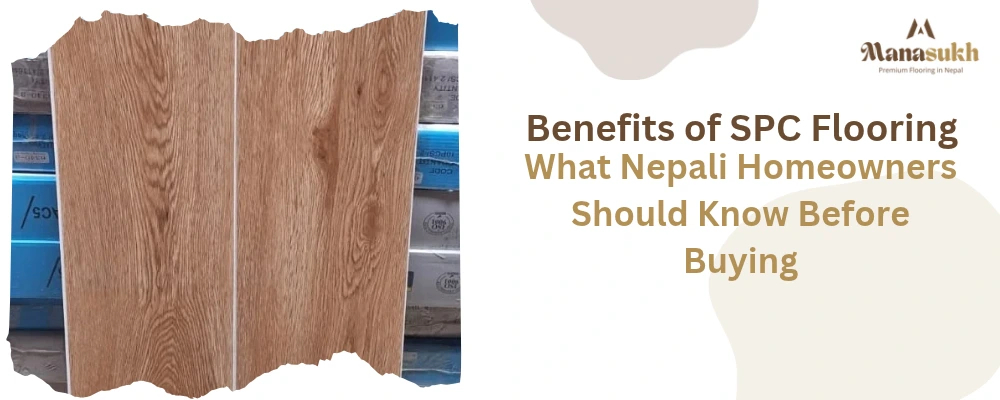
Your wooden floor swelled after one monsoon. Your tiles feel like ice every winter morning. Your laminate edges are lifting near the kitchen. If any of this sounds familiar, you are not unlucky. You picked a floor that was never built for Nepal’s humidity, temperature swings and busy family life.
SPC flooring (Stone Plastic Composite) is a rigid, waterproof floor made from limestone powder and PVC. It does not swell, warp or rot when exposed to moisture, it clicks together in a day or two, and it comes in realistic wood, stone and marble looks. The main benefits of SPC flooring are waterproof performance, dimensional stability, scratch resistance, quick installation, low maintenance, and good value over its lifetime.
But there is a catch. Not every SPC floor is good. A thin wear layer, a weak click system or an uneven subfloor can ruin even a premium-looking plank. So this guide covers the benefits, the honest limits, the buying mistakes we see most often, and a simple checklist to choose well.
Who this guide is for: homeowners renovating or building in Kathmandu, Lalitpur, Bhaktapur, Pokhara and other cities, plus architects, interior designers, landlords and small business owners who want a floor that lasts without constant repair.
What Is SPC Flooring?
SPC flooring is a rigid-core vinyl floor made mainly from natural limestone powder, PVC and stabilizers. The dense core is what makes it hard, stable and waterproof. It is sold as planks or tiles that lock together with a click system, so no glue is needed in most installations.
Featured answer (40 to 60 words): SPC flooring stands for Stone Plastic Composite. It has a rigid limestone and PVC core, a printed design layer, and a clear protective wear layer on top. It is waterproof, dimensionally stable, scratch resistant and easy to install, which makes it a practical choice for homes, shops and offices.
The Layers Inside an SPC Plank
Understanding the layers helps you judge quality. Here is a typical structure from top to bottom:
| Layer | What It Does | Why It Matters to You |
|---|---|---|
| UV coating | Adds surface protection and a finish | Helps resist stains and light scuffs |
| Wear layer (clear PVC) | Takes the daily traffic | Thicker usually means longer life |
| Decorative film | Carries the wood, stone or marble print | Determines how realistic the floor looks |
| SPC core | Rigid limestone and PVC base | Provides stability and waterproofing |
| Underlay (often attached) | Cushion, often IXPE or EVA foam | Reduces footstep noise and adds comfort |
SPC vs WPC vs LVT: A Quick Clarification
People often mix these up, so here is the short version:
- SPC: Dense, hard, very stable core. Best for durability and moisture.
- WPC (Wood Plastic Composite): Softer, thicker core with more cushioning. Often more comfortable underfoot but dents more easily.
- LVT (Luxury Vinyl Tile): A flexible vinyl plank or tile. It is thinner and usually needs a very smooth subfloor.
If you want one floor that handles water, traffic and temperature changes, SPC is usually the strongest all-rounder of the three.
Benefits of SPC Flooring at a Glance
The biggest benefits of SPC flooring are waterproofing, stability, durability, easy installation and low upkeep. Here is the summary before we go deeper.
| Benefit | What It Means in Real Life |
|---|---|
| Waterproof core | Spills, mopping and humid weather will not swell the planks |
| Dimensional stability | Less expansion and contraction when temperature changes |
| Scratch and dent resistance | Handles chairs, pets, kids and foot traffic well |
| Click-lock installation | Often installed in one to two days for an average room |
| Low maintenance | Sweep and damp mop, no polishing or sanding |
| Comfort and noise control | Warmer feel than tile, quieter with a good underlay |
| Design variety | Realistic wood, stone and marble looks |
| Lifetime value | Fewer repairs and replacements than moisture-prone floors |
| Hygiene | Few gaps and no porous surface for dirt and moisture to settle in |
| Renovation-friendly | Can often go over existing flat floors, suitable for many underfloor heating systems |
Benefit 1: It Is Waterproof Where It Matters
The SPC core does not absorb water, so the planks will not swell, warp or rot. This is the number one reason people switch, and it is especially relevant in Nepal, where the monsoon runs from roughly June to September and humidity stays high for months.
The Problem with Wood and Laminate
Solid wood and many laminates have organic cores. Once moisture gets in, they swell at the edges, cup, or separate. Homeowners often describe it as “my floor started rising” or “the boards are bending near the door.” Repairing it usually means replacing entire sections.
How SPC Solves It
- The limestone-PVC core is mineral-based and does not soak up moisture.
- Planks keep their shape during humid months.
- Everyday spills from kitchens, dining areas and entry mats are a non-issue if wiped up reasonably quickly.
An Important Reality Check
“Waterproof” refers to the plank itself, not the whole system. Water can still travel through the seams if a large flood sits for a long time, and moisture rising from a damp concrete slab can cause problems underneath. So:
Pro tip: On ground-floor or basement concrete, check for dampness first. Use a proper moisture barrier (such as a polyethylene sheet) and let new concrete cure fully before installation.
Waterproof does not mean you can ignore standing water. It means the floor itself survives when accidents happen.
Benefit 2: It Stays Stable in Heat, Cold and Humidity
SPC has high dimensional stability, meaning it expands and contracts far less than wood or standard vinyl when the temperature changes. The dense core resists movement, which reduces gaps, buckling and peaking at the joints.
Nepal’s climate makes this valuable. A home in the Kathmandu Valley can see cold winter mornings and warm afternoons, and homes in the Terai experience far higher heat. Floors that react strongly to these swings develop gaps or lift at the seams.
Where Stability Helps Most
- Rooms with large windows that get strong afternoon sun
- Homes with big day-to-night temperature differences
- Open-plan spaces with long, continuous floor runs
Still Leave an Expansion Gap
Stable does not mean zero movement. Always leave a small gap around the walls, as specified by the manufacturer (often around 8 to 10 mm), and cover it with skirting. Skipping this is one of the most common installation errors.
Heat warning: Prolonged, direct, intense sunlight through glass can heat the surface significantly. Use curtains or blinds in rooms with strong sun exposure to protect the floor and its warranty.
Benefit 3: It Resists Scratches, Dents and Daily Wear
A good SPC floor has a hard core and a protective wear layer that together resist scratches, scuffs and dents better than many other floors. The wear layer is the clear top coating that shields the printed design, and its thickness is one of the best indicators of durability.
What to Know About the Wear Layer
Wear layers are commonly measured in millimeters (for example 0.3 mm, 0.5 mm or 0.7 mm). In general:
| Wear Layer | Typical Suitability |
|---|---|
| Around 0.3 mm | Light residential use, bedrooms |
| Around 0.5 mm | Regular residential use, living areas |
| 0.7 mm and above | Heavy residential or light commercial use |
Always confirm the rating with the supplier, because standards and test methods can differ between manufacturers.
Where SPC Performs Well
- Homes with children, running feet and dropped toys
- Households with pets (nails cause less visible damage than on softer floors)
- Rooms with dining chairs that get dragged often
- Small shops, cafés, salons and offices
Where You Still Need Care
SPC is tough, not indestructible. Sharp objects, heavy furniture dragged without protection, and sand or grit under shoes can still leave marks. Use felt pads under furniture legs and a doormat at entrances.
Benefit 4: It Installs Fast and Clean
SPC flooring uses a click-lock system and can be installed over a suitable existing floor, so installation is often completed in one to two days for an average room. There is no wet cement, no long curing time, and far less dust than tile work.
For families living in the house during renovation, this matters. Many people say, “I do not want my home torn apart for two weeks.” SPC avoids most of that.
Step-by-Step: How SPC Click Flooring Is Installed
- Acclimatize the planks. Leave the boxes in the room for the period the manufacturer recommends (commonly 24 to 48 hours).
- Prepare the subfloor. It must be clean, dry, firm and level. Fix cracks, remove loose material and grind down high spots.
- Lay a moisture barrier if needed. Essential over concrete on lower floors.
- Plan the layout. Measure the room and avoid ending with a very thin strip on one wall. Stagger plank joints for strength and appearance.
- Leave an expansion gap. Use spacers along all walls and fixed objects.
- Click the planks together. Angle and press in, working row by row, per the manufacturer’s instructions.
- Cut around obstacles. Doorframes, pipes and corners need careful measuring.
- Fit skirting or trim. This hides the gap and finishes the edge.
- Wait before heavy loading. Follow the supplier’s guidance before moving heavy furniture back.
The Subfloor Is Everything
If you remember one thing from this guide, make it this: an uneven subfloor is the biggest cause of SPC problems. Slight dips can stress the click joints and cause gaps or creaking. Many manufacturers specify a flatness tolerance of a few millimeters over two meters, so ask your installer to check it.
Benefit 5: It Is Easy to Clean and Maintain
SPC flooring needs only regular sweeping or vacuuming and occasional damp mopping. There is no sanding, sealing, waxing or polishing, which saves both money and weekend hours.
A Simple Weekly Care Routine
| Task | How Often | How |
|---|---|---|
| Sweep or vacuum | Daily or every few days | Soft broom or vacuum with hard-floor setting |
| Damp mop | Weekly | Well-wrung mop with a pH-neutral floor cleaner |
| Spot clean spills | Right away | Soft cloth, mild cleaner |
| Check furniture pads | Every few months | Replace worn felt pads |
What to Avoid
- Steam mops (heat and moisture can affect the finish and joints unless the manufacturer allows it)
- Abrasive scrubbers and harsh chemicals
- Wax or polish, which can leave a dull film
- Dragging heavy furniture across the surface
Benefit 6: It Feels Warmer and Quieter Than Tile
SPC feels less cold than tile or stone and, with an attached underlay, absorbs a fair amount of footstep noise. Many people replace tile because it is cold in winter and echoes in apartments.
SPC is not carpet-soft, but it is noticeably more comfortable than ceramic, marble or granite for standing and walking. In multi-story homes and flats, the underlay also reduces the hollow “click-clack” sound.
Quick note: Some SPC planks come with an underlay attached, while others need a separate one. Check this before you buy, and never stack extra underlay under a plank that already has one unless the manufacturer allows it, as it can weaken the click joints.
Benefit 7: It Looks Like Wood, Stone or Marble
Modern printing and embossing techniques allow SPC to imitate oak, walnut, travertine, marble and concrete convincingly, without the maintenance of the real material. You get the look you want without the monsoon worry of wood or the weight and cost of natural stone.
Popular Looks
- Warm oak and walnut tones: Cozy living rooms and bedrooms
- Light, natural wood: Smaller or darker rooms that need brightness
- Grey and concrete finishes: Modern apartments and offices
- Marble and stone looks: Entryways, lobbies and showrooms
- Herringbone and chevron patterns: Statement rooms (check that the product is made for this layout)
Matching Style to Space
| Room Type | Suggested Style |
|---|---|
| Small living room | Light wood tones to feel larger |
| Large open space | Medium or dark wood for warmth |
| Café or shop | Stone or concrete look for a modern feel |
| Bedroom | Soft, warm wood textures |
| Home office | Neutral, low-contrast finishes |
Look for embossed-in-register textures, where the surface texture follows the printed grain. They look and feel far more realistic than flat prints.
Benefit 8: It Offers Strong Value Over Time
SPC is not always the cheapest floor on day one, but its total cost of ownership is often lower because it avoids repairs, refinishing and early replacement. Prices in Nepal vary by thickness, wear layer, brand and import cost, so ask for a written quote and compare the same specifications.
Where the Savings Come From
- No polishing, sanding or refinishing as with solid wood
- Less risk of moisture damage and replacement
- Quick installation, which can reduce labor charges and disruption
- Can be laid over an existing flat floor in many cases, reducing demolition and debris removal costs
What to Compare When Looking at Price
Do not compare only price per square foot or square meter. Compare:
- Plank thickness
- Wear layer thickness
- Underlay included or not
- Warranty length and what it covers
- Installation and accessories (skirting, trims, moisture barrier)
A cheaper floor with a thin wear layer may need replacing years earlier, which erases the savings.
Benefit 9: It Supports a Cleaner Home
SPC has a non-porous surface and tight joints, so dust, spills and moisture have fewer places to settle. That makes it easier to keep clean than carpet and more forgiving than grout-heavy tiled floors.
- No grout lines to scrub and darken over time
- No fibers to trap dust like carpet
- A wipeable surface helpful for households with young children, elderly family members or allergy concerns
Note that SPC does not “cure” allergies. It simply removes a major place where dust and allergens collect. Also ask for products with low-emission or relevant indoor-air quality certifications if this matters to you, and request proof from the supplier.
Benefit 10: It Works for Renovations and Underfloor Heating
Many SPC floors can be installed over existing tile, concrete or vinyl if the surface is flat, clean and sound. This avoids the noise, dust and cost of ripping everything out.
Good Candidates for Floating Over
- Old but firmly attached ceramic tile that is level (grout lines may need filling so they do not telegraph through)
- Smooth concrete
- Existing vinyl in good condition
Not a Good Idea Over
- Damp, flaking or crumbling surfaces
- Heavily uneven floors
- Soft or rotting wood subfloors
Underfloor Heating
Many SPC products are compatible with underfloor heating, but each has a maximum surface temperature limit set by the manufacturer. Confirm this before purchase, and never exceed it. Heat the system up gradually rather than switching to full power.
SPC Flooring vs Other Flooring Types
SPC generally wins on moisture resistance and low maintenance, while solid wood wins on natural authenticity and tile wins on heat and scratch hardness. The right choice depends on the room and your priorities.
| Feature | SPC | Laminate | Solid Wood | Ceramic/Porcelain Tile | Marble |
|---|---|---|---|---|---|
| Water resistance | Excellent | Poor to moderate | Poor | Excellent | Good (needs sealing) |
| Feel underfoot | Moderate warmth | Moderate | Warm | Cold | Very cold |
| Installation speed | Fast | Fast | Slow | Slow | Slow |
| Maintenance | Very low | Low | High | Low (grout needs care) | High |
| Scratch resistance | High | High | Moderate | High | Moderate |
| Repairs | Replace planks | Replace planks | Sand or replace | Replace tiles | Polish or replace |
| Monsoon performance | Strong | Weak | Weak | Strong | Strong |
| Over existing floor | Often yes | Often yes | Rarely | Rarely | No |
Quick Decision Guide
- Choose SPC if moisture, speed and low upkeep matter most.
- Choose solid wood if you want a real natural material and accept the upkeep.
- Choose tile for heavy wet zones, outdoor-adjacent areas and extreme heat.
- Choose laminate only in dry rooms where budget is the top priority.
SPC vs Regular Vinyl Flooring
Regular flexible vinyl needs an almost perfect subfloor and can show every bump. SPC’s rigid core bridges small imperfections better, resists indentation more, and holds its shape. Regular vinyl is softer underfoot, but also dents more easily.
Common Mistakes Buyers Make With SPC Flooring
Most SPC complaints come from poor product choice or poor preparation, not from the material itself. These are the mistakes we see most often, along with the fix for each.
Mistake 1: Buying on Price Alone
A very low price often hides a thin wear layer, a recycled low-grade core or a weak click system.
Fix: Ask for the full specification sheet and compare like with like.
Mistake 2: Ignoring the Subfloor
Laying planks over bumps and dips causes gaps, creaking and joint failure.
Fix: Level and clean the surface first. Budget for preparation.
Mistake 3: Skipping the Expansion Gap
Pushing planks tight against the wall can cause buckling when the floor expands.
Fix: Leave the manufacturer’s gap and hide it with skirting.
Mistake 4: Not Acclimatizing the Planks
Installing straight from a cold truck or storeroom can lead to later movement.
Fix: Let the boxes rest in the room for the recommended time.
Mistake 5: Forgetting About Moisture Below
People assume “waterproof” means the slab below does not matter.
Fix: Use a moisture barrier and test for dampness on ground floors.
Mistake 6: Choosing the Wrong Thickness or Wear Layer
A thin plank in a high-traffic shop will wear out early.
Fix: Match the specification to the use: light for bedrooms, stronger for living areas and commercial spaces.
Mistake 7: Using the Wrong Cleaning Products
Harsh chemicals and steam mops can dull or damage the surface.
Fix: Use pH-neutral cleaners and a damp, not wet, mop.
Mistake 8: Not Ordering Enough Material
Running short mid-project can lead to a batch mismatch in shade.
Fix: Order extra, commonly 5 to 10 percent for cutting and waste, and keep leftover planks for future repairs.
Mistake 9: Dragging Heavy Furniture
It scratches even good floors.
Fix: Use felt pads and lift, do not drag.
Mistake 10: Skipping the Warranty Details
People assume every warranty covers everything.
Fix: Read what is covered (residential or commercial use, installation conditions, exclusions).
Honest Limitations of SPC Flooring
SPC is excellent, but not perfect, and a trustworthy supplier should tell you where it falls short.
- Hardness underfoot: It is firmer than WPC or carpet. If you stand for long periods, consider a good underlay or rugs.
- Heat sensitivity: Intense direct sun or heat sources can cause damage or movement.
- Not a true natural material: It will not match the character of real wood or stone, and PVC-based floors cannot be sanded and refinished.
- Point-load dents: Very heavy, narrow-footed furniture can leave marks.
- Subfloor dependent: It can transfer subfloor flaws if the base is poor.
- Quality varies widely: Two products that look the same can perform very differently.
- Environmental considerations: It is a PVC-based product, so ask about recyclability and emissions certification if sustainability matters to you.
Being upfront about these points helps you choose with confidence rather than regret.
How to Choose SPC Flooring: The 5-Point Check
Use this five-point check before paying for any SPC floor: Core, Wear layer, Underlay, Locking system, Warranty. If a supplier cannot answer these clearly, move on.
The 5-Point SPC Check
| # | Check | What to Ask | What Good Looks Like |
|---|---|---|---|
| 1 | Core | Is the core dense and uniform? Virgin materials or recycled content? | Consistent, rigid plank with no flexing or crumbling edges |
| 2 | Wear layer | What is the wear layer thickness and rating? | Matches your use (see Benefit 3) |
| 3 | Underlay | Is it attached? What type and thickness? | Even, firm underlay suited to your noise needs |
| 4 | Locking system | Which click type? Can I test a sample? | Planks lock tightly with no gaps and separate only with deliberate effort |
| 5 | Warranty | What is covered, for how long, and for which use? | Clear written terms, residential vs commercial stated |
A Simple Buying Process
- Define the room and traffic. Bedroom, living room, shop or office?
- Set a total budget. Include prep, trims, underlay and labor.
- Request samples. Look at them in your own lighting, at different times of day.
- Test the sample. Click two pieces together, try bending, scratch lightly with a key on the back or edge, and wet part of the surface.
- Compare written quotes. Make sure each quote lists identical specifications.
- Book a site visit. A professional measurement and subfloor check avoids surprises.
- Confirm the timeline and installation conditions. Who prepares the subfloor and who supplies trims?
Where SPC Flooring Works Best
SPC performs well in almost every indoor room, and it is especially strong in moisture-prone and high-traffic areas.
| Space | Suitability | Notes |
|---|---|---|
| Living room | Excellent | Pick a mid-range or higher wear layer |
| Bedroom | Excellent | Warm tones and an underlay for comfort |
| Kitchen | Very good | Wipe spills promptly, protect near the sink |
| Dining area | Excellent | Use chair pads |
| Hallways and entrances | Very good | Add doormats to trap grit |
| Home office | Excellent | Use chair mats under rolling chairs |
| Shops, cafés, salons | Very good | Choose a high wear layer |
| Offices and clinics | Very good | Choose commercial-rated products |
| Bathrooms | Possible with care | Needs proper sealing at edges and no standing water |
| Outdoors or open terraces | Not recommended | Unless the product is explicitly rated for it |
| Rooms with heavy sun exposure | Use caution | Protect with blinds or curtains |
Conclusion
The benefits of SPC flooring come down to one idea: it solves the problems that make people regret their floors. It stays flat when humidity rises, handles daily wear, installs without major disruption, and needs little more than a sweep and a damp mop. For Nepali homes dealing with monsoon moisture, temperature changes and busy households, that combination is hard to beat.
Still, the best SPC floor is the one chosen with care. Check the core, wear layer, underlay, locking system and warranty. Prepare the subfloor properly. Leave the expansion gap. And buy based on specification, not just price.
Not sure which SPC floor fits your room? Request free samples and a site visit from the team at Flooring in Nepal. Tell us the room, the traffic and your budget, and we will help you narrow it down to the right options, with a clear written quote and no pressure.
Ready to see SPC flooring in your own space?
Visit flooringinnepal.com to request free samples, ask for a site measurement, or get a clear written quote. Share your room size, usage and budget, and we will recommend options that fit.