
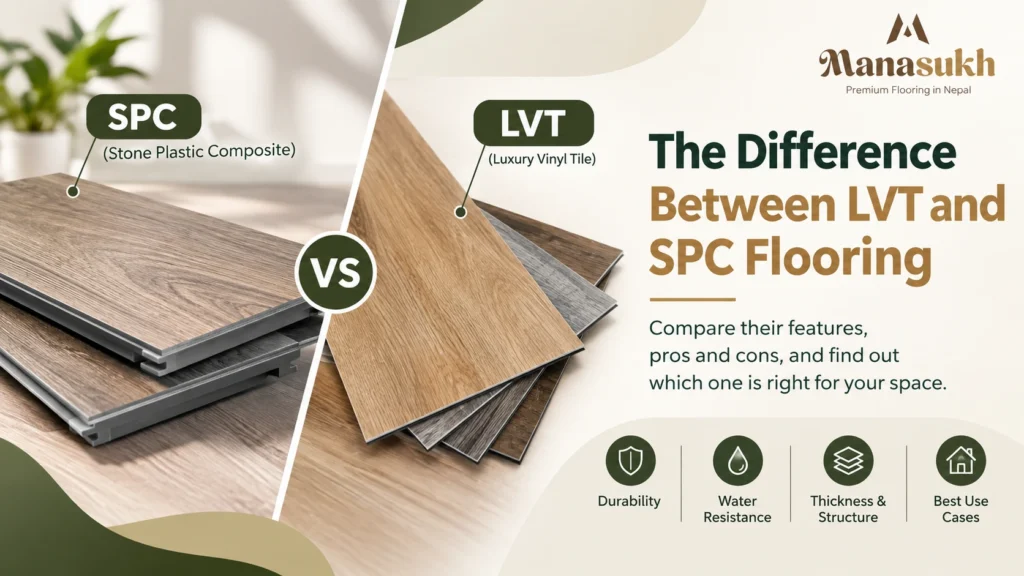
You have seen two quotes for “vinyl flooring.” One says LVT, the other says SPC. The samples look almost identical, the salesperson says both are “100% waterproof,” and one costs noticeably more. So which one are you paying for, and does the extra money buy anything real?
Here is the short version. The difference between LVT and SPC flooring comes down to what sits under the pretty top layer. LVT (luxury vinyl tile) is flexible, softer underfoot and quieter. SPC (stone plastic composite) has a hard, dense core made with limestone powder, so it resists dents and stays stable when temperatures swing. If you remember only one rule: choose SPC for high-traffic areas, heavy furniture and sunny rooms, and choose LVT when comfort and a flexible, glue-down finish matter more.
Most buyers are not stuck on the definition. They are worried about getting it wrong. They fear floors that dent, edges that lift, planks that gap in winter, or paying for a “premium” product they did not need. This guide covers each of those worries, with a clear framework at the end so you can decide in about ten minutes.
Who this guide is for: homeowners, landlords, interior designers, shop owners and builders in Nepal who are comparing vinyl flooring options. Beginners will get plain answers. Experienced buyers will find the technical details they need to question a supplier.
LVT vs SPC at a Glance
SPC is a rigid, dense, dent-resistant vinyl floor. LVT is a softer, more flexible vinyl floor. Both are water-resistant and both come in wood and stone looks. SPC suits busy areas and unstable temperatures, while LVT suits comfort-focused rooms and installers who prefer glue-down.
For a quick featured-snippet-style answer: LVT is a flexible vinyl floor with a soft core, while SPC is a rigid vinyl floor with a limestone-based core. SPC resists dents and temperature movement better. LVT feels softer and warmer underfoot. Both are water-resistant and suit kitchens, living rooms and offices.
| Feature | LVT (Luxury Vinyl Tile) | SPC (Stone Plastic Composite) |
|---|---|---|
| Core | Flexible vinyl | Rigid core of limestone powder, PVC and stabilizers |
| Feel underfoot | Softer, slightly cushioned | Harder, firmer |
| Dent resistance | Moderate | High |
| Temperature stability | Can expand or contract more | Very stable |
| Typical thickness | Roughly 2 to 6 mm | Roughly 4 to 8 mm |
| Common installation | Glue-down, click or loose lay | Click-lock floating |
| Subfloor tolerance | Needs a very smooth base for glue-down | More forgiving of small flaws |
| Sound | Quieter, less hollow | Can sound firmer without underlay |
| Best for | Bedrooms, comfort areas, curved or irregular layouts | Kitchens, halls, shops, sunny rooms |
Thickness ranges are typical industry figures and vary by manufacturer. Always check the product’s technical sheet.
What Is LVT Flooring?
LVT stands for luxury vinyl tile. It is a layered vinyl floor with a flexible core, a printed design layer and a clear wear layer on top. It is the more traditional “luxury vinyl” product and is often glued directly to the subfloor.
The word “tile” is a little misleading. LVT comes in tile shapes and long plank shapes. Planks are often called LVP (luxury vinyl plank). In everyday talk, many suppliers use “LVT” for both.
How LVT Is Built
A typical LVT floor has four layers:
- Backing layer: grips the subfloor or glue.
- Core layer: flexible vinyl that gives the floor its bend and softness.
- Design layer: a high-resolution photographic print of wood, stone or concrete.
- Wear layer: a clear coating that protects against scratches and scuffs, often with a UV-cured finish.
The wear layer is measured in mil (one mil is a thousandth of an inch). A 12 mil layer is about 0.3 mm, 20 mil is about 0.5 mm, and 28 mil is about 0.7 mm. Thicker wear layers are better for busy spaces.
Three Ways LVT Is Installed
- Glue-down: each piece is bonded to the subfloor. This gives a solid, quiet feel but needs a very smooth, clean, dry base.
- Click-lock: pieces snap together and float over the floor. Common in DIY and rental projects.
- Loose lay: heavier backing grips the floor with little or no adhesive. Useful where you want easy replacement.
LVT: Pros and Cons
| Pros | Cons |
|---|---|
| Softer and warmer underfoot | Can show subfloor bumps through the surface (glue-down) |
| Quieter when walked on | More movement with heat and sun than SPC |
| Wide range of styles, including large tiles | Heavy furniture can leave dents over time |
| Glue-down feels solid and premium | Needs skilled installation and careful floor prep |
| Individual pieces are often easy to replace | Adhesive adds cost and drying time |
What Is SPC Flooring?
SPC stands for stone plastic composite. It is a rigid-core vinyl floor whose core is made mostly from limestone powder, PVC and stabilizers. This makes it dense, hard and very stable, which is why it has become a favourite for busy homes and commercial spaces.
SPC is sometimes called “rigid core” flooring. That label is accurate but broad, because there is another rigid-core type called WPC (wood plastic composite) with a softer, foam-like core. SPC is the harder and denser of the two.
How SPC Is Built
SPC planks usually have five parts:
- Wear layer: the protective top coating.
- Decorative film: the printed wood or stone pattern.
- SPC core: the rigid, mineral-rich centre that gives the plank its strength.
- Underlay (often attached): commonly a thin IXPE or EVA foam pad that adds a little cushioning and reduces sound.
- Click-lock edges: milled tongue-and-groove edges that lock planks together without glue.
SPC: Pros and Cons
| Pros | Cons |
|---|---|
| Excellent dent and impact resistance | Feels harder and colder underfoot |
| Very stable when temperatures change | Can sound firmer or more hollow without good underlay |
| Click-lock is fast and glue-free | Cannot easily bend around curves |
| Hides small subfloor imperfections better | A damaged plank in the middle of a room takes care to replace |
| Thin profile suits renovation over existing floors | Quality varies widely between brands |
Why People Confuse LVT and SPC
LVT and SPC are not strict opposites. SPC is technically a rigid-core version of luxury vinyl, so many suppliers call it “LVT” too. The confusion comes from marketing language, not from the products being the same.
This is the number one reason buyers feel stuck. You may hear:
- “This is LVT click flooring” (it may actually be SPC).
- “This is SPC, so it is better than LVT” (not always true).
- “Rigid core LVT” (this usually means SPC or WPC).
Think of it like cars. “Car” is the big category, and “SUV” is one type inside it. In the same way, “luxury vinyl” is the big family, and SPC is one rigid member. When someone says “LVT” in a shop, ask one extra question: “Is the core flexible or rigid, and what is it made of?” That one question cuts through most of the confusion.
What to ask a supplier:
- What is the core material and the total thickness?
- What is the wear layer thickness in mil or mm?
- Is an underlay attached, and how thick is it?
- Is the floor made for click-lock or glue-down?
- Can I see the technical data sheet?
If a seller cannot answer these, treat that as a warning sign.
The Key Differences, One by One
The biggest differences between LVT and SPC are core hardness, stability, comfort and installation method. Everything else, such as looks and water resistance, is quite similar.
Core and Construction
LVT has a flexible vinyl core. SPC has a rigid, mineral-filled core. This one change drives almost every other difference.
A flexible core bends slightly and follows the floor beneath it. A rigid core holds its shape. That is why LVT is ideal for glue-down on a well-prepared base, and SPC works as a floating floor that does not need to bond to the surface.
Durability and Dent Resistance
SPC is the stronger choice against dents, drops and heavy furniture. LVT is durable too, but its softer core can show pressure marks more easily.
If you have a heavy sofa, a fridge, a bookcase, a piano or a shop display counter, SPC gives more peace of mind. Chair legs, kids’ toys and furniture wheels are also less likely to leave lasting marks.
Scratch resistance, however, depends mostly on the wear layer, not the core. A thick wear layer on LVT can resist scratches better than a thin one on SPC. Do not judge by the core alone.
Comfort and Warmth Underfoot
LVT feels softer and a little warmer. SPC feels firmer and can feel cold on winter mornings.
This matters in Nepal. In Kathmandu Valley and hill towns, winter floors can be cold in the early morning. People often walk barefoot at home or in prayer rooms. A softer LVT, or an SPC with a good attached underlay, makes a real difference. If you pick SPC for a bedroom, add a rug beside the bed.
Water Resistance
Both LVT and SPC are highly water-resistant, and most products in both categories are marketed as waterproof. The surface will not swell or rot the way wood can.
There is one honest caveat. Water-resistant does not mean the whole installation is immune. Water can still seep through seams, pool under the floor and cause mould or odour if the subfloor stays wet. SPC planks do not swell, which is a plus. Glue-down LVT can lose its bond if moisture rises from a damp slab. In both cases, the real protection is a dry, sealed subfloor and tight seams.
Temperature Stability
SPC handles heat and cold changes better. LVT is more likely to expand, contract or soften in strong sun or near heat sources.
Think of south-facing rooms with big glass doors, sunny balconies turned into sitting areas, or rooms with a stove or heater. Vinyl reacts to temperature. The dense SPC core limits how much it moves. If a floor is exposed to strong direct sun for hours, SPC (and window film or curtains) is the safer path.
Sound
LVT is generally quieter underfoot, especially when glued down. SPC can sound harder or slightly hollow, though a good attached underlay improves it.
Apartment owners and families with rooms below others should pay attention here. Ask about an acoustic underlay, and check your building’s rules on flooring in shared apartments.
Installation
SPC is the easier floor for most DIY and quick installs because it clicks together and floats. LVT glue-down looks superb but needs an experienced installer and more prep time.
| Installation factor | LVT | SPC |
|---|---|---|
| Method | Glue-down, click or loose lay | Click-lock floating |
| Glue needed | Often yes | Usually no |
| Skill level | Higher for glue-down | Moderate |
| Time to finish | Longer (adhesive curing) | Usually faster |
| Walk on it right away | Not always | Usually yes |
| Easy to replace one piece | Often easier | Needs care with click joints |
Subfloor Tolerance
SPC forgives small bumps and dips better than LVT. Glue-down LVT can telegraph every imperfection through the surface.
Many Nepali homes have concrete slabs with uneven surfaces, patched areas or old tile below. A rigid SPC plank bridges tiny flaws. But “forgiving” is not “magic.” Manufacturers usually allow only small variations over a few metres, and larger dips need levelling compound. Never skip floor prep, whichever you choose.
Appearance and Design
Both can imitate oak, walnut, marble and concrete very convincingly. The design quality depends on the print and surface texture, not the core type.
LVT often offers a wider range of tile sizes, patterns and herringbone or parquet layouts. SPC is mostly sold as long planks, though stone-look and tile-format SPC exist. Look for embossed-in-register texture, where the surface grain matches the printed pattern. It feels and looks more natural than flat printing.
Cost
SPC and LVT prices overlap widely, so the core type alone does not predict cost. Brand, wear layer, thickness, underlay and installation method matter more.
Glue-down LVT can look cheaper per square foot but add adhesive, subfloor prep and skilled labour. SPC click planks may cost more per piece but save on glue and time. Compare the total installed cost, not the sample price. I am not quoting Nepali rupee figures here because they change with brand and import costs. Ask for a written, itemised quote.
Which Is Better for Nepali Homes and Climate?
For most Nepali homes, SPC is the safer all-round choice because of its stability, click-lock speed and tolerance for uneven concrete floors. LVT is better where comfort, sound and glue-down finish matter most.
Nepal has conditions that general flooring guides rarely mention. Think through each of them before you buy.
Monsoon Humidity and Damp Slabs
Ground-floor slabs and basements can hold moisture, especially during monsoon. Solid wood and some laminates struggle in these conditions, which is why vinyl has become popular. Both SPC and LVT cope far better. Still, test the slab for dampness and use a vapour barrier where needed. Do not trap moisture under any floor.
Temperature Swings
Kathmandu and Pokhara see cool winters and warm, humid summers. Terai towns such as Biratnagar and Nepalgunj get far hotter. SPC’s stability handles these swings with fewer gaps. If you install in the Terai or in a very sunny room, lean toward SPC and leave the recommended expansion gap at walls.
Termites and Pests
Termites damage wood. Vinyl is not a food source for them, so both LVT and SPC avoid that problem, as long as the underlying structure is sound.
Uneven Concrete and Old Tiles
Many renovation jobs sit on old cement or ceramic tile. Rigid SPC is often easier to install over well-prepared old tile than glue-down LVT, provided the surface is flat, clean and the grout lines are filled where necessary. Ask your installer to check this first.
Stairs and Slopes
Both products can be used on stairs, but stair work needs proper nosing profiles and precise cuts. For fully glued staircases, flexible LVT can wrap more easily. Whatever you pick, use a professional for stairs.
Rental Properties and Quick Turnaround
Landlords usually want durability, speed and low maintenance. SPC click planks suit that need well. A room can often be finished in a day, and tenants can use it sooner.
Honest note: There is no single “best” floor for Nepal. The best floor is the one that matches your subfloor, your room’s use and your budget.
Room-by-Room Recommendations
Choose SPC for kitchens, hallways, shops and sunny living rooms. Choose LVT for bedrooms and quiet comfort rooms. Either works for bathrooms outside the shower zone, as long as seams and edges are well sealed.
| Room | Better pick | Why |
|---|---|---|
| Living room | SPC | Handles furniture weight and foot traffic |
| Bedroom | LVT (or SPC with good underlay) | Softer, quieter, warmer |
| Kitchen | SPC | Dent resistance, stability near cooking heat |
| Hallway / entrance | SPC | Heavy daily traffic, grit and shoes |
| Children’s room | LVT or SPC with soft underlay | Comfort for play, but check dent marks |
| Home office | SPC | Chair wheels and desks |
| Shop or showroom | SPC with thick wear layer | Heavy traffic and fixtures |
| Café or restaurant | SPC, thick wear layer | Spills, chairs, wheeled carts |
| Bathroom (dry zones) | SPC or LVT | Both water-resistant; seal edges |
| Prayer room | LVT or SPC with underlay | Barefoot comfort |
| Balcony enclosed by glass | SPC | Strong sun and heat |
For wet zones like inside a shower, vinyl plank flooring is not the right answer. Use ceramic or stone tile there.
Seven Mistakes Buyers Make
The most common mistakes are choosing by price alone, ignoring the wear layer, skipping subfloor prep, and not leaving expansion gaps. Each one can cost you far more than the money you saved.
1. Buying by Core Type Alone
Many people believe “SPC always beats LVT.” A premium glue-down LVT with a thick wear layer can outperform a cheap, thin SPC. Compare product data, not labels.
2. Ignoring the Wear Layer
The wear layer decides how well the surface resists scuffs. For homes, a thinner layer may be acceptable. For shops, offices or cafés, go thicker. Ask for the exact figure.
3. Skipping Subfloor Preparation
This is the most expensive mistake. Dust, bumps, cracks and moisture beneath the floor cause lifting, clicking sounds, gaps and dark spots. Preparation is not an optional extra.
4. Not Allowing for Expansion
Floating SPC and click LVT need a small gap at walls and fixed objects, hidden under skirting. Without it, the floor can buckle in warm weather.
5. Placing Rubber-Backed Mats on Vinyl
Some rubber mats can stain vinyl over time. Use vinyl-safe mats.
6. Choosing a Dark, Glossy Finish and Expecting Zero Maintenance
Dark and glossy vinyl shows dust, footprints and scratches more. Mid-tone, textured finishes hide wear far better.
7. Believing “Waterproof” Means “Maintenance-Free”
The plank may be waterproof, but the system is not invincible. Wipe spills, seal edges and keep the subfloor dry.
A 5-Step Framework to Choose
Use this five-step framework: define the room’s use, check the subfloor, decide how much comfort you need, compare specifications, and calculate the total installed cost. You will have your answer by the end of step five.
Step 1: Define the Room and Traffic
Write down who uses the room and how. A busy shop and a guest bedroom need different floors.
- High traffic, heavy furniture, wheels: lean toward SPC.
- Low traffic, comfort-first: lean toward LVT or SPC with soft underlay.
Step 2: Inspect the Subfloor
Ask a professional to check flatness, cracks and moisture.
- Smooth, dry and level: both options work.
- Slightly uneven: lean toward SPC.
- Damp: fix the moisture first. No floor should be installed over an active damp problem.
Step 3: Decide on Comfort and Sound
Do you walk barefoot? Do neighbours live below? If yes, prioritise a softer feel and an acoustic underlay.
Step 4: Compare Specifications
Put two or three products side by side using a simple checklist:
| Specification | Ask for |
|---|---|
| Wear layer | Thickness in mil or mm |
| Total thickness | Including attached underlay |
| Core | Flexible, SPC or WPC |
| Locking system | Click type and profile |
| Surface | Embossed texture, matte or gloss |
| Certifications | Low-emission or indoor air quality claims, with documents |
| Warranty | Written terms, residential vs commercial |
Step 5: Calculate Total Installed Cost
Add up material, underlay, adhesive (if any), skirting, transition strips, levelling work and labour. A cheaper sample can end up costing more once everything is included.
Quick decision rule:
- Busy, heavy, sunny, uneven: SPC.
- Quiet, comfort-first, well-prepared base: LVT.
- Not sure: ask for samples of both and walk on them in the room where they will be installed.
Installation and Care Tips
Acclimatise planks for about 24 to 48 hours (or as the maker advises), prepare the subfloor, leave an expansion gap, and clean with a damp mop and a pH-neutral cleaner. These four habits extend the life of any vinyl floor.
Before You Install
- Let boxes sit flat in the room for the time the manufacturer recommends.
- Clean and level the base. Fill cracks and sand high spots.
- Check moisture. Use a barrier if the slab is damp.
- Plan the layout so the last row is not a thin sliver.
During Installation
- Mix planks from several boxes for a natural look.
- Stagger end joints, usually by at least the manufacturer’s stated distance.
- Keep a gap at walls, pipes and door frames.
- Do not fix heavy cabinets on top of a floating floor. Fit cabinets first, or follow the maker’s guidance.
Daily and Weekly Care
- Sweep or vacuum with a soft brush head to remove grit.
- Mop with a lightly damp mop. Do not flood the floor.
- Use a pH-neutral vinyl cleaner. Avoid wax, strong solvents and abrasive scrubbers.
- Place felt pads under furniture legs.
- Put doormats at entrances to catch grit.
Long-Term Protection
- Use curtains or UV film in rooms with strong sun.
- Keep sharp stones and gravel from shoes off the floor.
- Wipe up spills, oil and hair dye quickly.
- Lift heavy items instead of dragging them.
When Neither Is the Right Answer
If you need a floor for wet areas such as inside showers, or for outdoor use, vinyl is not the best choice. For a natural, long-lasting look at a higher price, consider hardwood, engineered wood or tile.
A short comparison helps:
| Floor type | Strengths | Weak spots |
|---|---|---|
| LVT / SPC | Water-resistant, many designs, easy upkeep | Can scratch, not for wet zones or outdoors |
| Laminate | Budget-friendly, scratch resistant | Edges swell if soaked |
| Engineered wood | Natural look, warm | Costs more, sensitive to water |
| Ceramic / porcelain tile | Very durable, great for wet zones | Cold, hard, grout needs cleaning |
If you want to compare vinyl against these, browse the flooring ranges at flooringinnepal.com and ask for samples to compare in your own lighting.
Conclusion
The difference between LVT and SPC flooring is simpler than the marketing makes it sound. LVT has a flexible core, so it feels softer, quieter and warmer, and it shines when glued down on a perfect base. SPC has a rigid, mineral-rich core, so it resists dents, handles temperature swings and clicks together quickly over slightly imperfect floors.
For most busy Nepali homes, shops and sunny rooms, SPC is the more practical default. For bedrooms and comfort-first spaces, LVT or SPC with a soft underlay can feel better. The right floor is the one that fits your subfloor, your room and your routine, not the one with the longest spec list.
Before you commit, take three actions: ask for the wear layer and core details in writing, test samples in your own room, and get an itemised installation quote.
Frequently Asked Questions
1. What is the main difference between LVT and SPC flooring?
The main difference is the core. LVT has a flexible vinyl core, so it feels softer and quieter. SPC has a rigid core made with limestone powder, so it resists dents and temperature changes better. Both are water-resistant vinyl floors with printed designs and a protective wear layer.
2. Is SPC flooring better than LVT?
Not always. SPC is better for heavy traffic, heavy furniture and temperature swings. LVT can be better for comfort, sound and glue-down finishes. A high-quality LVT can beat a poor SPC. Compare wear layer, thickness and installation quality, not just the core type.
3. Is SPC a type of LVT?
Technically, yes. SPC is a rigid-core form of luxury vinyl, so many sellers use “LVT” as an umbrella term. In practice, “LVT” often means the flexible type and “SPC” means the rigid type. Always ask about the core to be sure.
4. Is LVT or SPC more waterproof?
Both are highly water-resistant, and neither swells like wood. SPC has a slight edge because its rigid core does not absorb water and holds seams tightly. For either floor, a dry subfloor and sealed edges matter more than the label.
5. Which is more durable, LVT or SPC?
SPC is usually more durable against dents and heavy loads. Scratch resistance depends mostly on the wear layer. A thicker wear layer protects better in either type, so check that number before buying.
6. Which feels more comfortable to walk on?
LVT feels softer and slightly warmer. SPC feels firmer and can feel colder in winter. An SPC plank with a good attached underlay narrows the gap, and a rug in bedrooms helps further.
7. Is SPC flooring good for Nepal’s climate?
Yes, in most cases. Its stability handles hot summers, cool winters and monsoon humidity well. It is also termite-proof because vinyl is not a food source. Just make sure the slab is dry before installation.
8. Can I install SPC or LVT over old tiles?
Often yes, if the tiles are firmly fixed, clean and level. Deep grout lines may need filling so they do not show through. SPC is usually more forgiving than glue-down LVT, but an installer should inspect the surface first.
9. How thick should SPC flooring be?
Typical SPC planks range from about 4 mm to 8 mm. For homes, 5 to 6 mm is common. For shops or heavy-use areas, pick a thicker plank with a higher wear layer. Check what the thickness includes, such as attached underlay.
10. What is a wear layer, and why does it matter?
The wear layer is the clear top coating that protects the printed design from scratches and scuffs. It is measured in mil or mm. A thicker layer lasts longer in busy spaces, so ask for the exact figure in writing.
11. Do LVT and SPC need underlay?
Many SPC planks come with an underlay attached. If not, a separate underlay may help with sound and comfort. Glue-down LVT does not use one. Always follow the manufacturer’s instructions, because extra underlay on the wrong product can void warranties.
12. Can LVT or SPC be used in bathrooms?
Yes, in dry and splash zones, if edges are sealed and the room is ventilated. Do not use plank flooring inside the shower tray or on areas that stay under standing water. Tile is better there.
13. Can I use vinyl flooring with underfloor heating?
Some products allow it within set temperature limits, but not all do. Check the technical sheet and ask the manufacturer. Underfloor heating is uncommon in Nepali homes, so confirm compatibility before buying if you plan to use it.
14. How long does LVT or SPC flooring last?
Lifespan depends on the wear layer, quality, traffic and care. Good residential vinyl can last many years with proper maintenance. Exact numbers vary by brand, so rely on the written warranty rather than general claims.
15. How do I clean LVT and SPC floors?
Sweep or vacuum regularly, then mop with a lightly damp mop and a pH-neutral cleaner. Avoid wax, steam mops, harsh solvents and abrasive pads. Wipe spills quickly and use felt pads under furniture.
16. Do LVT and SPC floors fade in sunlight?
Strong, constant sun can fade or warm any floor over time. Many products have UV-resistant surfaces, but curtains, blinds or window film add protection. SPC handles heat movement better than flexible LVT.
17. Can scratched vinyl flooring be repaired?
Minor surface scuffs can sometimes be improved with manufacturer-approved repair kits. Deep gouges usually need plank replacement. Click-lock SPC planks may require lifting several rows, while glued LVT tiles can often be replaced individually.
18. Is SPC flooring safe for children and pets?
Most buyers choose it for just that reason, because it resists spills and stains. Look for low-emission or indoor air quality certifications and ask for documentation. A matte, textured surface also helps reduce slips.
19. What is the difference between SPC and WPC flooring?
SPC has a dense limestone-based core that is hard and dent-resistant. WPC has a softer, foam-containing core that feels more cushioned but dents more easily. SPC is generally better for heavy furniture, and WPC for comfort.
20. How do I choose between LVT and SPC for my home?
Start with the room’s use and subfloor condition. Choose SPC for busy, sunny or slightly uneven spaces. Choose LVT for quiet, comfort-first rooms with a smooth base. Ask for samples of both and compare them in your own lighting.
Still unsure which floor suits your room? Order free or low-cost samples, walk on them in your own space, and see how they look in your morning and evening light. The team at Flooring in Nepal can help you compare options, understand specifications and plan a clean installation. Share your room size, current subfloor and budget range, and ask for a recommendation before you commit.