
Introduction
Choosing between SPC flooring in Nepal and tiles is one of the biggest decisions you will make when building or renovating a home in Nepal. Both materials are widely available in Kathmandu, Pokhara, and other growing cities, and both claim to be durable, waterproof, and low maintenance. The right choice depends less on which material is “better” in general and more on which one fits your rooms, your budget, and Nepal’s specific climate of humid monsoons, dusty dry seasons, and cold winters.
This guide compares SPC flooring and tiles across cost, durability, water resistance, comfort, installation, and long-term maintenance, using real price ranges from the Nepali market. By the end, you will know exactly which flooring makes sense for your living room, kitchen, bathroom, and bedroom.
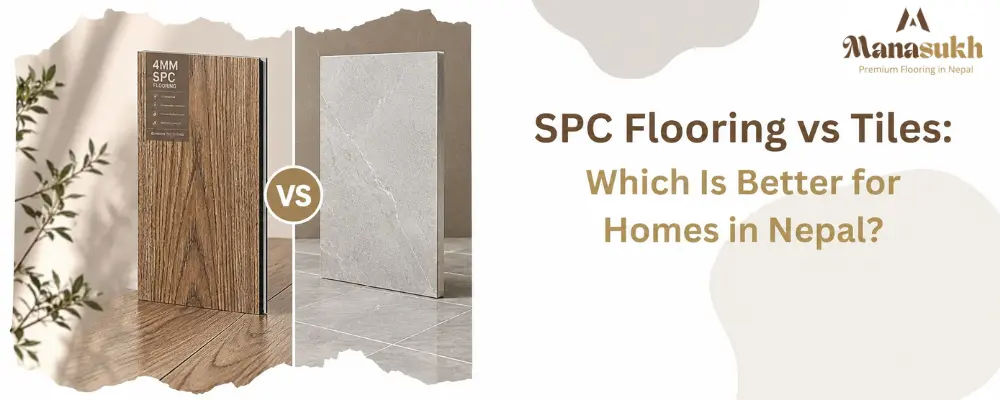
Quick answer: SPC flooring is generally the better choice for bedrooms, living rooms, and offices in Nepal because it is warmer underfoot, lighter in weight, faster to install, and resistant to cracking during minor structural movement. Tiles remain the stronger choice for bathrooms, kitchens, and terraces where constant water exposure, heat from cooking, and heavy long-term durability matter most.
See the video as well in this Link
What Is SPC Flooring
SPC stands for Stone Plastic Composite, a rigid vinyl flooring made of limestone powder and PVC compressed into a dense core, topped with a printed design layer and a wear layer. It clicks together in planks or tiles and floats above the subfloor without needing cement, grout, or heavy adhesives in most residential installations.
A typical SPC plank has four layers:
- Base layer: A rigid stone-plastic composite core that resists denting and moisture.
- Design layer: A high-resolution print that mimics wood, marble, or stone.
- Wear layer: A clear PVC coating measured in mm that determines scratch resistance.
- UV coating: A top finish that protects against fading and adds a slight sheen or matte texture.
SPC flooring became popular in Nepal over the last several years because it solves two problems that older laminate and wood flooring had here: it does not warp in the monsoon, and it installs quickly without the mess of cement work.
What Are Tiles
Tiles are fired ceramic or vitrified slabs, cemented or adhered permanently to the subfloor, and have been the standard flooring choice in Nepal for decades. The three main types used in Nepali homes are:
- Ceramic tiles: Made from natural clay fired at high temperature. Budget-friendly and widely available.
- Vitrified tiles: Made by fusing clay with silica at very high temperatures, producing a denser, harder tile with near-zero water absorption.
- Porcelain tiles: A refined, denser version of ceramic, fired at even higher temperatures, often used in premium and outdoor applications.
Tiles are installed by skilled masons using cement mortar or tile adhesive, then grouted between joints. Once set, they become a permanent part of the floor structure and are extremely difficult to remove without breaking them.
SPC Flooring vs Tiles: Price Comparison in Nepal
Cost is usually the first question homeowners ask, and the honest answer is that both materials span a wide range depending on brand, thickness, and finish.
SPC Flooring Price in Nepal (per sq. ft.)
| Category | Approximate Price (NPR/sq. ft.) |
|---|---|
| Budget SPC (local/unbranded) | 150 – 400 |
| Mid-range SPC (5mm-7mm) | 200 – 800 |
| Premium branded SPC (Gerflor, Mannington) | 800 – 1,500 |
Tiles Price in Nepal (per sq. ft.)
| Category | Approximate Price (NPR/sq. ft.) |
|---|---|
| Basic ceramic tiles | 100 – 260 |
| Vitrified tiles | 160 – 400 |
| Glazed vitrified / designer tiles (GVT) | 400 – 800 |
| Marble, granite, and imported porcelain | 800 – 2,000+ |
SPC flooring in Nepal typically costs NPR 250 to 1,500 per square foot depending on brand and thickness, while tiles range from NPR 100 to over NPR 2,000 per square foot. At the entry level, ceramic tiles are usually cheaper than SPC, but SPC often works out more cost-effective once you add tile labor, cement, and adhesive costs.
The material price is only part of the story. Tile installation labor in Nepal typically adds another NPR 80 to 200+ per square foot for cement, sand, adhesive, and mason charges, plus additional days of work. SPC flooring installation is usually faster and requires fewer additional materials, which can narrow or even close the total cost gap between the two, especially for mid-range projects.
Durability and Lifespan
Tiles generally outlast SPC flooring in terms of raw material lifespan, often serving 20 to 30 years or more without needing replacement, while quality SPC flooring typically lasts 10 to 20 years depending on foot traffic and wear layer thickness.
Tiles are extremely scratch-resistant and do not dent under heavy furniture or dropped objects, though they can crack or chip if something heavy is dropped directly on an edge. Once a tile cracks, replacing a single piece without disturbing surrounding tiles is difficult and can leave a visible patch.
SPC flooring resists dents and scratches well thanks to its wear layer, and because it is installed in individual planks, a damaged plank can often be replaced without redoing the whole floor. However, the wear layer can degrade faster than fired ceramic under constant heavy-duty commercial traffic, so SPC is better suited to residential use than high-traffic commercial spaces.
Water Resistance and Moisture Performance
Nepal’s monsoon season, running roughly from June to September, puts flooring through months of high humidity, and this is where both materials perform well but in different ways.
Both SPC flooring and quality vitrified tiles are effectively waterproof, but tiles handle standing water and constant wet-mopping in bathrooms and kitchens slightly better because water cannot seep into seams or edges over time. SPC flooring is water-resistant at the surface and core, but the click-lock seams between planks can allow moisture in if water is left standing for extended periods, particularly in poorly sealed installations near doorways or bathroom edges.
For rooms with constant water contact, such as bathrooms, kitchens with heavy washing, or ground-floor spaces prone to seepage during monsoon, tiles remain the safer long-term choice. For living rooms, bedrooms, and dry areas, SPC flooring’s water resistance is more than sufficient.
Comfort, Sound, and Temperature
This is one of the most noticeable everyday differences between the two materials, especially during Kathmandu Valley’s cold winters.
- Underfoot warmth: SPC flooring feels noticeably warmer than tiles, especially in winter mornings, because it has some natural insulating properties and is often installed with an underlayment. Tiles stay cold to the touch for most of the year in Nepal’s climate.
- Sound: Tiles tend to echo and amplify footstep sound in empty or sparsely furnished rooms. SPC flooring, particularly with an underlayment pad, absorbs sound better and feels quieter to walk on.
- Cushioning: SPC flooring has slight give underfoot, which is more comfortable for standing or walking for long periods, while tiles are rigid and can feel harder on joints over time.
For bedrooms and living rooms where family members spend long hours, this comfort difference is often the deciding factor for homeowners choosing SPC flooring over tiles in Nepal.
Installation Time and Process
SPC flooring installs significantly faster than tiles because it uses a click-lock floating system that does not require cement curing time, while tile installation involves laying, leveling, grouting, and multiple days of curing before the floor can be used.
A typical SPC installation for an average room can be completed in a single day, and the floor is walkable almost immediately. Tile installation for the same room can take two to four days when you account for cement setting time, grouting, and cleanup, and the room usually cannot be used normally until the cement has fully cured.
This matters in Nepal for two practical reasons: renovation projects in occupied homes are disrupted for a shorter time with SPC, and construction during the monsoon is easier with SPC since cement-based tile work is more sensitive to humidity and drying conditions.
Maintenance and Cleaning
Both materials are low maintenance compared to older options like natural wood or marble, but their upkeep differs slightly.
Tiles require occasional grout cleaning since grout lines can collect dirt and develop mold in humid conditions, while SPC flooring has no grout lines and only needs regular sweeping and damp mopping.
- Tiles: Sweep and mop regularly; scrub grout lines every few months; avoid acidic cleaners on natural stone tiles.
- SPC flooring: Sweep or vacuum regularly; damp mop with a mild cleaner; avoid excessive standing water and steam mops, which can affect the seams over time.
Neither material needs polishing, waxing, or refinishing, which puts both well ahead of hardwood flooring for long-term upkeep in Nepal’s dusty climate.
Weight and Structural Considerations for Nepal
This is a factor many homeowners overlook, but it matters in an earthquake-prone country. SPC flooring is significantly lighter than tiles and their underlying cement bed, which reduces the added dead load on floor slabs, an important consideration for older buildings, upper floors, and renovation projects in Nepal.
Tiles require a cement mortar bed beneath them, adding real weight to the structure, particularly on upper floors of multi-story homes. SPC flooring’s floating installation adds minimal weight since it sits on the existing subfloor with just a thin underlayment.
For renovations of older buildings or upper-floor rooms where structural load is a concern, SPC flooring is generally the more conservative choice. For ground-floor new construction where the structure is designed to carry tile loads from the start, this is less of a deciding factor.
Design and Aesthetic Options
Tiles offer a wider range of finishes at the premium end, including natural stone looks, large-format seamless designs, and glossy polished surfaces, while SPC flooring specializes in realistic wood-look and stone-look designs with a warmer, more residential feel.
If you want the appearance of hardwood flooring without the price or maintenance of real wood, SPC flooring is the closer match. If you want a polished, marble-like, high-shine look often seen in showrooms and premium apartments, glazed vitrified tiles or porcelain tiles deliver that better.
Both materials are available in large formats that reduce visible seams and joints, giving a more open, modern look to smaller rooms common in Kathmandu Valley apartments.
Best Flooring by Room
| Room | Better Choice | Why |
|---|---|---|
| Living Room | SPC Flooring | Warmer, quieter, faster to install, good aesthetics |
| Bedroom | SPC Flooring | Comfortable underfoot, warmer in winter |
| Kitchen | Tiles, SPC | Better resistance to heat, oil, and constant water |
| Bathroom | Tiles | Superior performance with standing water and heavy cleaning |
| Balcony/Terrace | Tiles | Withstands direct sun, rain, and outdoor exposure |
| Home Office | SPC Flooring | Comfortable for long hours, quieter underfoot |
| Staircase | Tiles, SPC | Higher wear resistance for repeated heavy foot traffic |
Many homeowners in Nepal now mix both materials, using SPC flooring for living areas and bedrooms while keeping tiles in kitchens, bathrooms, and outdoor spaces. This hybrid approach is increasingly common in new apartment interiors across Kathmandu and Pokhara.
Environmental Considerations
Tiles are made from natural clay and minerals and are fully recyclable as construction rubble, though the firing process is energy intensive. SPC flooring contains PVC, a plastic-based material, and while modern SPC production has reduced harmful additives compared to older vinyl flooring, it is not biodegradable and disposal requires it to go through general waste rather than being recycled locally in most parts of Nepal.
If environmental impact over the building’s lifetime is a priority, tiles have a longer service life per unit of material used, which can offset their higher production energy over decades of use.
Resale Value and Long-Term Investment
For resale value, tiles are generally viewed as the more permanent, higher-value flooring investment in Nepal’s real estate market, since buyers associate tile and marble flooring with quality construction, while SPC flooring is viewed as a modern, stylish upgrade but not yet a standard expectation in resale valuations.
This is shifting as SPC flooring becomes more common in new apartment developments, but for now, ground floor and formal living spaces in homes built for resale often still favor tiles, while SPC flooring is a strong choice for owner-occupied homes prioritizing comfort and faster renovation.
SPC Flooring vs Tiles: Final Verdict for Nepal
There is no single winner between SPC flooring and tiles. The right choice depends on the room, your budget, and how long you plan to live in the space.
Choose SPC flooring if you want a warmer, quieter, faster-to-install floor for bedrooms, living rooms, and home offices, especially in a renovation where structural weight and installation time matter.
Choose tiles if you need maximum durability and water resistance for kitchens, bathrooms, and outdoor areas, or if you are building for long-term resale value where traditional flooring is expected.
For most Nepali homes, the smartest approach is a hybrid one: SPC flooring in the rooms where comfort matters most, and tiles in the rooms where water resistance and heavy-duty durability matter most.
Frequently Asked Questions
1. Is SPC flooring good for Nepal’s climate?
Yes. SPC flooring resists humidity, does not warp during the monsoon, and performs well across Nepal’s temperature range from cold winters to hot, humid summers.
2. Is SPC flooring cheaper than tiles in Nepal?
It depends on the grade. Basic ceramic tiles are often cheaper than SPC flooring at the entry level, but once tile labor and cement costs are added, mid-range SPC flooring can end up similarly priced or cheaper overall.
3. Can SPC flooring be installed over old tiles?
Yes, in most cases. SPC flooring can be installed directly over existing tiles as long as the surface is flat, clean, and free of major cracks or unevenness.
4. Is SPC flooring waterproof?
The core material of SPC flooring is waterproof, but seams between planks can allow moisture in if water is left standing for long periods, so it is best used in areas without constant standing water.
5. Which lasts longer, SPC flooring or tiles?
Tiles generally last longer, often 20 to 30 years or more, while good quality SPC flooring typically lasts 10 to 20 years depending on the wear layer thickness and foot traffic.
6. Is SPC flooring suitable for bathrooms in Nepal?
It can be used in bathrooms with proper sealing, but tiles remain the safer choice for bathrooms because they handle constant standing water and heavy cleaning better over time.
7. Does SPC flooring feel cold like tiles?
No. SPC flooring feels noticeably warmer underfoot than tiles, which is a major reason homeowners in Nepal choose it for bedrooms and living rooms during winter.
8. How much does SPC flooring cost per square foot in Nepal?
SPC flooring in Nepal typically costs between NPR 150 and NPR 1,500 per square foot depending on the brand, thickness, and quality.
9. How much do tiles cost per square foot in Nepal?
Tiles in Nepal range from around NPR 100 per square foot for basic ceramic tiles to over NPR 2,000 per square foot for premium marble, granite, or imported porcelain tiles.
10. Is SPC flooring good for earthquake-prone areas like Nepal?
SPC flooring is lighter than tile and cement flooring, which reduces the added structural load on a building, making it a practical choice for older buildings and upper floors in an earthquake-prone country like Nepal.
11. Can tiles crack during earthquakes?
Tiles can crack during significant structural movement because they are rigidly bonded to the subfloor, while SPC flooring’s floating installation has more flexibility to handle minor movement without cracking.
12. Which is easier to install, SPC flooring or tiles?
SPC flooring is easier and faster to install because it uses a click-lock system without cement or grout, while tile installation requires skilled masonry work and several days of curing time.
13. Is SPC flooring durable enough for daily family use?
Yes. Quality SPC flooring with an adequate wear layer thickness handles daily residential foot traffic, furniture, and pets well, though it is not designed for heavy commercial traffic.
14. Do tiles need grout maintenance?
Yes. Grout lines between tiles can collect dirt and develop mold in humid conditions and need periodic cleaning, which SPC flooring avoids since it has no grout lines.
15. Is SPC flooring good for rental properties in Nepal?
Yes. Its fast installation, comfort, and ease of replacing individual damaged planks make it a practical, cost-effective option for rental units.
16. Can SPC flooring be used in kitchens?
It can be used in kitchens, but tiles are generally better suited to kitchens because of their superior resistance to heat, oil spills, and constant water exposure near sinks.
17. What is the difference between ceramic and vitrified tiles?
Ceramic tiles are made from fired clay and are more affordable, while vitrified tiles are made by fusing clay with silica at higher temperatures, making them denser, stronger, and more water-resistant.
18. Is SPC flooring slippery when wet?
Most SPC flooring has a textured or matte finish that provides reasonable slip resistance, though it can still be slippery with standing water, similar to glossy tiles.
19. How long does SPC flooring installation take for an average home?
A typical home can have SPC flooring installed in one to three days depending on size, compared to several days to a week or more for full tile installation including curing time.
20. Are tiles better for resale value in Nepal?
Currently, yes, in most cases. Tiles are still viewed as the traditional, expected flooring for resale properties in Nepal, though this is gradually changing as SPC flooring gains popularity.
21. Can you walk on SPC flooring immediately after installation?
Yes. Since SPC flooring does not require cement curing, the floor is typically walkable immediately or within a few hours after installation.
22. Is SPC flooring eco-friendly?
SPC flooring is PVC-based and not biodegradable, so it is generally considered less eco-friendly than tiles over the full building lifecycle, though modern SPC production has reduced harmful additives compared to older vinyl products.
23. Which flooring is quieter to walk on, SPC or tiles?
SPC flooring is quieter, especially with an underlayment pad, since it absorbs sound better than the hard, reflective surface of tiles.
24. Can SPC flooring be repaired if damaged?
Yes. Individual damaged planks can often be replaced without redoing the entire floor, which is more difficult with cemented tiles.
25. Do tiles fade over time in sunlight?
Quality ceramic and vitrified tiles resist fading well, though some SPC flooring with lower UV protection can fade slightly in areas with direct, prolonged sun exposure, such as near large windows or balconies.
26. What thickness of SPC flooring is best for homes in Nepal?
For residential use, 4mm to 6mm SPC flooring is generally sufficient, while 7mm and above is recommended for higher traffic areas or added comfort underfoot.
28. Which is more affordable to maintain over time, SPC flooring or tiles?
Both are low maintenance, but SPC flooring has a slight edge since it has no grout lines to clean, while tiles require occasional grout maintenance to prevent staining and mold.
29. Can SPC flooring be used on staircases?
It can be used on staircases with proper nosing and installation, but tiles are generally preferred for staircases in Nepal due to their higher resistance to repeated heavy foot traffic.
30. Should I mix SPC flooring and tiles in the same home?
Yes, this is a common and practical approach. Many homeowners in Nepal use SPC flooring in living rooms and bedrooms for comfort, and tiles in kitchens, bathrooms, and outdoor areas for water resistance and durability.
Call to Action
Still unsure which flooring fits your home? Walk through your floor plan room by room, note where water exposure and structural weight matter most, and match each space to the material that performs best there. If you are ready to compare samples in person, visit a flooring showroom near you to feel the texture, warmth, and finish of both SPC flooring and tiles before making your final decision.