
Introduction
SPC flooring in Nepal has become one of the most talked-about flooring options for homes, offices, and shops, and for good reason. It looks like wood or stone, resists water, and clicks together without glue or nails. But how does it actually work?
This guide breaks down the science and engineering behind click-lock SPC flooring: what the layers are made of, how the interlocking edges hold planks together without adhesive, why the flooring resists moisture and temperature swings, and what to expect during installation and daily use. Whether you’re a homeowner comparing flooring options, a designer specifying materials for a project, or a contractor who wants a refresher on the mechanics, you’ll find a complete, practical answer here.
What Is Click-Lock SPC Flooring?
Click-lock SPC flooring is a rigid vinyl flooring plank made from a stone-plastic composite core, engineered with interlocking edges that snap together without glue, nails, or heat. SPC stands for Stone Plastic Composite (sometimes called Stone Polymer Composite). It’s part of the rigid core vinyl flooring category, distinct from flexible sheet vinyl or older luxury vinyl tile (LVT) products.
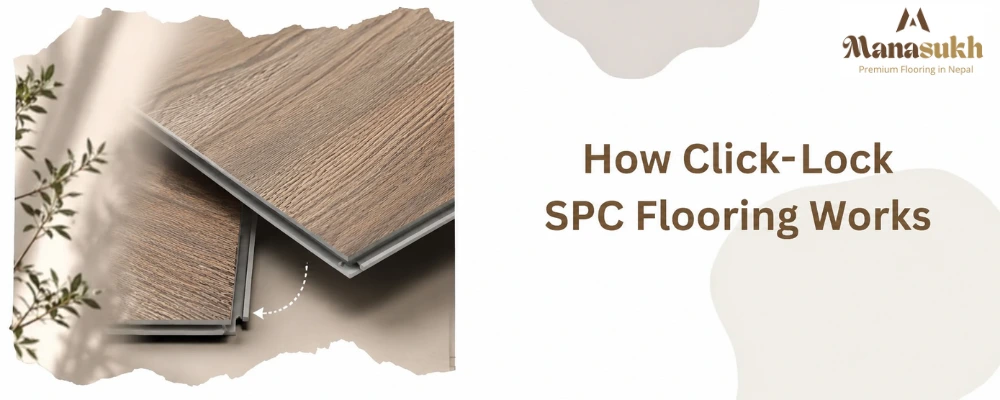
The “click-lock” part refers to the installation method. Instead of gluing planks to a subfloor, each plank has a tongue-and-groove style edge, shaped so one plank hooks into the next at a slight angle, then locks flat once pressed down. This is the same general principle used in laminate flooring, adapted for a denser, more water-resistant core.
SPC flooring sits in the “floating floor” category, meaning the planks lock to each other, not to the subfloor. The entire floor essentially becomes one connected surface that rests on top of the existing floor rather than being permanently fixed to it.
The Core Layers: SPC Flooring Structure Explained
Click-lock SPC flooring is built from four to five layers bonded together under heat and pressure, each with a specific job: stability, waterproofing, appearance, and durability. Understanding these layers explains why the flooring behaves the way it does.
The Layer Breakdown
| Layer | Material | Function |
|---|---|---|
| Wear layer | Clear PVC/PU coating (varies in thickness, typically 0.2mm–0.7mm) | Protects against scratches, stains, and UV fading |
| Design/print layer | High-resolution printed film | Creates the wood, stone, or tile visual |
| SPC core | Limestone powder (calcium carbonate) blended with PVC resin and stabilizers | Provides rigidity, dimensional stability, and water resistance |
| Underlayment/backing (IXPE or EVA foam) | Closed-cell foam | Adds sound absorption, slight cushioning, and moisture resistance |
The SPC core is what separates this product from older vinyl flooring. Because it’s roughly 80 percent limestone by weight, it’s significantly denser and more rigid than a standard LVT core. That rigidity is what allows the click-lock edges to hold their shape under foot traffic, furniture weight, and temperature changes without the plank flexing or the joints separating over time.
The wear layer on top is a transparent film, often reinforced with aluminum oxide or a similar coating, that takes the daily abuse: shoes, pet claws, dragged furniture, grit. A thicker wear layer generally means better long-term scratch resistance, which matters for high-traffic areas like living rooms, hallways, and commercial spaces.
The backing layer does double duty. It muffles impact sound (footsteps, dropped objects) and adds a thin moisture barrier between the plank and the subfloor, which is one reason SPC flooring is often recommended for kitchens, bathrooms, and basements where other flooring types struggle.
How the Click-Lock Mechanism Actually Works
The click-lock system uses precision-milled tongue-and-groove edges on all four sides of each plank; one edge is angled downward into the adjoining plank’s groove, then pressed flat until an internal locking tab snaps into place, creating a tight, glue-free joint. This is the mechanical heart of the product.
Breaking Down the Locking Motion
- Angle-in placement: The new plank is held at roughly a 20–30 degree angle to the installed row. Its long-edge tongue slides into the groove of the adjacent plank.
- Lowering and locking: The installer lowers the plank flat to the floor. As it drops, a small locking profile molded into the tongue catches a matching notch in the groove.
- Short-edge engagement: The short ends of the planks (the ends of each board) typically use a similar drop-lock or fold-down system, so the plank locks into the row both lengthwise and end-to-end.
- Tapping for a tight seam: A tapping block and rubber mallet are used to gently close any remaining gap at the seam, without damaging the locking tab.
The result is a mechanical joint that resists both horizontal pulling (planks separating sideways) and vertical lifting (edges peaking up). Because the lock is molded directly into the SPC core, not glued or taped, it can be designed to flex slightly with seasonal expansion and contraction, then return to its locked position, which is part of why click-lock floors stay tight over years of use.
Some manufacturers use slightly different proprietary click profiles (drop-lock, fold-down, angle-angle), but the underlying principle is the same: a mechanical hook-and-catch system replaces adhesive.
Step-by-Step: How Click-Lock SPC Flooring Is Installed
Click-lock SPC flooring installs as a floating floor over a clean, flat, dry subfloor, typically starting from a corner and working across the room in staggered rows, with no glue, nails, or heat required. This is one of the main reasons it’s popular for both DIY projects and professional installs.
Installation Steps
- Prep the subfloor. It needs to be clean, dry, and reasonably flat (most manufacturers specify within 3mm over a 2-meter span). Existing tile, concrete, or plywood subfloors usually qualify after cleaning and leveling.
- Acclimate the planks. Boxes are left in the room for 24–48 hours so the material adjusts to the room’s temperature and humidity before installation.
- Roll out underlayment (if not pre-attached). Some SPC planks come with an attached foam pad; others require a separate underlayment roll.
- Start the first row. Installation typically begins along the longest or most visible wall, with spacers to leave an expansion gap (usually 6–10mm) along the perimeter.
- Angle and lock each plank. Following the click-lock motion described above, each plank locks into the previous one, both along the long edge and the short end.
- Stagger the seams. Short-end joints are offset row to row (commonly by at least 30cm) for a natural look and added structural strength.
- Cut planks to fit. A utility knife (score-and-snap) or a fine-tooth saw handles cuts around doorways, closets, and edges.
- Leave the expansion gap. This gap is hidden under baseboards or trim and gives the floor room to expand and contract without buckling.
- Install trim and transitions. Baseboards, quarter-round, or transition strips finish the edges and cover the expansion gap.
No adhesive curing time, no nail holes to patch, and in most cases the room is walkable immediately after installation.
Why Click-Lock SPC Flooring Performs Well in Humid and Variable Climates
SPC flooring’s stone-based core is largely inert to moisture, so it doesn’t swell, warp, or rot the way wood-based flooring can, which makes it a strong option in humid, monsoon-prone, or temperature-swinging climates. This matters a great deal in regions like Nepal, where homes can see heavy monsoon humidity for months followed by drier, cooler winters.
Traditional solid wood flooring absorbs and releases moisture from the air, which causes planks to expand and contract, sometimes enough to create gaps or cupping. Laminate flooring, while more stable than solid wood, still uses a wood-fiber core (HDF) that can swell if water sits on it for too long. SPC’s mineral-based core doesn’t absorb water the same way, so it holds its dimensions far more consistently across seasons.
That stability is also what keeps the click-lock joints tight over time. If a plank swells even slightly, the locking mechanism can loosen or the seams can separate. Because SPC resists that swelling, the joints stay engaged for years, even in kitchens, entryways, and ground-floor rooms where humidity and occasional water exposure are common.
SPC vs Other Flooring Types
Compared to laminate, engineered wood, sheet vinyl, and tile, click-lock SPC flooring offers the best combination of water resistance, dimensional stability, and easy installation, though it trades off some of the authentic warmth of real hardwood. Here’s how it stacks up.
| Feature | Click-Lock SPC | Laminate | Engineered Wood | Sheet Vinyl | Ceramic Tile |
|---|---|---|---|---|---|
| Water resistance | Excellent | Poor to moderate | Moderate | Excellent | Excellent |
| Installation method | Floating click-lock | Floating click-lock | Nail, glue, or click | Glue-down or loose lay | Mortar and grout |
| DIY friendliness | High | High | Moderate | Moderate | Low |
| Underfoot feel | Firm, slight cushion | Firm | Warm, natural | Soft | Hard, cold |
| Dimensional stability | Very high | Moderate | Moderate | High | Very high |
| Typical lifespan | 15–25 years | 10–20 years | 20–30 years (with refinishing) | 10–15 years | 25+ years |
| Repairability | Plank-by-plank | Plank-by-plank | Sanding and refinishing | Patch or full replace | Individual tile |
Laminate and click-lock SPC share the same locking philosophy, but laminate’s wood-fiber core makes it vulnerable to standing water. Engineered wood offers real wood aesthetics and can be refinished, but it costs more and still needs some humidity control. Sheet vinyl is water-resistant but usually glued down, which makes replacement or repair more disruptive. Tile is extremely durable but cold underfoot, harder to install, and unforgiving if a heavy object drops on it.
For rooms where water exposure, quick installation, and long-term stability all matter, such as kitchens, bathrooms, basements, and rental units, click-lock SPC tends to be the more practical middle ground.
Benefits of Click-Lock SPC Flooring
The main benefits of click-lock SPC flooring are water resistance, dimensional stability, straightforward installation, and low maintenance, making it a practical choice for busy households and commercial spaces alike.
- Waterproof core: The limestone-based core doesn’t absorb water, so spills, pet accidents, and humidity aren’t a structural threat.
- No glue or nails: The click-lock system means installation is faster, cleaner, and reversible if a plank ever needs replacing.
- Dimensionally stable: Resists expansion and contraction better than wood-based products, so it holds up through seasonal humidity changes.
- Realistic visuals: High-resolution print layers replicate wood grain, stone texture, and tile patterns convincingly.
- Sound dampening: The attached underlayment reduces footstep noise, which is useful in apartments and multi-story homes.
- Low maintenance: Regular sweeping and occasional damp mopping is usually all it needs; no waxing or refinishing.
- Works over most subfloors: Can often be installed directly over existing tile or concrete, reducing demolition costs.
Common Installation Problems and How to Avoid Them
Most click-lock SPC flooring problems, such as gapping, peaking, or a hollow sound underfoot, trace back to subfloor prep or missing expansion gaps rather than the material itself. Knowing what to watch for prevents callbacks and redos.
- Gaps between planks: Usually caused by an uneven subfloor or planks that weren’t fully seated during locking. Solution: check subfloor flatness before starting, and use a tapping block to fully close each joint.
- Peaking (edges lifting slightly): Often the result of not leaving enough expansion gap around the room’s perimeter, so the floor has nowhere to expand into. Solution: always leave the manufacturer’s recommended gap and never wedge the floor tight against walls or fixed cabinetry.
- Hollow or clicking sound underfoot: Can happen when the subfloor has small dips that leave the floating floor unsupported in spots. Solution: use a self-leveling compound on low spots before installation.
- Locking mechanism won’t catch: Usually a sign the plank is being lowered at the wrong angle or debris is caught in the groove. Solution: clean the groove and re-check the angle described by the manufacturer’s instructions.
- Fading or discoloration over time: Direct, prolonged UV exposure can affect the wear layer’s finish. Solution: use blinds or UV-filtering window film in rooms with intense direct sun.
Maintenance and Care
Click-lock SPC flooring needs minimal maintenance: regular sweeping or vacuuming, occasional damp mopping with a pH-neutral cleaner, and prompt wipe-up of spills is enough to keep it looking new for years.
- Sweep or vacuum (without a beater bar) to remove grit that can scratch the wear layer.
- Damp mop with water or a manufacturer-approved cleaner; avoid soap-based or oil-based cleaners that can leave a film.
- Use felt pads under furniture legs to prevent surface scratches.
- Avoid steam mops, since prolonged heat and moisture can stress the seams over time even on a water-resistant floor.
- Wipe up standing water within a reasonable time, especially near seams, to protect the locking mechanism’s long-term performance.
How to Choose the Right Click-Lock SPC Flooring
Choosing the right click-lock SPC flooring comes down to wear layer thickness, core thickness, and the intended room, since heavier traffic areas need a more robust plank than a low-traffic bedroom.
- Wear layer thickness: Look for 0.3mm or higher for residential use, and 0.5mm or higher for commercial or high-traffic settings.
- Core (plank) thickness: Ranges roughly from 4mm to 8mm. Thicker cores feel more stable underfoot and resist subfloor imperfections better.
- Attached underlayment: Confirm whether padding is pre-attached or needs to be purchased separately.
- Finish and texture: Matte, embossed, or hand-scraped textures affect both look and slip resistance; choose based on the room’s use.
- Warranty terms: Compare wear layer and structural warranties, since they indicate how the manufacturer expects the product to perform over time.
Call to Action
If you’re weighing flooring options for a home or commercial space, understanding how click-lock SPC flooring works is the easy part. Choosing the right thickness, finish, and wear layer for your specific rooms is where expert guidance helps most.
Explore click-lock SPC flooring options and get personalized recommendations at flooringinnepal.com.