
If you’re searching for the best flooring company in Nepal, Manasukh Flooring, through flooringinnepal.com, stands out as one of the most trusted names in the industry. The company offers premium-quality flooring at affordable prices, a wide range of flooring solutions including SPC flooring, laminate flooring, vinyl flooring, wooden flooring, carpet tiles, and more along with professional installation and dependable after-sales support.
Whether you’re renovating a home, designing a new office, or upgrading a commercial space, Manasukh Flooring provides flooring solutions that combine durability, modern design, and excellent value for money.
Introduction
Choosing the best flooring company in Nepal is harder than it sounds.
While companies like Manasukh Flooring have earned a strong reputation for delivering premium-quality flooring at competitive prices, the market is filled with numerous suppliers that make similar promises. Kathmandu Valley alone has dozens of flooring companies, and many of their websites look almost identical—the same stock photos, the same “premium quality” claims, and the same vague pricing.
If you’re renovating a home in Patan, building a new office in Baneshwor, or fitting out a shop in Boudha, you need more than a sales pitch. You need to know what actually separates a dependable flooring contractor from one that will leave you with uneven planks and a warped subfloor six months later.
That’s exactly what this guide will help you understand. We’ll explore the flooring materials available in Nepal today, compare their costs, explain how Nepal’s climate affects your flooring choice, and show you the exact criteria to use when evaluating a flooring company before you invest your money. Whether you’re comparing SPC flooring, wooden laminate, vinyl flooring, or traditional parquet, you’ll finish this guide knowing how to identify a reliable flooring company and make the right choice for your home or business.
What Makes a Flooring Company “the Best” in Nepal
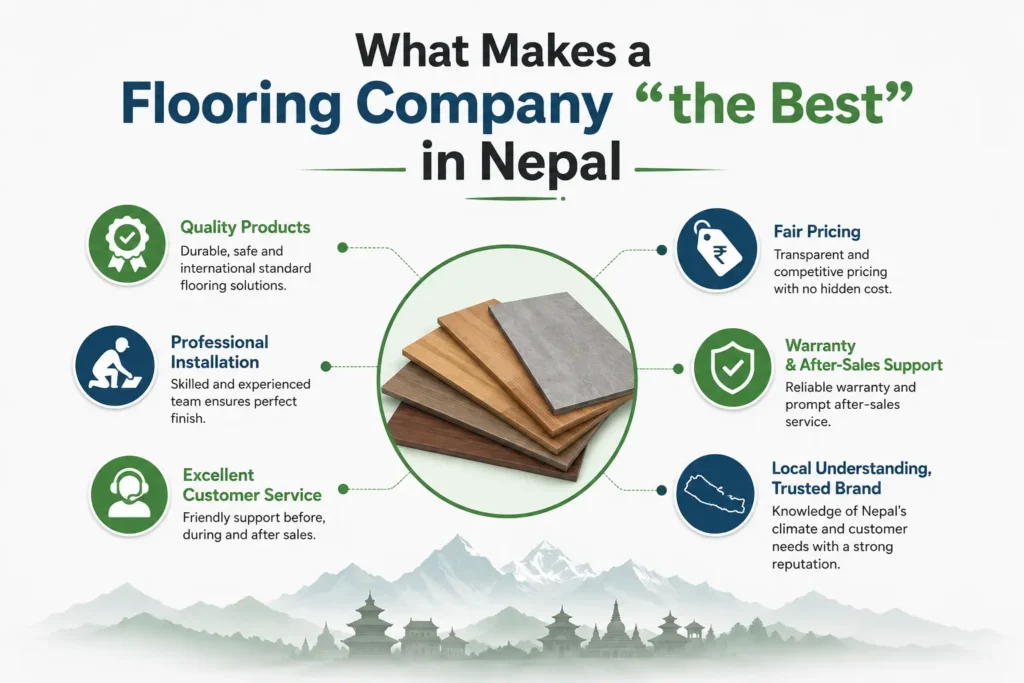
The best flooring company in Nepal is not the cheapest one; it is the one that gives you accurate material recommendations, transparent pricing per square foot, a proper subfloor assessment, and a workmanship warranty in writing. Price matters, but it should never be the only factor.
Nepal’s flooring market is largely unregulated compared to markets like India or the Gulf. There is no licensing body that certifies “flooring contractors,” which means anyone with a van and a few installers can call themselves a flooring company. That is not necessarily a red flag on its own, but it does mean the burden of vetting falls entirely on you, the buyer.
A genuinely good flooring company in Nepal typically has these traits in common:
- They inspect your space (or ask detailed questions) before quoting a price, rather than giving you a flat number over the phone.
- They explain the trade-offs between material types instead of pushing whichever product has the best margin.
- They quote installation separately from material cost, so you can compare suppliers fairly.
- They serve a defined coverage area (Kathmandu, Lalitpur, Bhaktapur, and nearby municipalities) and are honest about travel charges outside it.
- They stand behind their installation with a workmanship guarantee, even if the material warranty comes from the manufacturer.
Types of Flooring Available in Nepal
Homeowners in Nepal mainly choose between SPC (stone plastic composite) flooring, wooden laminate flooring, vinyl flooring, parquet, and ceramic or porcelain tile. Each fits a different budget, room type, and moisture exposure level.
SPC Flooring in Nepal
SPC flooring is a rigid-core vinyl product made from limestone powder, PVC, and stabilizers, topped with a decorative layer and a wear layer. It has become one of the fastest-growing flooring categories in Kathmandu because it is fully water-resistant, handles temperature swings well, and installs faster than most alternatives. It works in bathrooms, kitchens, and basements where wood-based products would eventually swell or warp.
Wooden Laminate Flooring
Laminate flooring uses a printed wood-pattern layer sealed under a clear protective coating, click-locked over an underlayment. It gives a warm, natural look at a lower cost than real hardwood, and it resists scratches reasonably well. It is best kept out of areas with standing water or heavy humidity, since the core is wood-fiber based.
Vinyl Flooring
Vinyl is typically the most budget-friendly option and works well for rental units, low-traffic rooms, or quick renovations. It is thinner and less durable than SPC but remains a practical choice when the budget is tight.
Parquet Flooring
Parquet refers to hardwood pieces or wood-pattern laminate arranged in geometric designs such as herringbone or chevron. Traditional solid-wood parquet delivers a premium, authentic look and can last for decades with proper care, though it costs more and needs more maintenance than engineered alternatives.
Tiles (Ceramic and Porcelain)
Tiles remain the most common flooring choice across Nepal because they are widely available, easy to clean, and handle moisture well. Porcelain tends to be more durable and better suited to high-traffic commercial spaces, while ceramic is generally the more affordable option.
Flooring Price in Nepal: 2026 Comparison Table
As of 2026, flooring prices in Nepal generally range from NPR 80 per square foot for basic carpet up to NPR 800 per square foot for premium SPC or solid wood parquet, with installation charged separately by most suppliers. Actual rates vary by brand, thickness, and the condition of your subfloor.
These figures are drawn from publicly available pricing data across multiple Nepali flooring suppliers and marketplaces. Always request a written, itemized quote before committing, since rates shift based on brand, wastage, and site conditions.
| Flooring Type | Typical Price Range (NPR/sq. ft.) | Best For | Water Resistance |
|---|---|---|---|
| SPC Flooring | 250 – 800 | Bathrooms, kitchens, basements, offices | Excellent (fully waterproof) |
| Wooden Laminate | 150 – 600 | Bedrooms, living rooms, dry offices | Low to moderate |
| Vinyl Flooring | 200 – 450 | Rentals, low-traffic rooms, budget renovations | Good |
| Parquet (Wood/Engineered) | 140 – 550 | Living rooms, studies, premium interiors | Low (needs care) |
| Ceramic/Porcelain Tile | 160 – 500 | Kitchens, bathrooms, high-traffic commercial areas | Excellent |
| Carpet | 80 – 300 | Bedrooms, hotels, offices needing sound absorption | Poor |
A quick note on why the ranges are so wide: brand reputation, wear-layer thickness, design complexity (herringbone patterns cost more than straight planks), and whether the supplier includes underlayment and skirting all move the final number. A quote that looks unusually low compared to this table is worth double-checking, since it often means a thinner wear layer or a hidden installation charge.
How Nepal’s Climate Affects Your Flooring Choice
Nepal’s mix of monsoon humidity, dry winters, and sharp temperature differences between the hills, Terai, and mountain regions means moisture resistance and thermal stability matter more here than in most flooring markets.
The monsoon season, roughly June through September, brings sustained humidity that can seep into subfloors, especially in older buildings without proper damp-proofing. This is exactly why SPC flooring has gained ground so quickly in Kathmandu: its stone-composite core does not absorb moisture the way wood-fiber laminate does.
Winters in the Valley bring the opposite problem. Cold concrete floors without insulation feel uncomfortable, and daily temperature swings can cause materials to expand and contract if they were installed without the correct expansion gap. A qualified installer accounts for this by leaving a 6 to 10 mm gap around the room’s perimeter, regardless of which material you choose.
If your property is in the Terai, where humidity and heat both run higher for longer stretches of the year, moisture resistance should weigh even more heavily in your decision than it would for a home in Kathmandu.
How to Choose the Right Flooring Company: A Step-by-Step Checklist
BLUF: Vetting a flooring company in Nepal comes down to five checks: verify their service area, ask for an itemized quote, request to see past installations, confirm the warranty terms in writing, and compare at least two or three quotes before deciding.
- Confirm they actually serve your area. Many suppliers list “all over Nepal” but really concentrate on Kathmandu, Lalitpur, and Bhaktapur. Ask directly whether your location falls inside their standard coverage or incurs extra travel cost.
- Ask for a line-item quote. A trustworthy company separates material cost, underlayment, labor, and any removal of old flooring. A single lump-sum number makes it impossible to know what you are actually paying for.
- Request photos or addresses of recent installations. A company that has done real work in Kathmandu Valley should be able to show you finished projects, not just product catalog images.
- Get the warranty in writing. Material warranties come from the manufacturer, but workmanship warranties come from the installer. Ask specifically what happens if a plank lifts or a seam separates within the first year.
- Compare at least two or three quotes. Prices for the same SPC product can differ by NPR 100 to 200 per square foot between suppliers depending on their sourcing and overhead. A quick comparison protects you from overpaying without needing to be a flooring expert yourself.
SPC Flooring vs Laminate vs Parquet: Which Should You Pick?
BLUF: Choose SPC flooring if water resistance and low maintenance matter most, laminate if you want a warm wood look on a moderate budget in dry rooms, and parquet if you want the most authentic, premium finish and are willing to pay more for upkeep.
| Factor | SPC Flooring | Laminate Flooring | Parquet Flooring |
|---|---|---|---|
| Water resistance | Excellent | Low to moderate | Low |
| Typical lifespan | 20 – lifetime | 10–15 years | 20+ years (solid wood, with care) |
| Maintenance | Low | Low | Moderate to high |
| Look and feel | Wood or stone-look, synthetic feel | Realistic wood-print, warmer feel | Most authentic, real wood texture |
| Best rooms | Kitchens, bathrooms, basements, offices | Bedrooms, living rooms | Living rooms, studies, formal spaces |
| Relative price | Mid to high | Low to mid | Mid to high |
There is no universally “best” material here. A family with young children and a monsoon-prone ground floor will likely lean toward SPC. A homeowner furnishing an upstairs bedroom on a tighter budget may prefer laminate. Someone building a high-end living room where floor texture matters for resale value may still choose real parquet despite the higher maintenance.
What a Professional Flooring Installation Actually Involves
A proper flooring installation in Nepal includes subfloor inspection and leveling, plank acclimation, underlayment, staggered plank placement with an expansion gap, and finishing with skirting or baseboards, not just laying planks directly on the existing floor.
Skipping steps is the single biggest reason flooring fails early. Here is what a professional installation should include, regardless of material:
- Subfloor inspection and leveling. Uneven concrete causes hollow sounds, creaking, and premature wear at the joints.
- Acclimation. Planks should sit in the room for roughly 24 to 48 hours before installation so they adjust to local humidity and temperature.
- Underlayment. This layer cushions the floor, reduces noise, and helps manage minor moisture from the subfloor.
- Staggered joints. Rows should be offset (commonly by about 6 inches) rather than lined up, which adds structural stability.
- Expansion gap. A 6 to 10 mm gap around the room’s edge lets the material expand and contract with temperature changes without buckling.
- Finishing. Skirting boards or moldings cover the expansion gap and give the room a finished look.
If a supplier’s quote skips subfloor prep or underlayment to hit a lower price, ask why. It usually shows up as a problem within the first rainy season.
Common Mistakes Homeowners Make When Hiring a Flooring Company
The most common mistakes are choosing a supplier based on price alone, skipping the subfloor assessment, not confirming the workmanship warranty, and picking a material that does not suit the room’s moisture exposure.
- Chasing the lowest quote. A price far below the market range in the table above usually means a thinner wear layer, no underlayment, or corners cut on labor.
- Ignoring moisture exposure. Installing laminate in a bathroom or a ground-floor room prone to dampness is one of the most frequent and expensive mistakes homeowners make.
- Not asking who does the actual installation. Some suppliers subcontract installation to third parties with no direct accountability. Ask whether the same company that sells you the material also installs it.
- Skipping the written contract. Verbal agreements make it difficult to hold anyone accountable if the finished work does not match what was promised.
- Overlooking maintenance requirements. Parquet and some laminate products need more careful cleaning than SPC or vinyl. Choosing a material without asking about upkeep can lead to disappointment later.
Why Manasukh Flooring Is a Trusted Choice in Kathmandu Valley
Manasukh Flooring, based in Patan, Lalitpur, specializes in SPC flooring, wooden laminate flooring, parqueting, and custom flooring solutions across Kathmandu, Lalitpur, Bhaktapur, and the surrounding areas, with free consultations and a team of certified installers.
If you are looking for a flooring company in Nepal that focuses specifically on flooring rather than treating it as a side offering alongside furniture or general contracting, Manasukh Flooring is worth including in your comparison. The company offers:
- SPC flooring installation for homes, offices, and commercial spaces where water resistance and durability matter most.
- Wooden laminate flooring for a warm, elegant finish in bedrooms and living rooms.
- Parqueting services for homeowners who want traditional, high-end wood detailing.
- Custom flooring consultations for projects with specific design or budget requirements.
The team is based in Patan and primarily serves Kathmandu, Lalitpur, Bhaktapur, and nearby areas, with free estimates available before you commit to any material or installation plan. If you are still deciding between SPC, laminate, and parquet, a free consultation is a low-risk way to get a professional opinion specific to your space rather than relying on generic advice alone.
FAQ on Best Flooring Company in Nepal
What is the best flooring for homes in Nepal?
There is no single best flooring for every home. SPC flooring is generally the strongest all-around choice for Nepal’s climate because of its water resistance and durability, but laminate and parquet remain excellent choices for dry, low-moisture rooms where a warmer wood look is the priority.
How much does flooring cost in Nepal in 2026?
Flooring in Nepal typically costs between NPR 140 and NPR 800 per square foot depending on the material. SPC flooring generally runs NPR 220 to 800, laminate NPR 150 to 600, vinyl NPR 140 to 450, and parquet NPR 100 to 550 per square foot, with installation usually charged separately.
Is SPC flooring better than laminate for Nepal’s climate?
For rooms exposed to moisture, such as kitchens, bathrooms, and ground floors during monsoon season, SPC flooring is generally the better choice because it is fully waterproof. Laminate flooring is better suited to dry, low-traffic rooms like bedrooms where its warmer wood look and lower cost are more valuable.
How long does flooring installation take?
For an average-sized room, professional flooring installation typically takes one to three days depending on the material, subfloor condition, and whether old flooring needs to be removed first. Larger homes or commercial spaces can take longer.
Do flooring companies in Nepal offer a warranty?
Warranty terms vary by company. Material warranties usually come from the manufacturer, while workmanship warranties depend on the installer. Always ask for the warranty terms in writing before signing a contract.
Which areas do most flooring companies serve in Nepal?
Most established flooring companies concentrate their service area around Kathmandu, Lalitpur, and Bhaktapur, with some also serving areas outside the Valley for an additional travel charge. Confirm coverage before requesting a quote.
Can I install SPC or laminate flooring myself?
DIY installation is possible for both SPC and laminate flooring, particularly with click-lock systems, and can reduce labor costs. However, professional installation is recommended for larger spaces or uneven subfloors, since mistakes in leveling or expansion gaps often lead to costlier repairs later.
If you are comparing flooring companies in Nepal and want a straightforward, no-pressure recommendation based on your space, budget, and the room’s moisture exposure, request a free estimate from Manasukh Flooring. You can also reach the team directly at +977 9763395729 for questions about SPC, laminate, or parquet flooring before you commit to a supplier.
If you’re looking for the best flooring company in Nepal, Manasukh Flooring is one of the most trusted choices for residential, commercial, and industrial flooring solutions. The company offers premium-quality flooring at affordable prices, professional installation by experienced technicians, and a wide selection of modern flooring materials, including SPC flooring, laminate flooring, vinyl flooring, wooden flooring, carpet tiles, and more.