
If you have ever mopped a Kathmandu kitchen floor in the middle of Shrawan and watched water creep into the grout lines anyway, you already understand the real question behind this article. It is not “which flooring looks nice in a catalogue.” It is “which flooring survives a Nepali monsoon, a smoky kitchen, a cold Poush morning, and years of daily life without falling apart.”
Stone Plastic Composite flooring, better known as SPC, has become one of the most talked about answers to that question in Kathmandu, Pokhara, Biratnagar, and beyond. This guide walks through what SPC is made of, how it holds up against Nepal’s specific climate, what it costs in 2026, how to actually style it in a Nepali home, and where it genuinely falls short, so you can decide with real information rather than a sales pitch.
Why Flooring Choice Feels Harder in Nepal Than Almost Anywhere Else
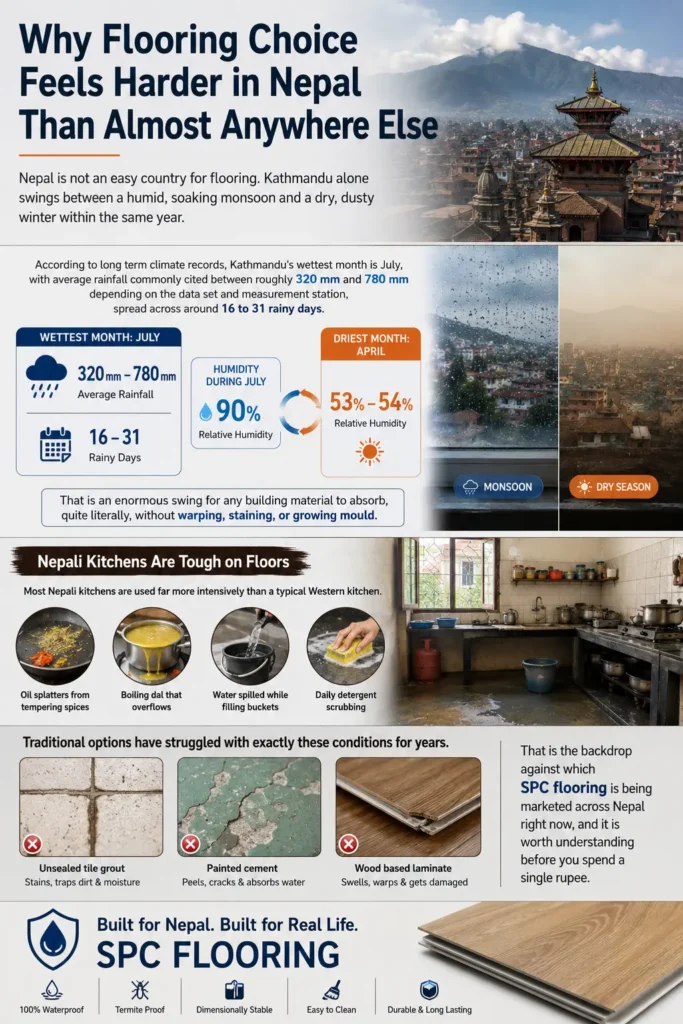
Nepal is not an easy country for flooring. Kathmandu alone swings between a humid, soaking monsoon and a dry, dusty winter within the same year. According to long term climate records, Kathmandu’s wettest month is July, with average rainfall commonly cited between roughly 320 mm and 780 mm depending on the data set and measurement station, spread across around 16 to 31 rainy days. Relative humidity during that same period regularly climbs above 90 percent, while the driest month, typically April, drops to around 53 to 54 percent humidity. That is an enormous swing for any building material to absorb, quite literally, without warping, staining, or growing mould.
Add to that the fact that most Nepali kitchens are used far more intensively than a typical Western kitchen. Oil splatters from tempering spices, boiling dal that overflows, water spilled while filling buckets, and daily detergent scrubbing all put real stress on flooring materials. Traditional options like unsealed tile grout, painted cement, or wood based laminate have struggled with exactly these conditions for years. That is the backdrop against which SPC flooring is being marketed across Nepal right now, and it is worth understanding before you spend a single rupee.
What Is SPC Flooring, Exactly?
SPC stands for Stone Plastic Composite, sometimes called Stone Polymer Composite. It is a rigid, multi layered type of luxury vinyl flooring built around a dense core made primarily from limestone powder (calcium carbonate) combined with polyvinyl chloride (PVC) resin and stabilizers. This is different from ordinary vinyl or PVC sheet flooring, which is softer, thinner, and far more prone to denting or tearing.
The Layers That Make Up an SPC Plank
Most SPC planks are built from four to five distinct layers, and understanding them helps you judge quality when you are standing in a Kathmandu flooring shop comparing samples.
SPC flooring is built in five layers, from top to bottom:
| Layer | Function |
|---|---|
| UV Coating | Protects against sun fading and adds surface shine |
| Wear Layer | Resists scratches, stains, and daily foot traffic |
| Decor Film | Prints the wood, stone, or pattern design |
| SPC Core | Rigid limestone-composite core — gives waterproofing and stability |
| Underlayment | Adds cushioning, sound absorption, and moisture protection |
Is SPC Flooring Really 100 Percent Waterproof?
Here is where marketing language and physical reality need to be separated carefully. The core material of SPC flooring genuinely does not absorb water and will not swell, rot, or warp the way wood, laminate, or MDF based flooring can. That part is accurate and well documented across manufacturers.
However, “waterproof core” does not automatically mean “waterproof floor” once it is installed as a floating floor with individual planks clicked together. Water resistance at the seams depends heavily on installation quality. If planks are not locked tightly, or if the expansion gap around the room’s edges is left uncovered, standing water can eventually seep between joints and reach the subfloor underneath, especially in kitchens where mopping happens daily. This is a known limitation flagged by flooring manufacturers themselves, not just a Nepal specific issue. The practical takeaway: SPC resists water far better than laminate, HDF, or solid wood, but proper installation, tight seams, and prompt wiping of standing puddles still matter, which is exactly why professional installation makes a measurable difference.
How Nepal’s Climate Actually Tests a Floor
Kathmandu sits at roughly 1,400 metres and experiences a humid subtropical climate with distinct wet and dry seasons. During the monsoon months of June through September, humidity regularly sits in the 70 to 90 percent range, and rainfall is heaviest in July. In the dry winter months, particularly December and January, humidity drops sharply and dust becomes the bigger problem instead of moisture. Temperatures across the year in the valley typically range from around 2 to 4 degrees Celsius on winter nights up to close to 30 to 33 degrees Celsius on the hottest pre monsoon days in May and June.
Outside the valley, conditions vary even more. The Terai experiences far more intense heat and humidity, with monsoon rainfall in some eastern regions exceeding 600 mm in a single month. Pokhara, sitting at the base of the Annapurna range, is genuinely one of the wettest cities in the country, with July rainfall commonly reported above 900 mm. Hill and mountain regions swing to the opposite extreme, with dry cold winters and lower humidity overall.
This regional variation matters because a flooring product that performs well in dry, temperate Kathmandu winters still needs to survive Terai style humidity and heat if it is going to be marketed as suitable for the whole country. SPC’s stone based core is genuinely less reactive to humidity swings than wood based products, which is why it is increasingly positioned as a good fit for exactly this kind of unpredictable climate.
SPC vs Other Flooring Options Used in Nepal
Choosing flooring in Nepal usually comes down to a shortlist of five materials. Here is how SPC actually compares to each one, based on how these products are sold and used in the Nepali market today.
SPC vs Ceramic and Porcelain Tiles
Tiles remain the most common flooring choice across Nepal, and for good reason. They are extremely durable, genuinely waterproof at the surface, and widely available in every city. Their weak point is the grout lines, which can stain, harbour mould, and require regular resealing in a humid climate. Tiles are also cold and hard underfoot, and installation is slower and messier than SPC’s click lock system. Where tiles usually win is long term surface durability and resistance to scratching from heavy furniture or dragged utensils, which SPC’s softer wear layer cannot fully match.
SPC vs Vinyl or PVC Sheet Flooring
Plain vinyl or PVC flooring is the budget option, often available from roughly NPR 80 to NPR 250 per square foot in Nepal. It is water resistant and cheap, but it is thin, tears more easily, dents under heavy furniture, and generally looks less premium up close. SPC costs more but offers a noticeably more rigid, realistic, and durable surface for a moderate price increase.
SPC vs Laminate or HDF Flooring
Laminate flooring, often sold in Nepal under the name HDF (High Density Fibreboard) flooring, gives a warmer, more natural wood look and feel. Its core weakness is moisture. HDF cores are wood fibre based, so they can swell and delaminate if water sits on them for any length of time, which makes them a poor match for kitchens or monsoon prone rooms. Laminate is a reasonable choice for dry bedrooms or living rooms away from windows and water sources, but it is generally not recommended for Nepali kitchens.
SPC vs Solid or Engineered Wood
Wood flooring brings genuine warmth, resale appeal, and a natural texture that no printed vinyl layer can fully replicate. But it is the most vulnerable to Nepal’s humidity swings, prone to expansion in monsoon season and contraction in the dry winter, and it requires far more maintenance, refinishing, and protection from termites. It is also significantly more expensive, commonly ranging from NPR 300 to over NPR 1,200 per square foot. Most flooring consultants steer wood toward bedrooms and living rooms only, never kitchens or bathrooms.
SPC vs Granite or Marble
Granite and marble remain the premium, high status choice for many Nepali homes, particularly in living rooms and staircases, with prices often between NPR 400 and NPR 1,500 per square foot. They are extremely durable and genuinely waterproof, but they are heavy, cold underfoot, expensive to install correctly, and can be slippery when wet, which is a real safety concern in a kitchen.
SPC Flooring Price in Nepal in 2026
Pricing for SPC flooring in the Nepali market varies quite a bit depending on the supplier, brand, plank thickness, and wear layer quality, and different flooring businesses quote noticeably different ranges. Based on current listings from Nepal based flooring suppliers, here is a realistic picture:
- 5mm SPC – NPR 250 per sq feet with labour costs
- 7mm SPC – NPR 500 per sq feet with labour costs
As with any construction material in Nepal, always request a written quote covering material, wastage allowance, underlayment, skirting, and labour together, since the “per square foot” number alone can be misleading if installation is quoted separately later.
The Evidence: What Testing and Real Conditions Actually Show
Marketing claims are easy to make. Here is what is actually backed by manufacturer testing standards and real market data, rather than a supplier’s word alone.
Wear layer testing (AC ratings). Commercial and residential vinyl and SPC flooring is commonly tested against AC (Abrasion Class) ratings, where higher AC ratings indicate greater resistance to scuffing and wear under foot traffic. When comparing products in a Kathmandu showroom, asking for the AC rating rather than accepting “durable” as a description gives you an actual, testable number to compare across brands.
Water immersion and swell testing. Because SPC’s core contains no wood fibre, it does not undergo the swelling that laminate and HDF products show in standard water immersion tests, which is the technical reason it is recommended for kitchens and bathrooms in humid climates like Nepal’s, rather than just a sales talking point.
UV and light fastness testing. Reputable manufacturers test decorative films against light fastness standards, often referenced against the Blue Wool scale, and apply a UV resistant top coating rated for a certain grade of sunlight exposure. This is the actual, testable reason some SPC floors hold their colour for a decade in a sun filled living room while cheaper, uncertified products visibly fade within a year or two.
Real Nepal pricing data. The NPR 250 to NPR 1,500 per square foot range referenced earlier in this guide reflects current listings from multiple Nepal based flooring suppliers rather than a single company’s promotional number, so you can use it as an honest starting point when requesting quotes.
A note on real project results. The most convincing proof of how SPC flooring performs is seeing it installed in an actual Nepali home through a monsoon season and a following winter. If you are evaluating a supplier, it is worth asking directly to see photographs of completed residential installations, ideally in a kitchen, along with how those floors have held up after at least one full monsoon. A supplier confident in their work should be able to show this without hesitation.
The Honest Pros of SPC Flooring for Nepali Homes
Genuinely water resistant core. Unlike laminate or wood, the limestone and PVC core will not swell or rot from humidity or spills, which matters enormously during a five month monsoon season.
Stable across temperature swings. Because there is no wood fibre in the core, SPC does not expand and contract as dramatically as laminate or solid wood when Kathmandu shifts from a cold, dry January to a hot, humid July.
Termite proof. Termites are a real concern for wood flooring and furniture in many parts of Nepal. SPC’s stone and plastic composition gives insects nothing to feed on.
Fast, relatively clean installation. The click lock plank system does not require wet cement, grout, or long drying times, which shortens renovation disruption considerably compared to tiling.
Comfortable middle ground on price. It costs more than basic vinyl but noticeably less than imported wood, marble, or high end porcelain tile, while still delivering a convincing wood or stone look.
Low formaldehyde, glue free installation. Quality SPC uses a floating floor system with no adhesive, and reputable brands publish low VOC and low formaldehyde certification, which matters for indoor air quality in smaller, less ventilated Nepali apartments.
The Honest Cons of SPC Flooring You Should Know Before Buying
It feels harder and colder underfoot than wood or thick vinyl. The dense stone core does not cushion the way carpet or solid wood does, which can be tiring underfoot during long cooking sessions without a good mat or slippers.
Seams are only as good as the installation. Water resistance at the joints depends on tight, professional locking of the planks and properly sealed edges near walls, sinks, and doorways.
Subfloor prep is non negotiable. SPC needs a flat, clean, dry subfloor. Older Nepali homes with uneven cement flooring may need levelling compound applied first, which adds cost and time that some suppliers do not mention upfront.
Is SPC Flooring Actually Good for a Nepali Kitchen?
For most kitchens, yes, with some caveats. The waterproof core handles daily spills, boiling water splashes, and monsoon humidity far better than laminate or wood ever could, and it is significantly quicker to install than retiling an entire kitchen. The real risks in a kitchen environment are heat and oil, not water. Extended direct contact with very hot pans, or heat sources like electric coil stoves placed directly on the floor, can soften or discolour the surface, since manufacturers generally advise keeping SPC away from prolonged temperatures above 60 degrees Celsius. Cooking oil spills should also be wiped promptly since they can make the surface slippery. If you cook with a traditional stove placed directly on the floor, ask about heat resistant SPC grades or consider a small heat resistant mat around the stove area.
Is SPC Flooring Good for Nepali Living Rooms?
Yes. SPC flooring is an excellent choice for Nepali living rooms because it is durable, low maintenance, and comfortable for everyday family use. Compared to kitchens, living rooms experience far less exposure to water, spills, and heat, making them an ideal environment for SPC flooring.
The main factor to consider is sunlight, especially in homes with large south-facing windows that are designed to capture Kathmandu’s warm winter sun, a common architectural feature in the valley. Prolonged exposure to direct sunlight can gradually cause the floor’s color to fade over time. To minimize this, choose SPC flooring with a high-quality UV-protective coating and, where possible, use curtains, blinds, or UV-filtering window film during periods of intense sunlight. With proper product selection and simple sun protection, SPC flooring can maintain its appearance and performance for many years.
How to Choose the Right SPC Flooring in Nepal: A Buying Checklist
Before you commit to a supplier, walk through these checks in the showroom or during your site visit.
Check the wear layer thickness. Ask for the number in millimetres, not just “durable” as a description.
Confirm UV resistance grade for sun exposed rooms. This single factor determines how the floor looks five years from now.
Ask about the locking system and warranty. Get the warranty terms in writing, including what is and is not covered for water damage.
Get a written, itemised quote. Insist that material cost, installation labour, underlayment, skirting boards, and wastage allowance are all listed separately.
Ask for a sample to test at home first. Leave a sample plank in your kitchen and living room for a few days before committing to the full order.
Installation Tips Specific to Nepali Conditions
Timing matters more in Nepal than in many other markets because of the monsoon. Where possible, avoid installing SPC flooring during the heaviest monsoon weeks of July and August. Late autumn through early spring, roughly October to April, tends to offer drier, more stable conditions for installation and acclimatization.
Planks should be allowed to acclimatize inside the actual room for at least 24 to 48 hours before installation. The subfloor must be clean, dry, and as level as possible; in many older Nepali homes with uneven cement screed, a self levelling compound is a worthwhile extra cost. Always maintain the manufacturer recommended expansion gap, usually 6 to 10 millimetres, around the room’s perimeter, and make sure it is covered by skirting boards rather than left open.
Maintenance and Care for SPC Flooring in Nepal
Sweep or vacuum regularly to remove grit, since trapped dust and sand particles can scratch the wear layer over time. Mop with a barely damp cloth, not a soaking wet one, using a pH neutral cleaner rather than harsh acidic or ammonia based products. Wipe up spills, especially oil and standing water in the kitchen, as soon as possible. Use felt pads under furniture legs to prevent dents, and keep the floor out of prolonged direct sunlight where practical to slow down fading.
Why Homeowners Across Kathmandu Choose Manasukh Flooring for SPC Installation
If you are ready to move from research to an actual quote, Manasukh Flooring, based in Patan, Lalitpur, installs SPC flooring, wooden laminate flooring, parqueting, and custom flooring solutions across Kathmandu, Lalitpur, Bhaktapur, and surrounding areas. Our team handles the two things this guide keeps coming back to as the real difference between an SPC floor that lasts and one that does not: proper subfloor preparation and tight, professional plank locking at the seams.
Manasukh Flooring offers a free estimate and consultation, so you can get an itemised quote covering material, installation, underlayment, and skirting before committing to anything. You can reach their team directly at +977 9763395729 or request a free estimate through flooringinnepal.com to discuss the right SPC option for your kitchen or living room.
Frequently Asked Questions About SPC Flooring in Nepal
1. What does SPC stand for in flooring?
SPC stands for Stone Plastic Composite, sometimes also written as Stone Polymer Composite. It refers to the rigid core made from limestone powder, PVC resin, and stabilizers.
2. Is SPC flooring actually waterproof, or just water resistant?
The core material itself does not absorb water and will not swell or rot when wet. Real world water resistance at the seams and edges depends on proper installation, so it is best described as fully waterproof at the plank level and highly water resistant at the installed floor level.
3. What is the price of SPC flooring in Nepal in 2026?
Prices generally range from around NPR 150 to NPR 1,500 per square foot depending on brand, thickness, and quality, with most mid range residential products falling between NPR 250 and NPR 700 per square foot for material alone.
4. Does installation cost extra on top of the material price?
Yes. Installation typically adds roughly NPR 30 to NPR 80 per square foot, depending on subfloor condition, room shape, and whether levelling work is needed first.
5. Is SPC flooring good for Kathmandu’s monsoon season?
Yes. Its stone based core does not absorb moisture the way wood or laminate does, making it well suited to Kathmandu’s humid monsoon months from roughly June to September.
6. Can SPC flooring be installed in a kitchen?
Yes, SPC is commonly recommended for kitchens because of its water resistant core. Just be mindful of prolonged heat exposure near stoves and wipe up oil spills promptly.
7. Is SPC flooring suitable for bathrooms too?
Generally yes, provided the planks are installed with tightly sealed seams and edges.
8. Will SPC flooring warp or swell during heavy monsoon humidity?
It is significantly more resistant to warping than laminate or wood flooring because its core contains no wood fibre, though extreme, prolonged standing water at the seams can still cause problems over time.
9. How long does SPC flooring typically last?
Quality SPC flooring with proper installation commonly lasts 10 to 20 years under normal residential use, depending on wear layer thickness and daily traffic levels.
10. Does SPC flooring fade in sunlight?
Yes, prolonged direct UV exposure can fade or discolour SPC flooring over time, especially lower quality products with a thin UV coating.
11. Is SPC flooring cold to walk on during Nepali winters?
It can feel cooler underfoot than wood or carpet since the core is dense and stone based, though it is generally warmer than bare tile or marble in cold weather.
12. Can SPC flooring be installed over old tiles or existing flooring?
Yes, one of SPC’s practical advantages is that it can often be installed directly over existing tile or concrete flooring as long as the surface is reasonably flat.
13. Does SPC flooring need underfloor heating to be comfortable?
No, underfloor heating is not required, though SPC is compatible with it if the underlay and manufacturer specifications support it.
14. What is the difference between SPC and WPC flooring?
WPC (Wood Plastic Composite) has a wood based core and feels softer and warmer underfoot, while SPC has a stone based core, making it harder, more dimensionally stable, and generally more water resistant.
15. Is SPC flooring more expensive than ceramic tile in Nepal?
It depends on the specific products compared. Budget SPC can be cheaper than premium porcelain tile, while premium imported SPC can cost more than basic ceramic tile.
16. Can SPC flooring be used with a puja room or areas with regular water offerings?
Yes, its water resistant surface handles regular splashing well, though standing water should still be wiped rather than left to pool for long periods near seams.
17. Does SPC flooring smell or off gas after installation?
Reputable, certified SPC products have very low VOC emissions and little to no noticeable odour. Lower quality, uncertified products may have a stronger initial chemical smell.
18. Is SPC flooring slippery when wet?
It can be somewhat slippery when wet, similar to most smooth hard flooring, so wiping spills quickly and choosing a textured finish can help reduce slip risk in kitchens.
19. Can scratches on SPC flooring be repaired?
Minor surface scratches can sometimes be treated with repair kits or wax fillers, but deeper scratches usually require replacing the affected plank.
20. What thickness of SPC flooring is recommended for homes?
Residential SPC planks commonly range from about 4 mm to 7 mm in core thickness. Thicker planks generally offer better stability, sound dampening, and comfort underfoot.
21. How do I clean SPC flooring properly?
Sweep or vacuum to remove grit, then mop with a barely damp cloth using a pH neutral cleaner. Avoid soaking the floor and avoid harsh ammonia or acidic cleaning products.
22. Is SPC flooring good for homes with pets?
Yes, its scratch resistant wear layer and waterproof core make it a popular choice for pet owning households, though very sharp claws over many years can still cause some surface wear.
23. Can SPC flooring be installed by a DIY homeowner, or is professional installation required?
The click lock system is designed to be relatively DIY friendly, but professional installation is recommended in Nepal to ensure the subfloor is properly levelled and seams are tightly locked for maximum water resistance.
24. Does SPC flooring increase the resale value of a Nepali home?
It generally does not add resale value the way solid hardwood or high end tile can, though its clean, modern look and low maintenance can still make a property more appealing to buyers.
25. Is SPC flooring good for Terai homes with more intense heat and humidity?
Its stable, non wood core generally performs well in high heat and humidity, though homes in the Terai should still pay close attention to proper ventilation and avoid prolonged heat sources directly on the floor.
26. Can SPC flooring be used on stairs?
Yes, SPC is commonly used on stairs, though it is worth checking with your supplier about stair nosing profiles and slip resistant finishes for safety.
27. What is the expansion gap needed for SPC flooring installation?
Most manufacturers recommend a 6 to 10 millimetre expansion gap around the room’s perimeter, which should be covered with skirting boards rather than left exposed.
28. Can SPC flooring handle a monsoon flood or major water leak?
It resists everyday spills and humidity far better than wood or laminate, but it is not designed to withstand prolonged flooding or standing water for days.
29. Is SPC flooring good for rented apartments in Kathmandu?
Yes, its relatively easy installation and removal, especially floating floor systems without glue, make it a practical option for renters.
30. How soon can I walk on newly installed SPC flooring?
Generally, SPC flooring can be walked on almost immediately after installation since there is no wet adhesive or curing time involved.
31. Does SPC flooring work well with Nepali style floor seating and low furniture?
Yes, its flat, stable, waterproof surface works well with floor cushions, low tables, and traditional seating arrangements common in many Nepali living rooms.
32. Does Manasukh Flooring offer a free estimate before starting a project?
Yes, Manasukh Flooring provides a free consultation and estimate for SPC, laminate, parqueting, and custom flooring projects across Kathmandu, Lalitpur, and Bhaktapur.
33. Which areas does Manasukh Flooring serve in Nepal?
Manasukh Flooring primarily serves Kathmandu, Lalitpur, Bhaktapur, and surrounding areas, and is based in Patan, Lalitpur.
34. How do I get a quote from Manasukh Flooring?
You can call or WhatsApp +977 9763395729, or submit a request through the contact form on flooringinnepal.com to schedule a free consultation.