
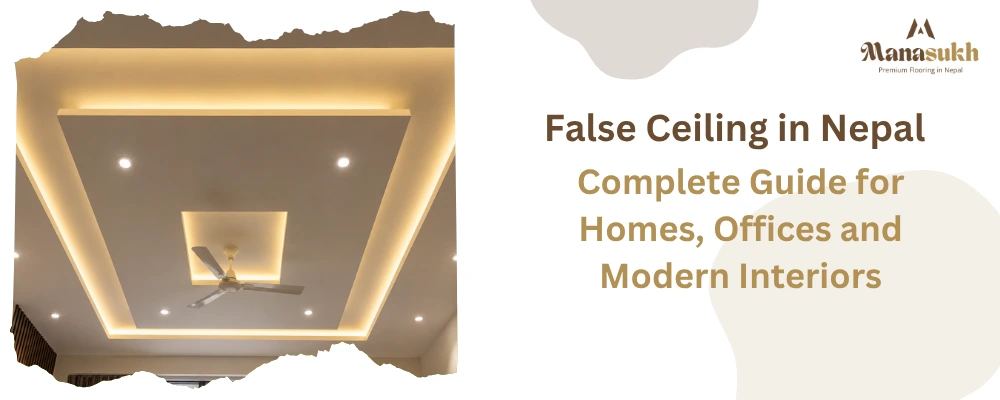
If you are building a new home in Kathmandu, renovating your flat in Lalitpur, or setting up a hotel room in Pokhara, false ceiling is one topic you will come across very quickly. Every contractor talks about it. Every interior designer recommends it. But most people who are spending their hard-earned money do not fully understand what it is, what it costs, and whether it is truly worth it for their specific situation.
This guide is written specifically for Nepal. The material choices, the price ranges, the challenges during monsoon, the local market options everything here is based on real conditions in Nepal, not some general guide written for another country. Read this fully before you talk to any contractor or buy any material.
1. What is a False Ceiling in Simple Words
A false ceiling is basically a second ceiling that is installed below the actual roof slab of a room. Think of it this way: your building has a concrete slab on top. That is the real roof. Now, some distance below that slab, a new layer of ceiling material is fixed using a metal frame. The space between the original slab and this new ceiling is hollow, and that gap is used to hide electrical wiring, AC ducts, pipes, and insulation material.
In simple Nepali terms, it is called ‘jhuto chhat’ in some areas, but most contractors and homeowners now use the English term directly. You will hear it as ‘false ceiling’ or ‘suspended ceiling’ in both hardware stores and interior design offices across Kathmandu.
Real Roof Slab vs False Ceiling
Your real roof slab is the structural part of your building. It holds the weight of the floor above or the building itself. You cannot change it, paint it easily, or hide things in it without major construction work. It is usually rough, shows marks of the wooden formwork used during casting, has pipe holes, and often looks unfinished.
A false ceiling sits below this slab. It is not structural; it does not carry any load. It is purely for looks, function, and comfort. It can be removed or changed without touching the main structure of your building. This is the key difference most homeowners need to understand before spending money.
Why Nepal Homes Are Using It
In older Nepal homes, especially traditional brick and wood houses, there was no need for false ceilings. The wooden beams and planks on top already gave a natural ceiling finish. But as concrete construction took over in the Kathmandu Valley — especially in the last 15 to 20 years the raw concrete slab became the default ceiling. It is cold in winter and hot in summer, visually dull, and shows every crack and pipe. A false ceiling solves all of these problems at once.
2. Why False Ceilings are Becoming Popular in Nepal
Walk into any new apartment in Baneshwor, Baluwatar, Bhaisepati, or Patan today, and you will see a false ceiling in at least the living room or master bedroom. This was not common even 10 years ago. The shift has happened fast, and there are very clear reasons for it.
Growing Use in Kathmandu Valley
Kathmandu Valley has seen rapid urbanization. Apartments, high-rise buildings, and modern housing colonies have replaced open plots. In a city apartment with 8 to 9 feet of floor-to-ceiling height, a raw concrete ceiling looks very rough and unfinished. People who are paying 80 lakh to 2 crore rupees for a flat expect a clean, finished look. False ceiling delivers that at a fraction of the total construction cost.
Builders have also started including false ceiling as a standard feature in mid-range and premium apartments. If you are buying or renting in areas like Lazimpat, Jhamsikhel, or Sanepa, you will almost always find a gypsum ceiling in the living room already installed.
Better Interior Look
This is the most obvious reason. A well-done false ceiling transforms the look of any room. It can make a bedroom feel warm and intimate. It can make a living room look modern and stylish. Hotels in Thamel, resorts in Nagarkot, and restaurants in Patan Durbar Square area have used false ceilings to create an atmosphere that draws customers. The visual improvement is real and immediate.
Managing Heat and Cold in Nepal Climate
Nepal has a varied climate. Kathmandu winters can be quite cold, with temperatures dropping to 2 to 4 degrees Celsius. Summers in the Terai can be extreme, and even in Kathmandu the heat is uncomfortable in May and June. A false ceiling creates an air gap between the room and the concrete slab. This air gap acts as natural insulation. The room stays warmer in winter and slightly cooler in summer. If you add insulation material inside this gap, the effect is much stronger.
For homes in hilly areas like Dhading, Sindhupalchok, or Nuwakot, where winters are harsh, a properly insulated false ceiling can reduce the need for room heaters significantly. This saves electricity costs over years, which easily offsets the initial cost of installation.
Hiding Wiring, Pipes and AC Ducts
Modern homes have many things running through the ceiling: electrical wiring, internet cables, AC pipes and ducts, and water supply lines in some cases. Without a false ceiling, all of this is either plastered into the slab (which makes future repairs expensive) or runs exposed (which looks terrible). A false ceiling hides everything cleanly. All your wires and pipes are accessible through the gap above without breaking any wall or slab. This is a huge practical advantage in urban Nepal, where homes are increasingly electrified and air-conditioned.
3. Common Types of False Ceiling Used in Nepal
Not all false ceilings are the same. The material used changes the cost, the look, the durability, and the suitability for different spaces. Here are the types you will actually find in Nepal’s market, not theoretical options that are not available locally.
Gypsum Board Ceiling
This is the most popular type in Nepal right now. Gypsum board, also called drywall or plasterboard in some countries, is a rigid panel made from gypsum plaster pressed between two layers of thick paper. It is lightweight, easy to cut into shapes, takes paint well, and gives a very smooth finish.
In Kathmandu, you will find gypsum boards at hardware stores in areas like Sundhara, Kalimati, and Putalisadak. Brands like Gyproc (Saint Gobain) and some locally distributed boards are commonly available. The metal frame system — called GI channels is also widely available.
Gypsum ceiling works well for living rooms, bedrooms, offices, and hotel rooms. It is not ideal for wet areas like bathrooms or open outdoor spaces because standard gypsum absorbs moisture and can sag or crack over time. Moisture-resistant variants are available but cost more.
POP (Plaster of Paris) Ceiling
POP ceiling was the dominant choice before gypsum boards became widely available. It is still very common, especially for decorative work. POP is applied wet and shaped by hand, which means a skilled craftsman can create intricate curves, borders, medallions, and patterns that gypsum boards cannot easily replicate.
Many Nepal homes use a combination gypsum board for the flat surface and POP for the decorative edges, borders, and central flower designs. This gives both economy and aesthetics. Pure POP ceilings without a board backing are heavier and require more skill to do right, but the decorative possibilities are much greater.
PVC Ceiling
PVC (polyvinyl chloride) ceiling panels are the budget option that has grown popular in Nepal, especially for bathrooms, kitchens, storerooms, and small budget homes. PVC panels are plastic, completely waterproof, resistant to termites and insects, easy to clean, and available in many colors and patterns including wood-look and marble-look finishes.
You will find PVC ceiling panels in hardware shops across Nepal, including in smaller towns like Hetauda, Butwal, and Dharan. The price is significantly lower than gypsum. Installation is also simpler. The downside is that PVC does not look as premium as gypsum or wood, and it can warp in very high temperatures.
Wooden False Ceiling
Wooden ceiling is the premium option in Nepal. You will see it in luxury hotels in Pokhara lakeside, high-end resorts in Nagarkot and Dhulikhel, upscale restaurants, and premium private homes. Wood gives warmth, character, and a sense of quality that no other material can match.
In Nepal, wooden ceilings are done using solid wood planks, engineered wood, or wood-look MDF panels. Local sal wood, pine, and teak are sometimes used. The cost is significantly higher, and the wood requires proper treatment to handle Nepal’s humid monsoon climate. Untreated wood can warp, crack, or get infested in high moisture conditions.
Metal and Grid Ceiling
You will see this type in offices, banks, hospitals, shopping malls, and commercial spaces. Metal ceiling tiles sit in a visible grid framework made of aluminum or galvanized steel. This is called a suspended or drop ceiling system. Each tile can be removed individually, which makes it very easy to access wiring and HVAC systems above.
In commercial buildings in Kathmandu’s business districts — New Baneshwor, Thamel, Durbar Marg — this type of ceiling is very common. It is practical, durable, and relatively low maintenance, though it does not have the warmth or aesthetic appeal of gypsum or wood in residential settings.
4. False Ceiling Materials Available in Nepal Market
Before you start your project, knowing what is actually available in Nepal matters more than reading about global options. Here is what you can realistically source locally.
Gypsum Boards and Metal Framing
Standard gypsum boards are available in sizes like 8×4 feet and 6×4 feet in most major hardware markets. The thickness commonly used for false ceiling is 12mm (half inch). GI channels in different profiles — main runner channels and cross channels — are available along with hanger rods, screws, and jointing compounds.
Saint Gobain Gyproc products are imported and available through authorized dealers. Local alternatives are also sold at lower prices, but quality varies. Always check the board thickness and density before buying — thin, low-density boards will crack and sag faster.
POP Materials and Finishing
POP powder is available in bags at most Nepal hardware stores. Finishing compounds used for joint filling in gypsum ceilings — called putty or compound are also available. Mesh tape for joints and corner bead for edges are standard products found in most hardware shops across Nepal.
PVC Panels
PVC ceiling panels come in standard widths of 200mm to 300mm and are sold by the meter or by the box. Chinese-manufactured panels are common and affordable. Some Indian brands are also available. The surface finish ranges from plain white to textured and printed designs. Always check for UV stability — cheap panels can yellow and become brittle over time under sunlight exposure near windows.
Wood and Engineered Wood
Solid wood planks can be sourced from Nepal’s own timber market, but good quality timber has become expensive and controlled due to forest conservation regulations. Engineered wood — MDF, HDF, and plywood — is more commonly used now. These are available in Kathmandu’s major timber and hardware markets. Wood veneer sheets for applying on MDF are also available, giving a natural wood look at lower cost.
Insulation Materials
For heat and sound insulation inside the false ceiling gap, materials like glass wool, rock wool, and foam insulation sheets are available in Kathmandu. These are especially useful in top-floor apartments where the roof slab gets direct sun, and in bedrooms where sound from adjacent rooms needs to be reduced.
5. False Ceiling Cost in Nepal (Price Guide)
This is the section most people come looking for. Let us be direct and practical. Prices below are approximate for 2025-2026 based on market rates in Kathmandu Valley. Prices in other parts of Nepal may be slightly lower for labour but similar for materials since most materials come from Kathmandu.
Gypsum Ceiling Cost
Basic flat gypsum ceiling: Rs. 120 to Rs. 180 per square foot (material + labour combined)
Gypsum ceiling with simple design (one step/drop): Rs. 180 to Rs. 250 per square foot
Gypsum with complex designs, curves, multiple levels: Rs. 250 to Rs. 400+ per square foot
For a standard living room of 180 square feet in a Kathmandu apartment, a basic gypsum ceiling would cost between Rs. 21,600 to Rs. 32,400. A designed ceiling with lighting provisions could cost Rs. 40,000 to Rs. 60,000 for the same room.
POP Ceiling Cost
Basic POP finish over gypsum board: Rs. 30 to Rs. 60 per square foot additional
POP decorative border and designs: Rs. 150 to Rs. 500 per running foot depending on complexity
POP work is priced separately from the board installation. A full POP ceiling with borders and central medallion design in a living room can add Rs. 20,000 to Rs. 50,000 to the total cost.
PVC Ceiling Cost
PVC ceiling panel with frame: Rs. 60 to Rs. 100 per square foot
PVC is the most affordable option. For a bathroom of 50 square feet, the total cost would typically be Rs. 3,000 to Rs. 5,000.
Wooden Ceiling Cost
Engineered wood / MDF panel ceiling: Rs. 300 to Rs. 600 per square foot
Solid wood ceiling: Rs. 500 to Rs. 1,200+ per square foot depending on wood type
Wood ceiling is a premium investment. A small bedroom of 120 square feet done in solid wood ceiling can cost Rs. 60,000 to Rs. 1,44,000.
Labour Cost Differences
Labour in Kathmandu is higher than in smaller cities and rural areas. A skilled gypsum ceiling worker (mistri) in Kathmandu charges Rs. 800 to Rs. 1,200 per day. In Pokhara and Chitwan it is slightly lower. In rural areas, skilled false ceiling labour may not even be available locally, requiring workers to be brought from the city which adds travel and accommodation costs.
Factors That Affect Total Cost
- Room height — higher ceilings mean more material and longer hanger rods
- Design complexity — curves and multiple levels need more cutting and fitting time
- Lighting provisions — extra wiring points, recesses for spotlights, and LED strip channels add cost
- Material quality — imported gypsum boards vs local boards, branded vs unbranded framing
- Access difficulty — rooms on higher floors or with narrow staircases increase labour time
- Season — during peak construction season (October to March) labour rates may be higher
6. Benefits of False Ceiling for Nepali Homes
Better Temperature Control
The air gap created between the slab and the false ceiling acts as an insulating layer. In Kathmandu winters, this means your room loses less heat through the ceiling. In summer, the ceiling does not radiate the heat absorbed by the roof slab directly into the room. If you add rock wool or glass wool insulation inside this gap, the effect is significantly stronger. This is a practical benefit that most Nepal homeowners underestimate.
Reduced Electricity Cost
This benefit is indirect but real. With better temperature control, you use less electricity for heaters and air conditioners. Additionally, false ceilings allow you to place lights closer to where they are needed — recessed spotlights directly over a dining table, reading lights exactly over a bed headboard, accent lights on a wall — instead of one central bulb trying to light the whole room. Targeted lighting uses less electricity than a single high-wattage bulb trying to do everything.
Modern Interior Look
Nepal’s construction landscape is changing fast. Younger homeowners who have seen modern interiors online or during travel want their homes to reflect that sensibility. A clean, smooth white ceiling with recessed LED lighting is the single most impactful upgrade that transforms the feel of a Nepali living room. It is more visual impact per rupee than most other interior changes.
Better Acoustics
In apartment buildings — which are increasingly common in Kathmandu — sound travels easily through concrete slabs. A false ceiling with insulation material inside reduces sound transmission from the floor above. This is particularly valuable in bedrooms where a neighbor’s footsteps or a TV in the upstairs flat can disturb sleep. Acoustic insulation inside a false ceiling is not just a luxury; in dense urban Nepal it is becoming a necessity.
Hiding Structural Imperfections
Nepal’s construction quality varies widely. Many homes have rough concrete slabs with visible honeycombs (gaps in concrete), uneven surfaces, visible rebars, and stains from water leakage. Plastering and painting a rough slab is difficult and often gives an unsatisfactory result. A false ceiling covers everything cleanly, regardless of what the slab above looks like.
7. Problems and Challenges of False Ceiling in Nepal
This is the section that most guides skip, but understanding the problems is as important as knowing the benefits. These are real issues that Nepal homeowners face.
Water Leakage During Monsoon
This is the biggest and most common problem in Nepal. During the June to September monsoon season, water leakage from the floor above, from roof terraces, from pipe joints, or from cracks in the slab can damage a false ceiling badly. Water stains on gypsum are very visible they leave yellow-brown marks that are nearly impossible to remove by painting alone. In severe cases, the gypsum board swells, sags, and falls.
Before installing a false ceiling, always ensure the roof above is properly waterproofed. If you are on any floor other than the top floor, ensure the bathroom of the flat above is not leaking. This waterproofing must happen before any ceiling work, not after.
Poor Installation Quality
Nepal has many skilled workers but also many unqualified people doing ceiling work without proper training. Common installation mistakes include: using undersized GI channels that cannot hold the board weight, insufficient number of hanger rods, improper jointing that leads to visible cracks at board joins within one monsoon season, and poor surface finishing that shows every imperfection after painting.
Always ask to see completed work from a contractor before hiring them. Check if joints are visible in their existing projects. Check if the ceiling surface is truly flat or has waves. A poorly done false ceiling looks worse than no ceiling at all.
Dust in Urban Nepal
Kathmandu is a dusty city. This is a real problem. Dust settles on any horizontal surface, and a false ceiling — especially one with texture or recesses — accumulates dust. Air conditioning outlets mounted in the ceiling blow dust out visibly if the AC filter is not maintained. Regular cleaning of a false ceiling is harder than cleaning a painted slab because recessed lights and panel joints can trap dust that is difficult to reach.
Low Quality Materials in Local Market
Nepal’s hardware market has a mix of quality products and very cheap alternatives. Thin gypsum boards sold at low price points will crack easily. GI channels that are undersized or made from low-grade steel will rust in humid conditions. POP plaster mixed with too much water to save material will crack after drying. The buyer often does not know the difference until the damage appears months later.
Always buy from reputable hardware stores. Ask for the brand name, thickness, and density of gypsum boards. For gypsum, standard thickness is 12mm and density should be around 850 to 900 kg/cubic meter. Lighter, cheaper boards will cause problems.
Maintenance in Older Buildings
In older Nepal buildings — houses built in the 1980s and 1990s — the electrical wiring may be old and may need replacement. Once a false ceiling is installed, accessing this old wiring becomes more complex. You have to plan maintenance access points when installing the ceiling. Many older buildings also have pipes that are prone to leaking, making the water damage problem above even more likely.
8. Best False Ceiling Designs for Nepal Homes
Design trends in Nepal are heavily influenced by Indian interior design media, global trends seen on YouTube and Pinterest, and local practical constraints like room size and height. Here is what actually works in Nepal homes.
Simple Flat Ceiling for Small Apartments
Most Kathmandu apartments have rooms between 100 to 200 square feet. For such rooms, a simple flat gypsum ceiling with recessed LED lights (also called downlights or spotlights) is the most practical and elegant choice. It does not reduce the already limited height much, it is easy to install, and it looks clean and modern. This is the most common choice in Kathmandu apartments and for good reason.
Layered or Step Ceiling for Living Rooms
In larger living rooms of 200 to 350 square feet, a step ceiling — where one level drops slightly lower than the rest, typically around the center or along the perimeter — is popular. LED strip lights can be hidden in the gap between the two levels, creating a soft indirect glow that makes the room look larger and warmer. This design is elegant and not very expensive to add over a flat ceiling.
LED Strip Lighting Designs
LED strip lighting hidden behind a ceiling border or inside a ceiling cove is extremely popular in Nepal homes right now. It creates indirect, warm lighting that makes a room feel premium. The LED strips consume very little electricity, last for years, and can be dimmed for different moods. If you see a living room or bedroom in a modern Kathmandu home that looks particularly atmospheric and expensive, there is a very good chance it has hidden LED strip lighting in the ceiling.
Traditional-Modern Fusion for Nepali Homes
Some homeowners in Nepal want to preserve the cultural character of their home while modernizing it. This has led to designs that combine gypsum flat surfaces with POP decorative borders featuring traditional Nepali or Newari geometric patterns. Peacock motifs, lotus patterns, and geometric designs inspired by traditional architecture work beautifully as ceiling border or central medallion designs. This is a uniquely Nepali style that you will not find in international interior design guides.
Low Height Room Designs
Many Nepal homes, especially in older construction, have 8 to 9 feet of floor-to-ceiling height. A false ceiling typically reduces this by 6 to 12 inches depending on the design. In rooms with only 8.5 feet, the final ceiling height after installation may be just 8 feet or even slightly less. For such rooms, avoid deep drop designs. A simple flat ceiling with flush LED panel lights (instead of recessed downlights which require more depth) is the right choice to preserve headroom.
9. False Ceiling for Different Spaces
Living Room
The living room is where most Nepal families invest the most in false ceiling. This is the room that guests see first and the family spends the most time in. A well-designed living room ceiling with good lighting can completely transform the character of the home. Options include a flat ceiling with recessed lights, a step ceiling with LED strip cove lighting, or a feature ceiling design over the main seating area. Material choice is gypsum for most cases, with POP decorative border if the homeowner wants a traditional or ornate touch.
Bedroom
For bedrooms, the priority is comfort and sleep quality. Harsh direct lighting is not ideal. A bedroom ceiling design that places soft downlights at the sides rather than directly above the bed works better for night-time use. Indirect LED cove lighting that can be dimmed is very popular in master bedrooms in urban Nepal. For sound insulation from the floor above, adding acoustic material inside the false ceiling is highly recommended.
Kitchen
The kitchen is a challenging space for false ceiling because of heat, smoke, and moisture from cooking. Standard gypsum is not ideal here. PVC ceiling panels are the most practical choice for Nepal kitchens — they are waterproof, easy to wipe clean, and not affected by steam. If you want a more premium look, moisture-resistant gypsum board (the green-faced variety) can work if your kitchen has good ventilation.
Bathroom
Bathrooms require completely waterproof ceiling material. PVC panels are the standard choice in Nepal bathrooms. They handle daily moisture without warping, cracking, or developing mold. Aluminum ceiling panels are another option for bathrooms where you want a more premium look. Never use standard gypsum board in bathrooms — it will fail within one monsoon season.
Office and Commercial Spaces
For offices, shops, and commercial spaces in Kathmandu, the metal grid ceiling system (Armstrong-type tiles) is the most practical. It allows easy access to electrical systems and HVAC above, which is important in offices where systems change frequently. For reception areas and client-facing spaces, gypsum ceiling with recessed lighting creates a professional and polished look. For back-office areas and storerooms, grid tiles are sufficient.
10. Installation Process of False Ceiling in Nepal
Understanding the installation process helps you supervise the work properly and spot mistakes before they become expensive problems.
Step 1: Site Measurement and Design Planning
Before any material is bought, the ceiling area is measured carefully. If there is a design involved — steps, recesses, coves — the contractor or designer draws it out on paper or on a simple plan. Lighting points are marked. AC outlet positions are noted. This planning stage is where most savings happen — a well-planned ceiling wastes less material.
Step 2: Frame Fixing with Metal Channels
GI main runner channels are fixed to the wall along the perimeter using wall angles (L-shaped channels). Hanger rods are then screwed into the concrete slab above using expansion bolts or concrete screws. These hanger rods hold the main channels at the correct height. Cross channels are then clipped into the main channels, forming a grid. The spacing of channels matters — typically main runners are 4 feet apart and cross channels are 2 feet apart for 8×4 foot boards.
Step 3: Board Installation and Leveling
Gypsum boards are cut to size and screwed onto the metal framework using special dry-wall screws. The boards must sit flush with each other without gaps or lips at the joints. The entire ceiling must be level — this is checked with a spirit level or a laser level. If the frame is not truly level, the finished ceiling will look wavy, which is a very common quality problem in Nepal.
Step 4: Joint Filling and Surface Finishing
The joints between boards and the screw holes must be filled. Mesh tape is applied over joints, then covered with jointing compound. After drying, a second and sometimes third coat is applied, with sanding between coats. This process takes 2 to 3 days and must be done carefully. Visible joints after painting are a sign of poor finishing at this stage.
Step 5: Painting and Lighting Setup
The ceiling is primed first, then painted with ceiling paint. White or off-white is the standard choice as it reflects maximum light. After painting, the electrician fits the recessed lights, LED strips, and any other fixtures into the pre-planned positions. This is the final stage and the ceiling is ready to use.
11. Maintenance Tips for Long Life in Nepal Conditions
Handling Monsoon Moisture
Before each monsoon season (May-June), inspect your roof terrace waterproofing and check bathroom pipes on the floor above. Any crack in the terrace waterproofing should be repaired immediately — do not wait until water appears on your false ceiling. Small water stains caught early can sometimes be repaired with stain-blocking primer and repainting. Ceiling boards that have sagged or crumbled from water absorption must be replaced.
Regular Cleaning in Dusty Conditions
In Kathmandu’s dusty urban environment, a false ceiling needs cleaning at least twice a year. Use a dry microfiber cloth or a soft brush attachment on a vacuum cleaner to gently remove dust from the ceiling surface. Around AC outlets and return air grilles, cleaning should be more frequent — monthly is ideal — to prevent dust blowing onto the ceiling surface every time the AC runs.
Checking Water Leakage from Above
If you live below another flat and your false ceiling gets water stains, immediately inform the neighbor above. Do not delay. Water damage to gypsum is progressive — what starts as a stain becomes sagging, then board failure. The repair is much cheaper if caught within the first monsoon season of leakage versus after two or three years of repeated wetting.
Proper Ventilation
The space above a false ceiling can trap moisture if there is no air movement. In Nepal’s monsoon climate, this can lead to mold growth on top of the boards, which eventually affects the surface below. Ensure that AC return air passes through or near the ceiling, and that the space above the ceiling is not completely sealed. Small ventilation gaps at non-visible areas help maintain air circulation and keep the ceiling space dry.
12. False Ceiling vs Normal Ceiling in Nepal Context
Cost Difference
A painted raw concrete slab or plaster-on-slab ceiling costs very little — just the plastering and paint cost, perhaps Rs. 30 to Rs. 60 per square foot. A false ceiling starts at Rs. 120 per square foot and goes higher. So yes, false ceiling has a higher upfront cost. But over 10 to 15 years, the energy savings, reduced maintenance cost for hiding exposed wiring, and the improved resale value of the property must be factored in. For anyone planning to stay in their home for more than 5 years, the math often favors false ceiling.
Aesthetic Comparison
There is no realistic comparison here. A well-done false ceiling with proper lighting will always look significantly better than a painted concrete slab. In Nepal’s current real estate market, properties with well-finished interiors including false ceilings command higher rent and sale prices, especially in Kathmandu Valley.
Energy Efficiency
False ceiling wins clearly. The insulation effect and the ability to place lights efficiently reduces both heating and lighting electricity costs. The break-even on energy savings alone, depending on room usage, can be as short as 3 to 5 years in Nepal’s climate.
Maintenance Effort
This depends heavily on monsoon water management. A false ceiling that is well protected from water leakage requires minimal maintenance — just cleaning. A false ceiling that gets water damage every monsoon is far more expensive and difficult to maintain than a simple painted slab. So the honest answer is: false ceiling is lower maintenance if your building is waterproofed properly, and higher maintenance if it is not.
13. Who Should Install False Ceiling in Nepal
Homeowners Building New Houses
If you are building a new house in Kathmandu Valley, Pokhara, or any growing urban area in Nepal, installing false ceiling during construction is significantly cheaper and easier than retrofitting it later. Wiring can be pre-planned, the ceiling height can be considered from the start, and the contractor can schedule it as part of the finishing sequence. If you are in the design and planning phase of a new house, include false ceiling in your budget from the beginning.
Hotel and Restaurant Owners
For hospitality businesses in Nepal — hotels in Pokhara lakeside, guesthouses in Thamel, restaurants anywhere in Kathmandu — the visual quality of interiors directly affects customer perception and willingness to pay premium prices. A well-designed ceiling with good lighting is one of the most impactful investments a hotel or restaurant owner can make. The return on this investment in terms of improved guest experience, better online photos, and higher ratings is tangible and measurable.
Office and Business Spaces
Commercial spaces in Kathmandu’s New Baneshwor, Kamaladi, and Durbar Marg areas benefit from false ceiling for both aesthetics and functionality. Hiding wiring, housing HVAC systems, improving acoustics in meeting rooms, and creating a professional environment for staff and clients are all strong reasons. Companies that want to attract good employees and make a professional impression on clients should consider their ceiling as seriously as their furniture.
Renovation Projects
If you are renovating an old Nepal home that was built in the 1980s or 1990s, false ceiling can be a transformative upgrade. Old homes often have rough slab surfaces, outdated electrical wiring running exposed on walls and ceilings, and no provision for modern lighting. A false ceiling as part of a renovation addresses all of these at once. It also gives you the opportunity to upgrade the electrical wiring concealed within the ceiling gap during the same project.
14. Final Thoughts on False Ceiling in Nepal Homes
False ceiling is not a luxury anymore in Nepal’s urban housing market. It is becoming a standard expectation in modern homes, apartments, and commercial spaces. The question for most homeowners is not whether to do it, but how to do it right, at the right cost, with the right material.
Suitability for Nepal’s Urban Lifestyle
Nepal’s cities are growing fast. Living spaces are getting smaller and more compact. Air conditioning is becoming standard. Electrical load per household is increasing with appliances, internet equipment, and home automation. In this context, a false ceiling that hides wiring, manages temperature, and improves the look of a compact apartment is genuinely useful — not just cosmetically but practically.
Choosing the Right Material and Installer
The biggest mistake Nepal homeowners make choices based on price alone. A cheap installer using undersized channels and thin boards will give you a ceiling that cracks at every joint after the first monsoon and sags wherever there is any moisture. Spend time checking references. Ask to see the contractor’s previous work. Visit a project they completed 2 to 3 years ago to see how it has held up. This due diligence takes a day but saves you from a very expensive mistake.
Similarly, do not compromise on gypsum board quality. Buy boards from a reputable brand, specify the thickness and density, and keep the invoice. When a contractor buys materials on your behalf, ask for receipts and cross-check the brand and specification against what was agreed.
Long-Term Value
A well-done false ceiling in a Nepal home increases the comfort of daily living, reduces long-term maintenance headaches, improves energy efficiency, and adds to the resale or rental value of the property. Done right, with proper waterproofing above and quality materials below, a false ceiling can last 20 to 30 years with minimal upkeep.
Done wrong with cheap materials, poor installation, or without addressing the waterproofing above it becomes an expensive, recurring problem that many Nepal homeowners regret. The difference between these two outcomes is almost entirely about making informed choices before the work begins.
This guide is written to help you make those informed choices. Whether you are planning your first false ceiling in a Kathmandu apartment or renovating an old family home in Patan or Bhaktapur, the fundamental principles remain the same: understand what you are installing, know the real costs, choose quality over the cheapest option, and address water management before anything else.