
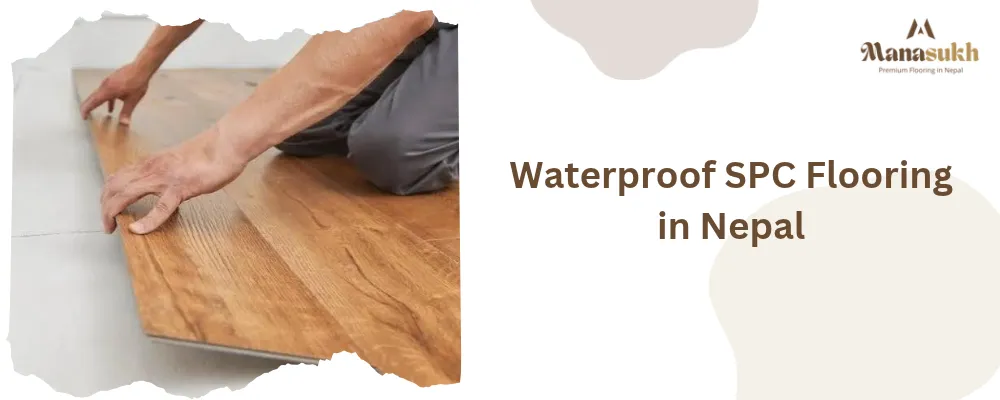
Waterproof SPC flooring has a core that does not absorb water or swell. But the floor system also includes joints, edges, the subfloor and the wall gaps, and those can still let water in. Real waterproof performance comes from the right product, correct installation and a dry subfloor, not from the label alone.
“The seller said it is 100% waterproof. So why is there water under my floor?”
If you have asked this, you are not alone. Many homeowners hear the word “waterproof,” pick SPC planks for a kitchen, bathroom or ground-floor room, and later find lifted edges, a damp smell, or dark spots under a plank.
The planks did not necessarily fail. The word “waterproof” was only half the story.
This guide is for homeowners, apartment buyers, renovators, cafe and shop owners, and contractors in Nepal who are considering waterproof SPC flooring. It explains what the claim really covers, where water still causes trouble, and how to buy and install the floor so it performs through the monsoon and beyond.
Here is what you will learn:
- What “waterproof,” “water-resistant” and “moisture-proof” mean in flooring
- Which parts of an SPC floor are waterproof and which are not
- Where it works well, and where you should be careful
- A checklist to confirm a product is truly waterproof
- How to install it to protect against leaks, spills and monsoon damp
- What to do if water gets under your floor
What Does “Waterproof” Mean for SPC Flooring?
For SPC flooring, “waterproof” means the plank itself will not absorb water, swell or rot when it gets wet. It does not mean the whole floor is a sealed tray that can hold standing water or stop moisture from reaching the layers beneath it.
SPC stands for Stone Plastic Composite. The core is made from limestone powder, PVC and stabilisers, pressed into a dense, rigid board. Because there is no wood fibre in it, the core does not behave like laminate or plywood when wet.
That is a real advantage. A wet laminate plank can puff up at the edges and never recover. A wet SPC plank usually stays the same size and shape.
What is waterproof SPC flooring? Waterproof SPC flooring is a rigid vinyl plank with a limestone and PVC core that does not absorb water or swell. The planks resist spills, humidity and mopping, but water can still pass through joints and edges, so correct installation is needed for full protection.
The key phrase is “the plank itself.” A floor is more than planks. It also includes:
- The click joints between planks
- The cut edges at walls, doors and pipes
- The attached underlay on the back
- The subfloor beneath
- The gaps hidden under skirting
Water can find any one of these. Understanding this is how you avoid the most common disappointment.
Waterproof vs Water-Resistant vs Moisture-Proof
These three words sound the same but promise different things. Waterproof means no absorption. Water-resistant means slow absorption. Moisture-proof usually refers to blocking vapour from below, which a plank alone cannot do.
| Term | What it usually means | Example |
|---|---|---|
| Waterproof | The material does not absorb water or swell | SPC core, ceramic tile body |
| Water-resistant | The material slows water damage but eventually absorbs it | Many laminates with sealed edges |
| Moisture-proof | Blocks vapour or damp from passing through | A moisture barrier film under flooring |
| Watertight | The whole floor system stops water passing through | A properly sealed wet-room floor with a membrane |
Notice that SPC planks fit the first row, but a standard SPC installation does not make the floor “watertight.” A click-lock floor has thousands of tiny joints. Under a large spill or a burst pipe, water can seep between planks and sit on top of the subfloor.
Rule of thumb: Waterproof planks protect themselves. Only good installation and a dry subfloor protect everything else.
Always ask a seller exactly what they mean by “waterproof.” A serious supplier can explain it in two sentences. A vague answer is a warning sign.
Why the SPC Core Does Not Swell
The SPC core stays stable because it is made from mineral powder and PVC, with no wood fibre to soak up water. This also gives it hardness, dent resistance and very little movement when temperature changes.
The layers of an SPC plank
| Layer | Role in water performance |
|---|---|
| Wear layer | Clear coating that keeps spills on the surface and protects the print |
| Decorative film | The wood, stone or concrete look; sealed under the wear layer |
| SPC core | Rigid, non-absorbent base that does not swell |
| Attached backing (IXPE or EVA) | Comfort and sound control; can hold moisture against the back if the subfloor is damp |
What makes SPC different from other “waterproof” floors
- WPC (wood plastic composite) also resists water but has a softer, foamed core.
- LVT (luxury vinyl tile, often glued down) is waterproof but follows every flaw in the subfloor.
- Laminate has an HDF wood fibre core. It is only water-resistant, even with a good surface coating.
SPC’s dense core is the reason it is a popular pick for kitchens, dining rooms, shops and rooms that see occasional spills.
Where Waterproof SPC Flooring Can Still Fail
Waterproof SPC floors usually fail at the joints, the edges, the subfloor or the wall gap, not in the middle of the plank. Knowing these seven weak points helps you prevent nearly all water-related complaints.
1. Click joints under standing water
A click joint is tight, but it is not a seal. If water sits on the floor for a long time, it can run into the joints and reach the subfloor. Wipe spills promptly.
2. Cut edges at doors, pipes and corners
Where a plank is cut, the edge has no factory finish. Water can enter there, especially around toilet pipes, floor drains and door frames.
3. The expansion gap
SPC is a floating floor and needs a gap around the walls, usually hidden by skirting. If water runs down a wall or backs up from a drain, it can enter the gap.
4. Moisture rising from the slab
Concrete releases moisture, especially when new or during the monsoon. Even if the plank is waterproof, trapped damp under the floor can cause odour, mould on the underside, or a hollow feeling.
5. Wet subfloors sealed in too early
If a damp subfloor is covered before it dries, the moisture has nowhere to go. This is a very common cause of problems in new construction.
6. Leaks from below or behind
Pipe leaks, seepage through a wall, or water from a flat above can end up beneath the floor. The planks hide it until it is noticeable.
7. Wrong installation in wet rooms
A bathroom with an open floor drain or regular standing water is a different environment from a dry living room. Standard installation may not be enough.
Common worry: “If the floor is waterproof, why does it smell?” The smell usually comes from damp trapped between the plank back and the subfloor, not from the plank face. Test the slab, not just the plank.
Is Waterproof SPC Flooring Right for Each Room?
Waterproof SPC suits living rooms, bedrooms, kitchens, dining areas, shops and offices very well. Bathrooms, basements and ground-floor rooms need extra checks. The main question is how much water the room really sees and for how long.
| Room | Suitability | Key points |
|---|---|---|
| Living room | Excellent | Humidity and occasional spills are no problem |
| Bedroom | Excellent | Comfortable underfoot, quiet with attached underlay |
| Kitchen | Very good | Wipe spills, protect under heavy appliances, check around the sink base |
| Dining area | Very good | Choose a surface that hides scuffs from chairs |
| Hallway and entrance | Good | Use mats; shoes bring in water and grit |
| Bathroom (dry zone, no open drain) | Good with care | Seal edges, keep water from pooling |
| Bathroom (wet room, open drain) | Needs assessment | Often better with tile unless the product and detailing are approved |
| Laundry room | Good with care | Watch washing machine hoses and floor drains |
| Basement | Needs moisture test | Check the slab and ventilation first |
| Ground-floor room | Needs moisture test | Rising damp is the main risk |
| Shops and cafes | Very good | Pick a heavier wear layer and commercial rating |
| Balcony or terrace (open to weather) | Not recommended | Rain, sun and temperature swings are beyond normal indoor use |
Kitchens
A kitchen is where waterproof SPC makes the most sense. Spills, splashes and mopping do not harm the planks. Take care near the dishwasher, fridge water line and sink base, since a slow leak can sit unnoticed.
Do not install a floating floor under fixed cabinets if the manufacturer advises against it. Cabinets pin the floor and can restrict movement.
Bathrooms
This is the most misunderstood room. A bathroom with a shower tray and a mostly dry floor can work with SPC if the edges are sealed and the room is ventilated. A wet room with an open drain and a sloped floor is different. Here, water constantly meets the floor, and tile with a waterproof membrane is usually the safer system.
If you still want SPC in a bathroom, ask the supplier whether the specific product is approved for it, and ask the installer how they will detail the edges, door threshold and drain area.
Basements and ground floors
The plank may be waterproof, but the slab beneath may not be dry. Test before laying. Use a moisture barrier if the manufacturer or installer recommends it. Keep the room ventilated during and after the monsoon.
Waterproof SPC vs Other Flooring Types
SPC beats laminate and engineered wood in wet conditions, and beats LVT when the subfloor is not perfect. Tile still wins in permanently wet areas. Here is a direct comparison.
| Feature | SPC | WPC | LVT (glue-down) | Laminate | Vitrified tile |
|---|---|---|---|---|---|
| Plank or tile body absorbs water | No | No | No | Yes (HDF core) | No |
| Joint seepage risk | Moderate | Moderate | Low (glued seams) | High | Low (grouted) |
| Hides small subfloor flaws | Moderately | Moderately | Poorly | Poorly | Needs a flat bed |
| Dent resistance | High | Moderate | Moderate | Moderate | Very high |
| Comfort underfoot | Firm, slightly soft | Softest | Soft | Firm | Hard, cold |
| Installation speed | Fast | Fast | Slow | Fast | Slow |
| Wet room suitability | Limited | Limited | Moderate | Poor | Excellent |
| Best for | General use, kitchens, shops | Comfort-focused rooms | Controlled dry spaces | Dry rooms | Wet areas, heavy use |
How to read this table: If your main concern is accidental spills, humidity and monsoon dampness, SPC is a strong choice. If your concern is constant water, as in a shower floor, tile is better.
How to Check If an SPC Floor Is Truly Waterproof
Ask for the product data sheet and check the core, thickness, wear layer, click system and warranty wording. A trustworthy product has clear specifications. A vague one has only slogans.
The buyer’s checklist
- Core material. Confirm it is a stone and PVC core, not a wood-based one.
- Total thickness. Written in millimetres, with and without attached underlay.
- Wear layer thickness. A thicker wear layer protects the print and keeps the surface sealed against water over time.
- Click system. Look for precise machining. Poorly cut joints leave gaps.
- Attached underlay. Ask what it is made of and whether it is meant to stay on.
- Warranty wording. Read what it says about water, moisture and wet areas. Some warranties exclude bathrooms, floods or moisture from below.
- Batch number. Written on the box. Useful for matching spare planks.
- Certificates or test reports. If the supplier claims specific standards, ask for the document.
A simple sample test
Ask for a small off-cut and test it at home.
- Place it in a bowl of water for a day, then check if it has swelled or changed shape.
- Check the cut edges, since the core should look dense and uniform.
- Bend it slightly. A good SPC plank should feel rigid, not crumbly.
This is not a laboratory test, but it quickly exposes poor material.
Warning signs
- The seller cannot give the thickness or wear layer.
- “100% waterproof” is the only claim, with no specification.
- The price is far below comparable products with no explanation.
- The warranty is vague, verbal or missing.
- The sample core looks chalky or breaks easily.
We do not claim any price is “too low” in general, because costs change by brand and season. But a price that is far below others, combined with no documents, deserves questions.
Installing Waterproof SPC Flooring Correctly
A waterproof floor is only as good as its installation. The steps that matter most for water performance are subfloor testing, repair, a proper expansion gap, careful cuts and edge detailing.
Step 1: Inspect and test the subfloor
The installer should check for damp patches, salt deposits, musty smells, hairline cracks and previous leaks. A moisture meter or a proper moisture test gives you a number instead of a guess.
Step 2: Fix the source of any moisture
If there is a leak, a damp wall or poor drainage, solve it first. Flooring does not fix moisture. It only hides it.
Step 3: Repair and level
Grind high spots, fill low spots, patch cracks and remove loose material. Many manufacturers allow only small variations in flatness, often around 3 mm over 2 metres, but your product’s instructions decide.
Step 4: Add a moisture barrier where recommended
On ground floors, basements and new slabs, a moisture barrier film may be advised. Overlap the seams and tape them as per the product instructions.
Step 5: Acclimatise the planks
Leave sealed boxes in the room for the time the manufacturer recommends, often 24 to 48 hours.
Step 6: Plan the layout
Decide the starting wall and plank direction. Avoid a very thin last row. Plan how to treat pipes, door frames and drains before cutting.
Step 7: Leave the expansion gap
The gap around walls and fixed objects is commonly 5 to 10 mm depending on the brand. Use spacers. Do not skip it, even in small rooms.
Step 8: Lay and lock
Click planks together as per the manufacturer’s method. Use a tapping block and pull bar, not a hammer on bare edges. Stagger end joints.
Step 9: Detail the edges
Fit skirting or quarter-round to cover the gap. Where wet areas meet the floor, use a flexible sealant as advised for the product, without gluing the planks down so hard that they cannot move.
Step 10: Final check
Walk the floor. Check for lifted edges, open joints, hollow sounds and messy cuts. Keep the warranty and batch details.
What to avoid during installation
| Mistake | Why it hurts water performance |
|---|---|
| Laying over a damp slab | Traps moisture and causes odour or mould |
| No expansion gap | Floor can buckle and open joints |
| Doubling the underlay | Makes joints flex and gap |
| Rough cuts near pipes | Leaves raw edges that let water in |
| Fixing skirting tight to the planks | Pins the floor and breaks joints |
| Skipping the moisture test | Hides problems that appear months later |
Subfloor Moisture and Nepal’s Monsoon
Monsoon humidity, new concrete and ground-floor dampness are the biggest water risks for SPC floors in Nepal. Plan the installation timing and subfloor checks around them.
Why the monsoon matters
During heavy rain, slabs and walls hold more water. Rooms can feel damp for weeks. If planks are laid over a wet slab, the moisture has nowhere to go.
Timing for new buildings
Flooring should usually be one of the last jobs. Wait until plastering, painting and plumbing work are done and dry. Rushing flooring into a building that is still drying is a common cause of later complaints.
Cure time for new concrete
New concrete needs time to cure and release moisture. The exact time depends on thickness, weather and ventilation, so do not rely on a fixed number of days. Ask for a moisture reading.
Ground-floor and basement rooms
These have more rising damp risk. Check the outside drainage, wall dampness and ventilation before laying. A moisture barrier may be recommended.
Humidity in the Kathmandu Valley, Pokhara and the Terai
Different regions have different humidity patterns. Terai areas can be hot and humid for long stretches. Valley and hill areas swing between cold, dry winters and humid monsoons. Good ventilation helps in all of them.
Temperature changes
SPC is stable, but any floating floor moves slightly with temperature. Large windows with direct sun can heat a floor strongly. Use curtains or window film in these rooms.
Quick monsoon checklist
- Check the slab with a moisture meter
- Look for damp walls, paint bubbling and salt deposits
- Fix roof, wall or plumbing leaks first
- Ventilate rooms before and after installation
- Store planks flat, dry and away from wet floors
- Avoid installing right after heavy rain or wet plastering
Sealing Edges, Transitions and Wall Gaps
The edges are where waterproof SPC floors are most exposed. Careful finishing at walls, doors, pipes and wet areas gives you the protection the plank alone cannot provide.
Wall edges
Skirting boards cover the expansion gap. In kitchens and bathrooms, consider water-resistant skirting such as PVC or sealed material, rather than plain MDF that can swell.
Door thresholds
A threshold strip or door-bar covers the gap between rooms. In wet areas, choose a strip that closes the gap neatly and keeps water from running under the planks.
Pipes and drains
Cut holes slightly larger than the pipe to allow movement, then cover with a pipe collar or flexible sealant. Do not force planks tight around pipes.
Around sinks, bathtubs and shower trays
Use a flexible, mould-resistant sealant at the perimeter. The aim is to keep splashes out of the gap without locking the floor in place.
What flexible sealing does and does not do
| It does | It does not |
|---|---|
| Keeps splashes out of the expansion gap | Make the floor fully watertight |
| Protects raw cut edges | Fix a leak from below |
| Slows water travelling along the wall | Replace a membrane in a wet room |
If a room needs a truly watertight surface, ask your installer about a tiled floor with a waterproofing membrane instead.
Cleaning and Spill Care
Waterproof SPC is easy to clean, but the right habits protect it. Wipe spills quickly, use a damp mop, and avoid steam, harsh chemicals and soaking.
Daily and weekly routine
- Sweep or vacuum with a soft brush head
- Use a well-wrung damp mop, not a dripping one
- Use a pH-neutral cleaner suitable for vinyl
- Wipe spills as soon as you see them
- Place mats at entrances and in front of sinks
What to avoid
| Avoid | Reason |
|---|---|
| Steam mops | Heat and steam can enter joints and damage the surface |
| Bleach and strong solvents | May dull or discolour the wear layer |
| Soaking the floor with buckets | Pushes water into joints |
| Abrasive pads | Scratch the surface |
| Dragging furniture | Scratches and may break the locking edges |
| Rubber-backed mats with strong dyes | Can stain some vinyl floors |
Spill rule of the day
“Waterproof” gives you time, not unlimited time. A spill wiped within minutes is harmless. A puddle left overnight near a joint is a risk.
Pet accidents and kitchen spills
Wipe up quickly and clean with a mild solution. Pet urine left to dry can leave marks and odour in the joints, even on waterproof floors.
What to Do After a Leak or Flood
Act quickly: stop the water, remove standing water, lift affected planks, dry the subfloor fully, and only then reinstall. Waterproof planks can often be reused, but the subfloor underneath decides whether the floor is safe.
Step-by-step response
- Stop the source. Shut off the water supply or fix the leak.
- Remove standing water. Use a mop, wet vacuum or squeegee.
- Open the floor. Remove skirting and lift planks in the wet area, working from the nearest wall. Click-lock planks can often be unlocked and set aside.
- Check the underlay and subfloor. Look for water trapped underneath, damp patches or mould.
- Dry thoroughly. Use ventilation, fans and a dehumidifier if available. Wait until a moisture meter shows the subfloor is dry.
- Clean and disinfect. Wash the plank backs and the subfloor with a suitable cleaner.
- Inspect the planks. Discard any plank with a damaged locking edge, warping or mould on the backing.
- Reinstall. Lay the dried planks, or replace damaged ones using spare boxes from the same batch.
- Record everything. Take photos and keep receipts in case of a warranty or insurance claim.
When to call a professional
- Water has been under the floor for more than a day or two
- You can smell damp or see mould
- Planks look lifted, warped or hollow
- The leak came from a wall or a unit above you
This is also why spare planks from the same batch matter. If you need to replace a few planks, a match is much easier.
Waterproof SPC Flooring Cost Factors
The price of waterproof SPC flooring depends on product quality, floor area, subfloor repair, moisture protection and installation complexity. We do not publish fixed prices because they change by brand, season and site.
| Factor | Effect on cost |
|---|---|
| Plank thickness and wear layer | Higher specification costs more |
| Attached underlay | Adds to the material cost |
| Moisture barrier film | Extra material and labour |
| Subfloor repair and levelling | Can be a large part of the budget |
| Removal of old flooring | Adds labour and disposal |
| Skirting and transitions | Priced per piece or running foot |
| Stairs and complex layouts | More cutting and time |
| Site access and delivery | Upper floors without a lift cost more |
What a good quote should list
- Measured area and wastage allowance (often around 5 to 10 percent)
- Product name, thickness and wear layer
- Whether underlay is attached or separate
- Moisture test and barrier work, if needed
- Subfloor repair and levelling
- Skirting, strips and sealant
- Labour, number of days and payment schedule
- Warranty terms for product and workmanship
Smart move: Ask for two itemised quotes using the same specification. Compare line by line, not just the total.
Hidden costs people forget
- Door trimming
- Moving heavy furniture and appliances
- Extra skirting
- Levelling compound for larger repairs
- Repairing the cause of a leak before flooring
Five Myths About Waterproof SPC Flooring
Most disappointments come from believing one of five myths. Each one has a simple correction.
Myth 1: “Waterproof means I can flood the floor.”
No. The planks tolerate water, but joints and edges are not sealed. Wipe standing water promptly.
Myth 2: “I do not need to test the subfloor.”
Always test. A waterproof plank on a damp slab can still cause odour and mould underneath.
Myth 3: “SPC works anywhere, including open wet rooms.”
It works in many rooms, but wet rooms with open drains need a different approach, often tile and a membrane.
Myth 4: “All waterproof SPC is the same.”
Thickness, wear layer, core quality and click precision vary a lot. Compare specifications.
Myth 5: “If it is waterproof, it is also unaffected by heat and sun.”
No. Strong direct sun, heaters or steam can affect any vinyl floor. Protect against extreme heat.
Questions to Ask Your Supplier and Installer
Ask questions about the whole floor system, not only the plank. The answers show whether the seller understands water risk or only repeats a slogan.
For the supplier
- What is the core made of?
- What are the total thickness and wear layer thickness?
- Does the warranty cover moisture, and in which rooms?
- Is the underlay attached, and what is it made of?
- Can I have a sample and the data sheet?
- Can you reserve extra boxes from the same batch?
For the installer
- Will you test moisture and flatness before quoting?
- What will you do if the slab is damp?
- Will a moisture barrier be needed in my room?
- How will you finish edges around pipes, drains and doors?
- What expansion gap will you leave?
- How many days will the work take?
- Is there a written workmanship warranty?
- Can I see photos of similar finished projects?
Green flags
- Asks about the room’s use and any history of leaks
- Talks about the subfloor before the planks
- Explains the limits of SPC honestly
- Gives a written, itemised quote
Red flags
- Promises “100% waterproof, no problem anywhere”
- Gives a final price without seeing the site
- Says no preparation is needed
- Refuses to provide specifications in writing
- Asks for full payment upfront
Choosing a company that both supplies and installs the floor can simplify responsibility if something goes wrong. Still, get every promise in writing.
Conclusion
Waterproof SPC flooring is a smart choice for Nepali homes and businesses, as long as you treat “waterproof” as a starting point rather than a guarantee. The core resists water, but the joints, edges and subfloor decide how the floor behaves in real life.
If you are planning waterproof SPC flooring in Nepal, test the subfloor, pick a product with clear specifications, plan for the monsoon, seal the edges, and keep spare planks. Choose a rigid, well-made plank, and have it installed by someone who talks about moisture before they talk about colour.
Do that, and your floor will look good and stay solid through spills, humidity and wet seasons.
FAQ Section
1. Is SPC flooring really waterproof?
The SPC plank itself does not absorb water or swell. However, water can still pass through joints and edges, so spills should be wiped promptly and the floor installed correctly.
2. What is the difference between waterproof and water-resistant flooring?
Waterproof flooring does not absorb water. Water-resistant flooring slows damage but can eventually swell or warp if exposed for long.
3. Can waterproof SPC flooring be used in bathrooms?
Yes, in many dry or semi-dry bathrooms with sealed edges. For wet rooms with open drains, tile with a waterproof membrane is often safer unless the product and detailing are approved.
4. Is SPC flooring good for kitchens?
Yes. It handles spills, splashes and mopping well. Wipe standing water and use pads under heavy appliances.
5. Will SPC flooring warp if it gets wet?
The planks usually do not warp from water. Extreme heat, trapped moisture or poor installation can still cause movement.
6. Can water get under SPC flooring?
Yes. Water can enter through joints, cut edges and wall gaps, especially if it stands for a long time.
7. Does SPC flooring need a moisture barrier?
Often on ground floors, basements and new concrete slabs. Your installer or the manufacturer will advise based on a moisture test.
8. Can SPC flooring be installed over damp concrete?
No. The slab should be dry first. Find and fix the moisture source, then test again before installing.
9. How do I know if my subfloor is dry enough?
Use a moisture meter or a professional test. Look for damp patches, salt deposits and musty smells, but do not rely on looks alone.
10. Is SPC flooring safe during the monsoon?
Yes, if the subfloor is dry at installation and rooms are ventilated. Avoid installing right after heavy rain or wet plastering.
11. Can I mop SPC flooring?
Yes, with a well-wrung damp mop and a pH-neutral cleaner. Avoid soaking the floor.
12. Can I use a steam mop on SPC flooring?
Not recommended. Steam and heat can damage the surface and enter the joints.
13. Is SPC flooring suitable for basements?
It can be, but only after testing the slab for moisture and fixing any damp problems. A moisture barrier and good ventilation are usually advised.
14. What happens if my SPC floor floods?
Remove the water quickly, lift the affected planks, dry the subfloor fully, and reinstall or replace damaged planks. Call a professional if water sat for a long time.
15. Can SPC planks be reused after getting wet?
Often yes, if the locking edges are undamaged and the planks are cleaned and dried. Replace any that are warped or show mould on the backing.
16. Is SPC flooring better than laminate in wet areas?
Yes. SPC has a non-absorbent core, while laminate has a wood fibre core that can swell if water reaches it.
17. Is SPC flooring better than tile for waterproofing?
Not in permanently wet areas. Tile with a membrane is more watertight. SPC is better for comfort, speed and general living spaces.
18. Can SPC flooring be used outdoors or on balconies?
It is made for indoor use. Open balconies and terraces face rain, sun and temperature swings that can damage it.
19. How do I seal the edges of SPC flooring in wet areas?
Use skirting and a flexible, mould-resistant sealant at edges and around pipes, without gluing the floor in a way that blocks movement. Follow the manufacturer’s guidance.
20. What should I ask before buying waterproof SPC flooring?
Ask for the core material, thickness, wear layer, warranty wording on moisture, click system details, and whether a moisture barrier is needed for your room.
Worried about water in your kitchen, bathroom or ground-floor room? Talk to the Flooring in Nepal team before you buy. We can help you check the subfloor, choose the right SPC product for each room, and plan the edges and moisture protection properly.
👉 Request a site assessment at flooringinnepal.com